The Politics of the “Non-Political”

Communication around politics matters a lot for the healthy development of a society. We usually associate political information with campaigns, public appearances by politicians, and discussions about voting. Yet politically relevant information nowadays frequently enters everyday life: when people decide which city or neighborhood to live in, when groups gather around sharply different cultures, and even when people date each other.

These everyday connections are at the heart of our new article, “The Politics of the ‘Non-Political’: A Conceptual Review”, published in Political Communication. My co-author Yufan Guo, a PhD student in Communication at the Chinese University of Hong Kong, and I (Yibin Fan) set out to understand how researchers conceptualize the relationship between politics and what they call “non-political.”

The rapid development of media technologies further blurs these boundaries. On social media, for instance, you cannot always prevent yourself from encountering political videos or advertisements, even when you go online for something entirely different.

This keeps pushing social scientists to ask: is politics necessarily bounded by political institutions? And when we look beyond those institutions, what on earth counts as political or nonpolitical?

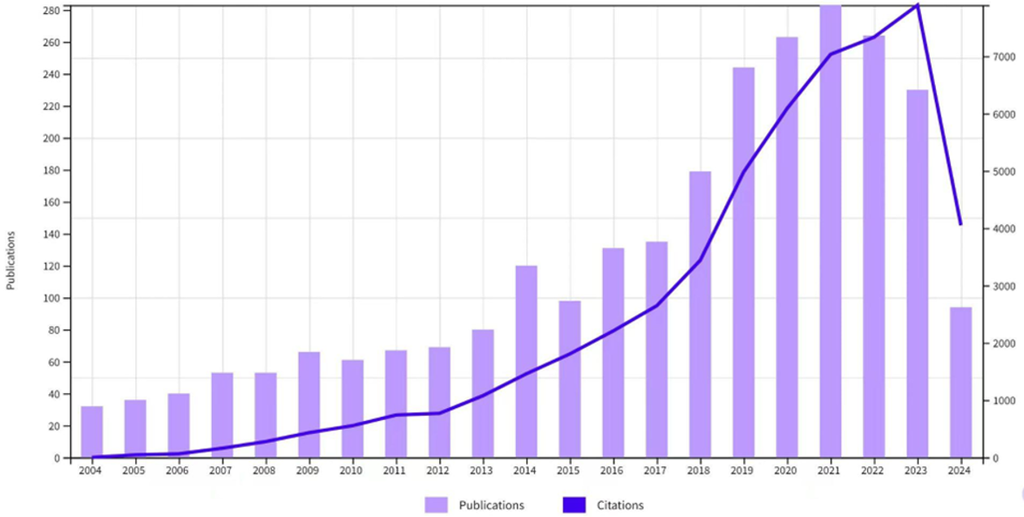
Scholarly interest in these questions has grown alongside their presence in everyday life. As the figure below shows, the number of articles in political science and communication with relevant terms roughly tripled over the past two decades. Yet beneath this growing interest, we found surprising inconsistency in how the term is conceptualized, often without a clear definition of either side of the boundary.
Amazed, while also puzzled, by this trend in both everyday life and academia, we began reading relevant articles. We started with political science and communication, and followed the question into other fields, which we have found in information science, sociology, and management. 

Along the way, we encountered studies asking, “What does ‘political’ mean to you?” We read about social movement organizers strategically politicizing or depoliticizing their identities, and about political discussion flourishing in communities around The Bachelor, the popular American reality TV show—just to name a few.

As we read more, we settled on a scope: empirical studies published in SSCI-indexed political science and communication journals that included “non-political” in their titles, abstracts, or keywords. This gave us 140 articles to review.

This is certainly not a perfect way to capture every relevant study. But we believe that explicitly using the term signals an intentional effort to conceptualize the nonpolitical—or, more specifically, to understand politics through its relationship with something considered nonpolitical.

Across these articles, we identified eight types of nonpolitical entities. Some concern actors, such as social media influencers and opinion leaders; identities, including religious and gender identities and politicians’ personal identities; issues, such as sexual violence and technology; and content, including memes, everyday posts, and sports news.

Others concern media channels, such as Google Play and entertainment communities; social contexts, including dating and social relationships; collective action, such as environmental protests and silence; and cognition, including anger and the desire to emigrate. The range itself was striking: “nonpolitical” could describe a person, a platform, a feeling, or a form of action.

We further identified two salient approaches to conceptualizing the nonpolitical.

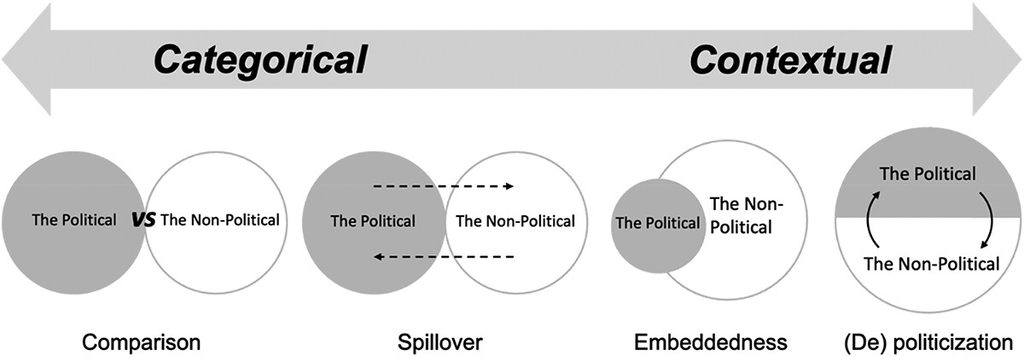
The first is categorical. Researchers treat the political and nonpolitical as distinct categories, comparing them or tracing spillovers between them—for example, how engagement with nonpolitical content might affect political attitudes.

The second is contextual. Researchers understand the political and nonpolitical as embedded in one another, with their relationship depending on the setting. Something understood as nonpolitical may become political, or vice versa, through processes of politicization and depoliticization. The following figure illustrates these different ways of relating the two.
Finally, we asked why these relational modes exist at all, and why they take such varied forms. In the studies we reviewed, the nonpolitical almost always helped researchers better understand or articulate the nature of politics. Drawing a boundary between the two also has a long history in Western philosophical traditions.

But researchers do not all draw that boundary in the same way. We believe these differences reflect several influences: institutional or relational views of politics, post-positivist or interpretive and critical theoretical orientations, methodological considerations, and rhetorical tensions in how scholars frame their arguments.

For us, this review responds to both empirical realities and scholarly debates about the relationship between politics and the nonpolitical in communication processes. It brings together a growing body of research while also inviting reflection on the nature of politics itself.

We thus suggest that (de)politicization can offer a sharp conceptual perspective for future research. It directs attention to how these boundaries are constructed, challenged, and changed. It also invites us to think critically about power: who gets to define something as political or nonpolitical, and what follows from that definition?

This article also grew through many conversations. I presented our very initial findings and groupings in a graduate seminar on the social construction of news at UW Communication and at the annual retreat of our Community Data Science Collective (CDSC). I was amazed by the positive feedback. Many of us shared a sense that political polarization was becoming visible across more areas of social and public life, which made these questions feel especially relevant.

That reception motivated us to develop the review further and present it as a poster at ICA 2025. There, I spoke with at least 30 people interested in the study. Those conversations helped us see how the questions resonated across different research interests.

Publishing this conceptual review in Political Communication, as a team consisting of just two doctoral students, makes the experience especially meaningful to us. We are grateful to the journal’s editors and reviewers for their thoughtful work, and to everyone who offered feedback along the way. All of these conversations helped make this article possible.

Political discussion in non-political online communities is more likely to see policy opinion expression

It seems natural to think that online political discussion happens in political spaces: comment sections under news articles, campaign pages, partisan forums, or video-sharing communities built around elections and public affairs.

But anyone who spends time online knows that politics does not stay neatly contained in those spaces. It shows up in local forums, hobby groups, gaming communities, entertainment discussions, and personal social media feeds. A conversation that begins with everyday life can suddenly become a debate about policy, rights, or government.

Communication scholars call this incidental political discussion: political talk that emerges in spaces not primarily organized around politics. I was interested in a simple question: what happens when people talk about politics in non-political online communities?

A common expectation in political communication research is that these conversations might be less polarized and more civil than political talk in explicitly political spaces. The logic goes: in non-political communities, people may not arrive with partisan identities already activated. They may also be guided by community norms built around shared interests, local concerns, or social connection rather than political conflict.

We wanted to test whether political talk in non-political spaces was actually less polarized, and perhaps less uncivil in real-world digital communities. To do so, I led an effort (with the support of Benjamin Mako Hill and Patricia Moy) to examine Reddit discussions about mass shootings and gun control in October 2017. Sampling over 100,000 comments on gun control issues across the platform that month, we compared comments from 15 explicitly political communities with those from 15 non-political communities, including culture-, location-, and game-based ones, among others.

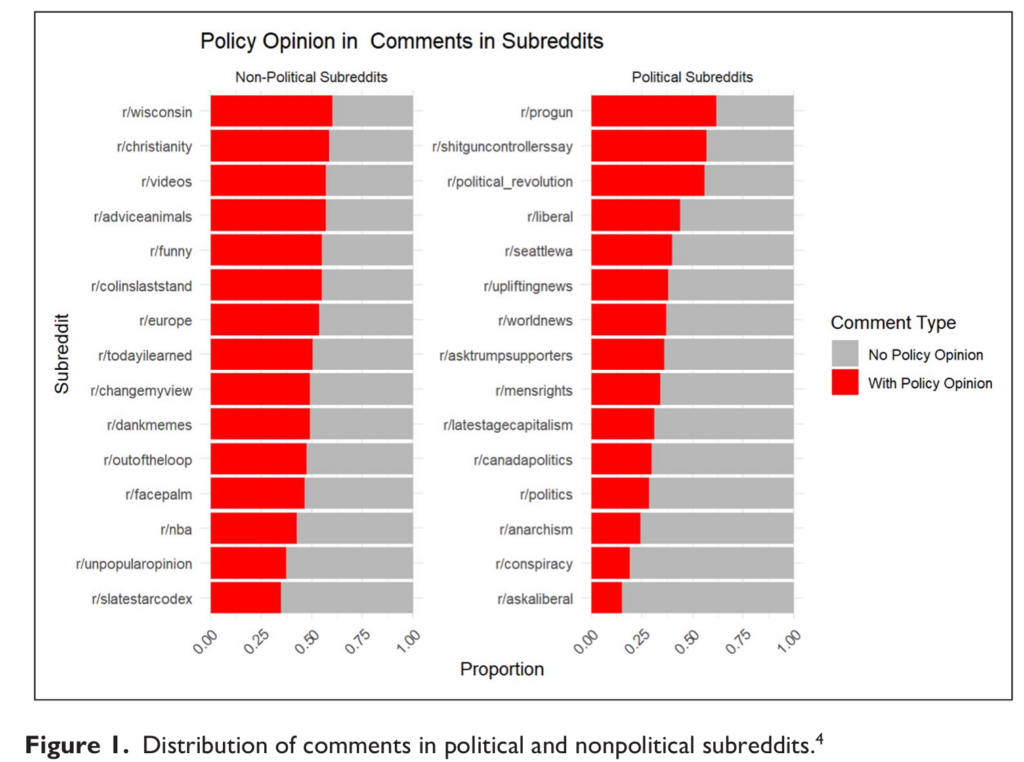
The results surprised us. As the figure below from our study shows, policy opinion expression was, on average, more common in non-political communities than in political ones. Several non-political subreddits—including r/Wisconsin, r/Christianity, r/videos, and r/funny—had especially high levels of policy opinion expression. In total, 10 non-political subreddits had policy opinions in more than half of the sampled comments. By contrast, only three political subreddits—r/progun, r/ShitGunControllersSay, and r/Political_Revolution—crossed the same 50% threshold. This pattern suggests that policy talk is not confined to explicitly political spaces; in some cases, it appears even more frequently in communities organized around local life, religion, entertainment, or humor.

After accounting for a range of factors in our regression model, we found that comments in non-political communities were more likely to contain a clear policy opinion than comments in explicitly political communities. The model estimated that the predicted probability of expressing a clear policy position was about 34% in political communities, compared with 51% in non-political communities. This difference was statistically significant. At the same time, we found no significant difference in incivility between political and non-political communities.

This combination of findings was especially interesting and contrasts with what’s most commonly reported in the current social science literature on digital political communication.

One possible explanation is that participants in explicitly political communities are often immersed in ongoing political debate. Their comments may include detailed argumentation, interpretation, irony, criticism of political actors, or discussion of the news cycle without always stating a clear policy position. By contrast, when a major political issue enters a non-political community, participants may be more likely to be newly exposed to it and react by saying what they think should be done.

Another explanation for incivility is that Reddit’s community-based moderation matters. Many communities, political and non-political alike, rely on rules, moderators, and shared expectations that can limit openly uncivil behavior. This helps explain why we did not find a significant difference in incivility: both types of communities show a low level of uncivil comments (around 6% of the sample).

The broader lesson is that political communication does not only happen where politics is expected. It also happens in the ordinary spaces of digital life, where people gather to talk about games, cities, hobbies, entertainment, or shared interests. If we want to understand democracy online, we need to pay attention not only to where people go to talk about politics, but also to where politics shows up uninvited.


This work was published in New Media & Society: Fan, Y., Hill, B. M., & Moy, P. (2026). “Unintended politics: Opinion expression and incivility in incidental political discussion.” New Media & Society.

The work began as my master’s thesis at the University of Washington. Thanks to the committee: Benjamin Mako Hill, Patricia Moy, and Yuan Hsiao.

Community Data Science Collective at ICA 2023

The International Communication Association (ICA)’s 73nd annual conference is coming up soon. This year, the conference takes place in Toronto, Canada, and a subset of our collective is showing up to present work in person. We are looking forward to meeting up, talking about research, and hanging out together!

ICA takes place from Wednesday, May 24, to Monday, May 29, and CDSC members will take various roles in a number of different conference programs, including chairing, presentations, and co-organizing of preconference. Here is the list of our participation by the time order, so feel free to join us!

Thursday, May 25

We start off with a presentation by Yibin Fan on Thursday at 10:45 am in the International Living Learning Centre of Toronto Metropolitan University on Political Communication Graduate Student Preconference. In a panel on The Causes and Outcomes of Political Polarization and Violence, Yibin will present a paper entitled “Does Incidental Political Discussion Make Political Expression Less Polarized? Evidence From Online Communities”.

Later on Thursday, another preconference on New Frontiers in Global Digital Inequalities Research will take place in M – Room Linden (Sheraton) from 1:30pm to 5pm, Floor Fiers will work as a co-chair with a number of scholars from international, various academic institutions, and they will give a presentation on “The Gig Economy: A Site of Opportunity Vs. a Site of Risk?”. This preconference is affiliated with Communication and Technology Division and Communication Law & Policy Division of ICA.

Friday, May 26

On Friday, Carl Colglazier will present in a panel on Disinformation, Politics and Social Media at 3:00pm in M – Room York (Sheraton), and the presentation is entitled as “The Effects of Sanctions on Decentralized Social Networking Sites: Quasi-Experimental Evidence From the Fediverse”.

Sunday, May 28

On Sunday we will be actively taking different roles in various sessions. In the morning, Yibin Fan will serve as the moderator for a research paper panel on Political Deliberation and Expression affiliated by Political Communication Division at 9:00 am in 2 – Room Simcoe (Sheraton).

Then there comes our highlighting paper that won the Top Paper Award by Computational Methods Division: Nathan TeBlunthuis will present a methodological research paper entitled as “Automated Content Misclassification Causes Bias in Regression: Can We Fix It? Yes We Can!” in a panel on Debate, Deliberation and Discussion in the Public Sphere at noon in M – Room Maple East (Sheraton). This is a project on which Nate collaborates with Valerie Hase at LMU Munich and Chung-hong Chan at University of Mannheim. Congratulations to them for getting the Top Paper Award!

Last but not least, we will finish off our ICA 2023 by seeing our faculty members serving as the chair and discussants in the Computational Methods Research Escalator Session at 1:30pm in M – Room Maple West (the same room as Nate’s presentation!). The session is junior scholars who are inexperienced in publishing to have connections with more senior researchers in the field. As the Call for Papers by Computational Methods Division says, “Research escalator papers provide an opportunity for less experienced researchers to obtain feedback from more senior scholars about a paper-in-progress, with the goal of making the paper ready for submission to a conference or journal.” Aaron Shaw, together with Matthew Weber at Rutgers University, will serve as the chairs for the session. Benjamin Mako Hill and Jeremy Foote, together with a bunch of scholars from other institutions, will work as discussants for improving the research presented here.

We look forward to sharing our research and connecting with you at ICA!