CDSC at the NCA 2025

CDSC members will be presenting at this years National Communication Association (NCA) Convention in Denver! You are warmly invited to join CDSC members during our talks and other scheduled events. Please come say hi!

Check out group members attending and what research they’ll be sharing:

Dyuti Jha: Dyuti will be presenting her paper titled “Mapping the Digital Life of Caste-Based Hate Speech” on Thursday, November 20th from 11:00 AM to 12:15 PM, discussing the processes of subreddit level moderation of caste-based hate speech in the absence of Reddit’s acknowledgement of Caste as a system of discrimination. The project seeks to understand how moderators in South Asian subreddits such as r/India and r/UnitedStatesofIndia identify caste based hate speech, how, if at all, they moderate it, whether the caste composition of the moderator teams for these subreddits influence the decision making on whether to or how to moderate such speech, and how they do so without any platform level guidelines. This project highlights a severely under researched area of caste in computing, particularly about how issues of identity bolsters or hinders inclusivity of a community.

Maddie Douglas: Maddie will be part of the Digital Rhetorics and Contemporary Media panel (Rhetorical and Communication Theory Division) on Friday, November 21st from 8:00 AM – 9:15 AM presenting a full paper titled “Strategic Ambiguity in the Modern Digital Age: Polysemy, Controversy, and AI Hype in the ‘Pause Giant AI Experiments’ Open Letter.” Maddie’s paper conducts a close reading of an “AI ethics” open letter that was spread shortly after GPT-4’s release, viewing it as a strategy to benefit AI investors and amplify hype. This reading makes a case for redefining “strategic ambiguity” from Leah Ceccarelli’s 1998 definition to include polysemy that achieves criticism (as well as praise) from audiences.

Hsuen-Chi (Hazel) Chiu: Hazel will be presenting her paper “AI Companions and the Illusion of Privacy: When Social Connection Meets Data Exposure” on Thursday, November 20th from 2:30 – 3:45 PM. She’ll discuss how users manage privacy when forming emotional relationships with AI companions. Drawing on interviews with 15 users of Replika and Character.AI, her study shows that people often treat these chatbots like trusted confidants while simultaneously worrying about how companies might use their data. Using Communication Privacy Management theory and the horizontal/vertical privacy framework, she highlights how users negotiate this tension between intimate disclosure and institutional surveillance. Her findings point to the need for more transparent, user-centered privacy design in emotionally supportive AI systems.

Srish Chatterjee: Srish will be at a day-long pre-conference called ‘Conspiratorial Economies,’ where they’ll present a full paper called “The Invisible Hand: Rhetorical Patterns in Conspiracy Theories on Technology’s Ubiquity.” Srish’s paper examines the rhetorical patterns of technological conspiracy theories and how they function as sophisticated folk epistemology that, while often factually inaccurate, articulate legitimate public anxieties about agency, surveillance, and corporate power in complex digital societies.
Join us at FOSSY 2025!

Interested in free and open source software? Want to hear insights from researchers, community leaders, contributors, and advocates working on and with FOSS?

Join us July 31st – August 3rd at the Free and Open Source Software Yearly conference!

We will be running the Science of Community track on Friday August 1st and Saturday August 2nd. We’re excited to have a number of awesome presenters speaking about their work. You can find the schedule here.

The Science of Community track is inspired by the CDSC Science of Community Dialogues, which aim to bring together practitioners and researchers to discuss scholarly work that is relevant to the efforts of practitioners. As researchers, we get so much from the communities we work with and study and we want them to also learn from the research they so generously take part in. While the Dialogues cover a broad range of topics and communities, FOSSY presentations focus on how that work related to free and open source software communities, projects, and practitioners.

Collaborations between practitioners and researchers can be transformative! Let’s get to know each other.

Tickets are still available at every price tier, check them out here.

We hope to see you there!

Come check out the CDSC at ICA 75!

A number of our CDSC folks will be attending the 75th Annual International Communication Association Conference “Disrupting and Consolidating Communication Research” in Denver, Colorado from June 12th to June 16th this year.

Below, you can find the schedule of where our CDSC members will be:

Friday

10:30 – 11:45, HIGH-DENSITY: Advances and Best Practices in Text Classification: Computational Methods. Centennial A (Regency 3)  (Benjamin Mako Hill will be the Session Chair)

13:30 – 14:45, Political Communication Poster Session: Political Communication. “The Politics of the Non-Political: A Scoping Review (2004–2024)” by Yufan Guo, Chinese U of Hong Kong, and Yibin Fan, University of Washington

13:30 – 14:45, HIGH-DENSITY: GIFTS in Instructional and Developmental Communication:  Instructional and Developmental Communication.  “Welcome Aboard: Simulating an Outsider-Within’s Organizational Assimilation and Socialization Through Role-Play” by Mavis Akom, Purdue U, Haley Sawyer, Purdue U, Loizos Bitsikokos, Purdue U, Alyssa Reed, Purdue U, Favour Ojike, Purdue U, Pamela Boateng, Purdue U, Onyinyechi Beatrice, Purdue U, Inusah Mohammed, Purdue U, Seungyoon Lee, Purdue U

Saturday

15:00 PM – 16:15, HIGH-DENSITY: Expression and Debates in Politics: “Unintended Politics: Partisan Opinion Expression and Incivility in Incidental Political Discussion” by Yibin Fan, U of Washington, Benjamin Mako Hill, U. of Washington, Patricia Moy, U. of Washington.

Sunday

12:00 – 13:15,  Organizational Communication Research Escalator.  “But Have You Tried to Ignore Them?” A Cross-National Comparison of Resilience Against Gendered Cyberhate in India and the USA by Bedadyuti Jha, Purdue U and Jeremy Foote, Purdue U.

15:00 – 16:15, Intergroup Communication Top Papers.  Effects of Racial Minority Language Use on the Conversational Sustenance of Online Discussions by Haomin Lin, University of Washington, and Wang Liao, University of Washington.

Monday

10:30 – 11:45,  NEKO-tiating Later Life: Digital Health, News Habits, and Tech Support: Communication and Technology. “Gig Work in Later Life: Sociodemographic and Digital Determinants of Older Adults’ Participation” by Floor Fiers, U of Amsterdam, Will Marler, Tilburg U, and Eszter Hargittai, U of Zurich.

Also, congratulations to Dr. Kaylea Champion, as her dissertation, “Social and Technical Sources of Risk in Sustaining Digital Infrastructure,” will be given the 2025 Annie Lang Dissertation Award from the International Communication Association Information Systems Division. The award will be given out at the ICA 2025 Information Systems business meeting 16:30 – 17:45 in Granite (Regency 3). Kaylea’s dissertation also received the 2025 Faculty Award for Outstanding Research Ph.D. Dissertation Award from the Department of Communication University of Washington. You can read more about Kaylea and her research on her homepage here.

Congrats to our CDSC folks on their accomplishments, and have safe travels to Denver this weekend!

Thinking about AI harms to communities? Submit to our upcoming 4S Panel!

We advocate for consideration of harms to communities (including online communities) as they respond to, are used for, and incorporate generative AI algorithms. One area of risk is one we call ‘Social Model Collapse,’ the notion that changes to community dynamics — social and technical — can disrupt the fundamental processes they rely on to sustain themselves and flourish. We see this as a clear point of shared concern among STS, HCI, Sociology, and Communication scholars, and are hosting an open panel at the upcoming meeting of the Society for Social Studies of Science (4S), September 3-7 in Seattle. This panel is being coordinated by CDSC members Kaylea Champion (University of Washington) and Sohyeon Hwang (Princeton University) along with our colleague Hanlin Li (University of Texas).

From our call for submissions:

Model collapse in machine learning refers to the deterioration such a model faces if it is re-fed with its own output, removing variation and generating poor output; in this panel, we extend this notion to ask in what ways the use of algorithmic output in place of human participation in social systems places those social systems at risk. Recent research findings in the generation of synthetic text using large language models have fed and been fed by a rush to extract value from, and engage with, online communities. Such communities include the discussion forum Reddit, the software development communities producing open source, the participants in the question and answer forum StackExchange, and the contributors to the online knowledge base Wikipedia.

The success of these communities depends on a range of social phenomena threatened by adoption of synthetic text generation as a modality replacing human authors. Newcomers who ask naive questions are a source of members and leaders, but may shift their inquiries to LLMs and never join the community as contributors. Software communities are to some extent reliant on a sense of generalized reciprocity to turn users into contributors; such appreciation may falter if their apparent benefactor is a tireless bot. Knowledge communities are dependent on human curation, inquiry, and effort to create new knowledge, which may be systemically diluted by the presence of purported participants who are only algorithms echoing back reconstructions of the others. Meanwhile, extractive technology firms profit from anyone still engaging in a genuine manner or following their own inquiries.

In this panel, we invite consideration of current forms of social model collapse driven by a rush of scientific-industrial activity, as well as reflection on past examples of social model collapse to better contextualize and understand our present moment
.

Submissions are 250-word abstracts due February 2nd; our panel is #223, “Risks of ‘Social Model Collapse’ in the Face of Scientific and Technological Advances” [Submission site link].

CDSC at CSCW 2024: Moderation, Bots, Taboos, and Governance Capture!

If you are attending the ACM conference on Computer-supported Cooperative Work and Social Computing (CSCW) this year CSCW in San José, Costa Rica. You are warmly invited to join CDSC members during our talks and other scheduled events. Please come say hi!

This CDSC has four papers at CSCW, which we will be presenting over the next three days:

Monday: At 11:00 am in Talamanca, Kaylea Champion will be presenting “Life Histories of Taboo Knowledge Artifacts” (full paper)

Tuesday: At 11:00 am in Central 3, Zarine Kharazian will be presenting “Governance Capture in a Self-Governing Community: A Qualitative Comparison of the Croatian, Serbian, Bosnian, and Serbo-Croatian Wikipedias” (full paper, blog post), followed by Sohyeon Hwang presenting “Adopting third-party bots for managing online communities” (full paper, blog post)

Wednesday: At 2:30 pm in Guanacaste 3, Kaylea Champion will be co-presenting “Challenges in Restructuring Community-based Moderation” (full paper, preprint)

If you’re at CSCW, feel free to get in touch in person or via Discord!

Come See Us at FOSSY!

Interested in free and open source software? Want to hear insights from researchers, community leaders, contributors, and advocates working on and with FOSS?

Join us next weekend at the Free and Open Source Software Yearly conference!

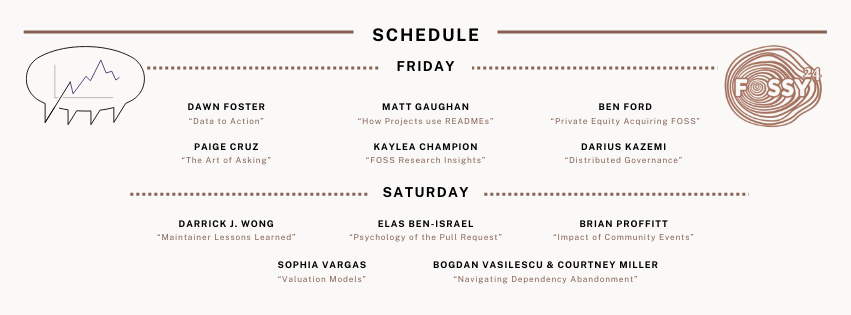
We will be running the Science of Community track on Friday August 2nd and Saturday August 3rd. We’re excited to have a number of awesome presenters speaking about their work. Check out the schedule below:

The Science of Community track is inspired by the CDSC Science of Community Dialogues, which aim to bring together practitioners and researchers to discuss scholarly work that is relevant to the efforts of practitioners. As researchers, we get so much from the communities we work with and study and we want them to also learn from the research they so generously take part in. While the Dialogues cover a broad range of topics and communities, FOSSY presentations focus on how that work related to free and open source software communities, projects, and practitioners.

Collaborations between practitioners and researchers can be transformative! Let’s get to know each other.

Tickets are still available at every price tier, check them out here.

We hope to see you there!

Meet us at FOSSY!

The Free and Open Source Software Yearly conference (FOSSY) is less than a month away and we will be there!

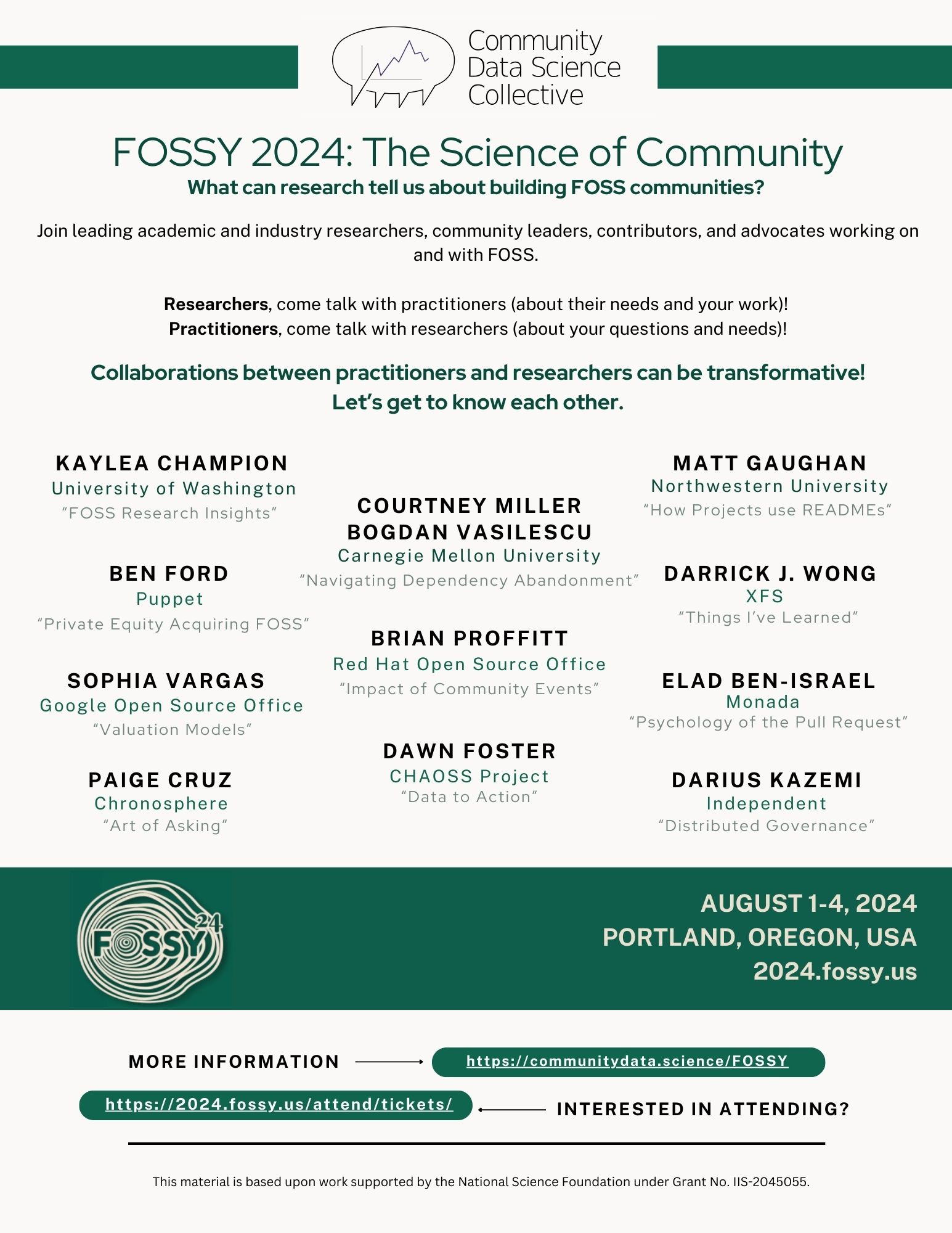
We will be running the Science of Community track on Friday August 2nd and Saturday August 3rd. Check out the full schedule here.

We’re excited to have a number of really amazing speakers presenting their work. Check out the list below:

Kaylea and Matt will be presenting again!

The Science of Community track is inspired by the CDSC Science of Community Dialogues, which aim to bring together practitioners and researchers to discuss scholarly work that is relevant to the efforts of practitioners. As researchers, we get so much from the communities we work with and study and we want them to also learn from the research they so generously take part in. While the Dialogues cover a broad range of topics and communities, FOSSY presentations focus on how that work related to free and open source software communities, projects, and practitioners.

We hope to see you at FOSSY. Even if you can’t make it to our sessions, we’ll be at the conference so stop by and say hello!

Come see us at CHI 2024!

We’re going to be at CHI! The Community Date Science Collective will be presenting work from group members and affiliates. CHI is taking place in Honolulu, Hawaiʻi from May 11th – 16th.

By Robert Linsdell from St. Andrews, Canada – Flight from Honolulu to Hilo. Over Sand Island and Honolulu (503729), CC BY 2.0

Jeremy Foote (Purdue University) coauthored “How Founder Motivations, Goals, and Actions Influence Early Trajectories of Online Communities” with Sanjay R Kairam. This work will be presented at “Online Communities: Engagement A” on Tuesday, May 14th at 9:45 a.m. You can also read about Jeremy and Sanjay’s work on our blog.

Carolyn Zou (Northwestern University) will be presenting with coauthor Helena Vasconcelos on their work “Validation Without Ground Truth? Methods for Trusts in Generative Simulations” at the CHI workshops HEAL (Human-Centered Evaluation and Auditing of Language Models) and TREW (Trust and Reliance in Evolving Human-AI Workflows). They will be presenting posters at both sessions and have been selected as a highlighted paper for HEAL and will be giving a presentation on Sunday, May 12th.

Ruijia Cheng (University of Washington) will be their presenting their research on “AXNav: Replaying Accessibility Tests from Natural Language” with cowriters Maryam Taeb, Eldon Schoop, Yue Jiang, Amanda Swearngin, and Jeffrey Nichols. This presentation will be taking place at “Universal Accessibility” on Tuesday, May 14th at 4:30 p.m.

CDSC affiliate Nicholas Vincent is receiving the Outstanding Dissertation Award for their research on “Economic Concentration and Dispossessive Data Use: Can HCI Solve Challenges from and to AI?“. Nicholas will also be presenting their papers “Pika: Empowering Non-Programmers to Author Executable Governance Policies in Online Communities” with Leijie Wang, Julija Rukanskaitė, and Amy X. Zhang at “Supporting Communities” on Thursday, May 16th at 11:00 a.m. and “A Canary in the AI Coal Mine: American Jews May Be Disproportionately Harmed by Intellectual Property Dispossession in Large Language Model Training” with Heila Precel, Brent Hecht, and Allison McDonald at “Politics of Data” on Wednesday, May 15th at 2:45 p.m.

Mandi Cai (Northwestern University) received an honorable mention award alongside coauthor Matthew Kay for their paper “Watching the Election Sausage Get Made: How Data Journalists Visualize the Vote Counting Process in U.S. Elections“. Mandi will be presenting this research at “Governance and Public Policies” on Wednesday, May 15th at 12:00 p.m.

The State of Wikimedia Research, 2022–2023

Wikimania, the annual global conference of the Wikimedia movement, took place in Singapore last month. For the first time since 2019, the conference was held in person again. It was attended by over 670 people in-person and more than 1,500 remotely.

At the conference, Benjamin Mako Hill, Tilman Bayer, and Miriam Redi presented “The State of Wikimedia Research: 2022–2023”, an overview of scholarship and academic research on Wikipedia and other Wikimedia projects from the last year. This resumed an annual Wikimania tradition started by Mako back in 2008 as a graduate student, aiming to provide “a quick tour … of the last year’s academic landscape around Wikimedia and its projects geared at non-academic editors and readers.” With hundreds of research publications every year featuring Wikipedia in their title (and more recently, Wikidata too), is it of course impossible to cover all important research results within one hour. Hence our presentation aimed to identify a set of important themes that attracted researchers’ attention during the past year, and illustrate each theme with a brief “research postcard” summary of one particular publication. Unfortunately, Miriam was not able to be in Singapore to present..

This year’s presentation focused on seven such research themes:

Theme 1. Generative AI and large language models
The boom in generative AI and LLMs triggered by the release of ChatGPT has affected Wikimedia research deeply. As an example, we highlighted a preprint that used Wikipedia to enhance the factual accuracy of a conversational LLM-based chatbot.

Theme 2. Wikidata as a community
While Wikidata is the subject of over 100 published studies each year, the vast majority of these have been primarily concerned with the project’s content as a database which scientists use to advance research about e.g. the semantic web, knowledge graphs and ontology management. This year also saw several papers studying Wikidata as a community, including a study of how Wikidata contributors use talk page to coordinate (preprint).

Theme 3. Cross-project collaboration
Beyond Wikipedia and Wikidata, Wikimedia sister projects have attracted comparatively little researcher attention over the years. We highlighted one of the very first research publication in the social sciences that studied Wikimedia Commons, the free media repository, examining how it interconnects with English Wikipedia.

Theme 4. Rules and governance
Research on rules and governance continues to attract researchers’ attention. Here, we featured a new paper by a political scientist that documented important changes in how English Wikipedia’s NPoV (Neutral Point of View) policy has been applied over time, and used this to advance an explanation for political change in general.

Theme 5. Wikipedia as a tool to measure bias
While Wikimedia research has often focused on Wikipedia’s own biases, researchers have also turned to Wikipedia to construct baselines against which to measure and mitigate biases elsewhere. We highlighted an example of Meta’s AI researchers doing this for their Llama 2 large language model.

Theme 6. Measuring Wikipedia’s own content bias
Despite the huge interest in content gaps along dimensions such as race and gender, systematic approaches to measuring them have not been as frequent as one might hope. We featured a paper that advanced our understanding in this regard, presented a useful method, and is also one of the first to study differences in intersectional identities.

Theme 7. Critical and humanistic approaches
Although most of the published research work related to Wikipedia is based in the sciences or engineering disciplines, a growing body of humanities scholarship can offer important insights as well. We highlighted a recent humanities paper about the measuring of race and ethnicity gaps on Wikipedia, which focused in particular on gaps in such measurements themselves, placing them into a broader social context.

We invite you to watch the video recording on Youtube or our self-hosted media server or peruse the annotated slides from the talk.

Again, this work represents just a tiny fraction of what has been published about Wikipedia in the last year. In particular, we avoided research that was presented elsewhere in Wikimania’s research track.

To keep up to date with the Wikimedia research field throughout the year, consider subscribing to the monthly Wikimedia Research Newsletter and its associated Twitter and Mastodon feeds which are maintained by Miriam and Tilman.


This post was written by Benjamin Mako Hill and Tilman Bayer.

Meet us at FOSSY!

The Free and Open Source Software Yearly conference (FOSSY) is in less than a week and we will be there!

We will be running the Science of Community track on Saturday July 15.

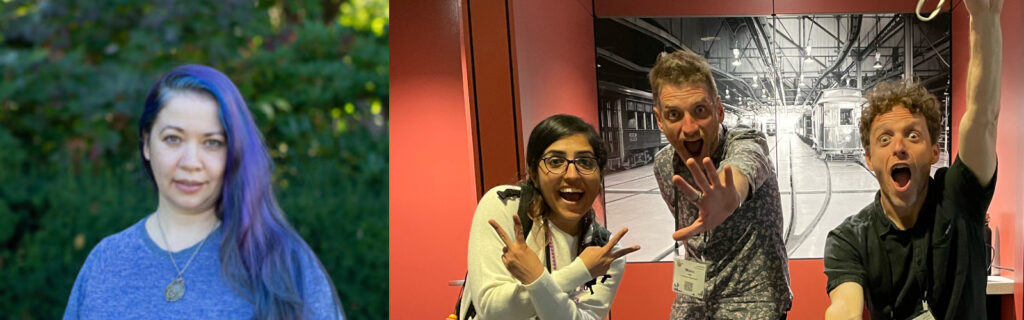
Two photos. In one is Kaylea Chamption, who has purple hair and a blue shirt. In the other is Sejal Khatri, Benjamin Mako Hill, and Aaron Shaw.
Kaylea Champion, and Benjamin Mako Hill and Aaron Shaw with Sejal Khatri (who won’t be at FOSSY)

The Science of Community track is inspired by the CDSC Science of Community Dialogues, which aim to bring together practitioners and researchers to discuss scholarly work that is relevant to the efforts of practitioners. As researchers, we get so much from the communities we work with and study and we want them to also learn from the research they so generously take part in. While the Dialogues cover a broad range of topics and communities, FOSSY presentations focus on how that work related to free and open source software communities, projects, and practitioners.

At FOSSY, we will have a number of really amazing researchers presenting their work. We wanted to share some highlights from the schedule.

Sophia Vargas, from Google’s Open Source Programs Office, will be presenting on how metrics can help us understand contributor burnout. Professor Shoji Kajita, from Kyoto University, will discuss research data management for FOSS communities. Mariam Guizani, from Oregon State University, will cover research on the why and how of corporate participation in FOSS. We will additionally have lightning talks by Adam Hyde, Anita Sarma, Shauna Gordon-McKeon, and incoming Northwestern Ph.D. student Matthew Gaughan.

We are really excited about our workshop “Let’s Get Real: Putting Research Findings Into Practice.” This workshop, designed for FOSS contributors and practitioners, will help guide you on how to get the most out of the incredible research on and relevant to FOSS. If you want to learn how to navigate the sheer volume of interesting research work happening or how to understand what it means, this is the session for you! Our workshop will be led by Kaylea Chamption and Professors Aaron Shaw and Benjamin Mako Hill. You can read more on our wiki.

Due to scheduling issues, Eriol Fox will be presenting their talk, “Community lead user research and usability in Science and Research OSS: What we learned,” in the Wildcard Track. We recommend going!

We hope to see you at FOSSY. Even if you can’t make it to our sessions, we’ll be at the conference so stop by and say hello!