Community Data Science Collective Research at DebConf 2021

Debian is one of the oldest, largest, and most influential peer production communities and has produced an operating system used by millions for over the last three decades. DebConf is that community’s annual meeting. This year, the Community Data Science Collective was out in force at Debian’s virtual conference to present several Debian-focused research projects that we’ve been working on.

First, Wm Salt Hale presented work from his master thesis project on “Resilience in FLOSS: Do founder decisions impact development activity after crisis events?” His work tried to understand the social dynamics behind organizational resilience among free software projects based on what Salt calls “founder decisions.” He did so by estimating the relationship between changes in developer activity after security bugs and testing several theories about how this relationship might vary between permissive and copyleft licensed software packages.

Wm Salt Hale’s presentation plus Q&A. (WebM available)

Next, Kaylea and Salt facilitated a “birds-of-a-feather” get-together session for FLOSS project founders (video is also available).

Finally, Kaylea Champion presented her work with Benjamin Mako Hill on “Detecting At Risk Software in Debian.” Her work described a new technique that involves identifying software packages that are less (or more) high quality than you we might expect given their popularity. You can read more about that work in our blog post from earlier this year.

Kaylea Champion’s presentation plus Q&A. (WebM available)

If you saw either presentation and are interested in continuing the conversation, you are welcome to reach out to us individually ({kaylea OR halew}@uw.edu). You can also follow us on this blog, or follow or engage with us in the Fediverse (@communitydata@social.coop), or on Twitter (@comdatasci).

Workshop Announcement: Imagining Future Tools for Youth Data Literacies @ CLS2021

As today’s youth come of age in an increasingly data-driven world, the development of new literacies is increasingly important. Young people need both skills to work with, analyze, and interpret data, as well as an understanding of the complex social issues surrounding the collection and use of data. But how can today’s youth develop the skills they need?

We will exploring this question during an upcoming workshop on Imagining Future Designs of Tools for Youth Data Literacies, one of the offerings at this year’s Connected Learning Summit. As co-organizers for this workshop, we are motivated by our interest in how young people learn to work with and understand data. We are also curious about how other people working in this area define the term ‘data literacy’ and what they feel are the most critical skills for young people to learn. As there are a number of great tools available to help young people learn about and use data, we  also hope to explore which features of these tools made them most effective. We are looking forward to discussions on all of these issues during the workshops.

This workshop promises to be an engaging discussion of existing tools available to help young people work with and understand data (Session 1) and an exploration of what future tools might offer (Session 2). We invite all researchers, educators, and other practitioners to join us for one or both of these sessions. We’re hoping for all attendees to come away with a deeper understanding of data literacies and how to support youth in developing data literacy skills.

Information on registering for the Connected Learning Summit available at: https://connectedlearningsummit.org/

To register interest in attending the Youth Data Literacies Workshop, please complete the pre-registration form at: http://dataliteracies.com/

The workshop is organized by Community Data Science Collective members Regina Cheng, Stefania Druga, Emilia Gan, and Benjamin Mako Hill in collaboration with Rahul Bhargava, Tamara Clegg, Catherine D’Ignazio, Yasmin Kafai, Victor Lee, Camillia Matuk, and Andee Rubin.

Community Data Science Collective at ICA 2021

As we do every year, members of the Community Data Science Collective will be presenting work at the International Communication Association (ICA)’s 71st Annual Conference which will take place virtually next week. Due to the asynchronous format of ICA this year, none of the talks will happen at specific times. Although the downside of the virtual conference is that we won’t be able to meet up with you all in person, the good news is that you’ll be able to watch our talks and engage with us on whatever timeline suits you best between May 27 and and 31st.

This year’s offerings from the collective include:

Nathan TeBlunthuis will be presenting work with Benjamin Mako Hill as part of the ICA Computational Methods section on “Time Series and Trends in Communication Research.” The name of their talk is “A Community Ecology Approach for Identifying Competitive and Mutualistic Relationships Between Online Communities.”

Aaron Shaw is presenting a paper on “Participation Inequality in the Gig Economy” on behalf of himself, Floor Fiers and Eszter Hargittai . The talk will be as part of a session organized by the ICA Communication and Technology section on “From Autism to Uber: The Digital Divide and Vulnerable Populations.”

Floor Fiers collaborated with Nathan Walter on a poster titled “Sharing Unfairly: Racial Bias on Airbnb and the Effect of Review Valence.” The poster is part of the interactive poster session of the ICA Ethnicity and Race section.

Nick Hager will be talking about his paper with Aaron Shaw titled “Randomly-Generated Inequality in Online News Communities,” which is part of a high density session on “Social Networks and Influence.”

Finally, Jeremy Foote will be chairing a session on “Cyber Communities: Conflicts and Collaborations” as part of the ICA Communication and Technology division.

We look forward to sharing our research and connecting with you at ICA!

UPDATE: The paper led by Nathan TeBlunthuis won the best paper award from the ICA Computational Methods section! Congratulations, Nate!

Newcomers, Help, Feedback, Critical Infrastructure….: Social Computing Scholarship at SANER 2021

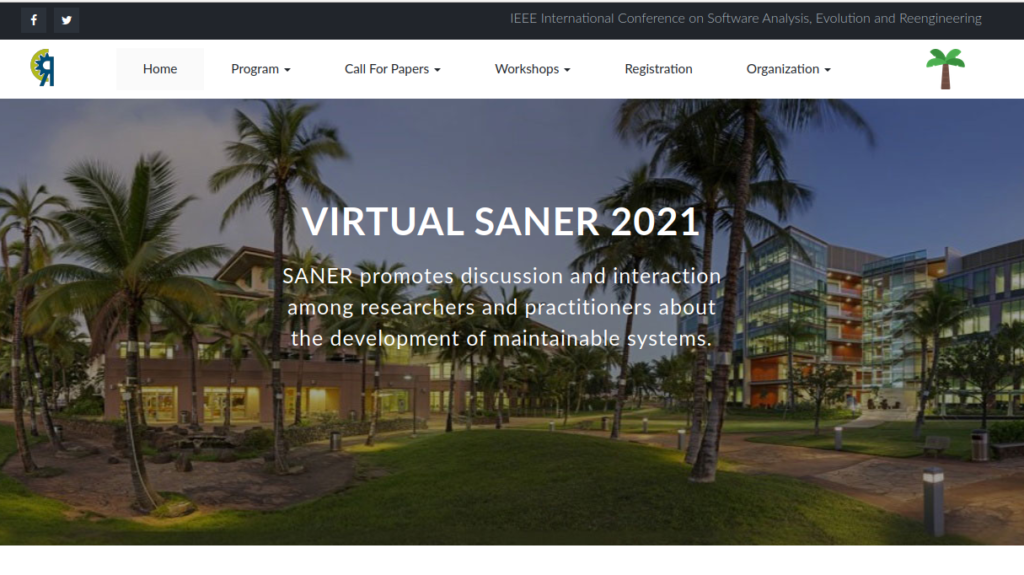
This year I was fortunate to present to the 2021 IEEE International Conference on Software Analysis, Evolution and Re-engineering or “SANER 2021.” You can see the write-up of my own presentation on “underproduction” elsewhere on this blog.

SANER is primarily focused on software engineering practices, and several of the projects presented this year were of interest for social computing scholars. Here’s a quick rundown of presentations I particularly enjoyed:

Newcomers: Does marking a bug as a ‘Good First Issue’ help retain newcomers? These results from Hyuga Horiguchi, Itsuki Omori and Masao Ohira suggest the answer is “yes.” However, marking documentation tasks as a ‘Good First Issue’ doesn’t seem to help with the onboarding process. Read more or watch the talk at: Onboarding to Open Source Projects with Good First Issues: A Preliminary Analysis [VIDEO]

Comparison of online help communities: This article by Mahshid Naghashzadeh, Amir Haghshenas, Ashkan Sami and David Lo compares two question/answer environments that we might imagine as competitors—the Matlab community of Stack Overflow versus the Matlab community hosted by Matlab. These sites have similar affordances and topics, however, the two sites seem to draw distinctly different types of questions. This article features an extensive hand-coded dataset by subject matter experts: How Do Users Answer MATLAB Questions on Q&A Sites? A Case Study on Stack Overflow and MathWorks [VIDEO]

Feedback: What goes wrong when software developers give one another feedback on their code? This study by a large team (Moataz Chouchen, Ali Ouni, Raula Gaikovina Kula, Dong Wang, Patanamon Thongtanunam, Mohamed Wiem Mkaouer and Kenichi Matsumoto) offers an ontology of the pitfalls and negative interactions that can occur during the popular code feedback practice known as code review: confused reviewers, divergent reviewers, low review participation, shallow review, and toxic review:
Anti-patterns in Modern Code Review: Symptoms and Prevalence [VIDEO]

Critical Infrastructure: This study by Mahmoud Alfadel, Diego Elias Costa and Emad Shihab was focused on traits of security problems in Python and made some comparisons to npm. This got me thinking about different community-level factors (like bug release/security alert policies) that may influence underproduction. I also found myself wondering about inter-rater reliability for bug triage in communities like Python. The paper showed a very similar survival curve for bugs of varying severities, whereas my work in Debian showed distinct per-severity curves. One explanation for uniform resolution rate across severities could be high variability in how severity ratings are applied. Another factor worth considering may be the role of library abandonment: Empirical analysis of security vulnerabilities in python packages [VIDEO]

Community Data Science Collective at CSCW 2019

A good chunk of the Community Data Science Collective is in Austin, Texas this week for the 2019 ACM Conference on Computer-supported Cooperative Work and Social Computing (CSCW).

The conference marks the official publication of four papers by collective students and faculty. All four papers were published in the journal Proceedings of the ACM on Human-Computer Interaction: CSCW.

Information on the talks as well as links to the papers are available here (CSCW members are listed in italics):

Additionally, Charlie Kiene is co-organizing a workshop on moderation:

And Sneha Narayan and Andrés Monroy-Hernández is participating in a panel:

Finally, Mako Hill is chairing a session:

  • Mon, Nov 11 14:30 – 16:00: Wikipedia and Wiki Research

Salt, Kaylea, Charlie, Regina, and Kaylea will all be at the conference as will affiliate Andrés Monroy-Hernández and tons of our social computing friends. Please come and say “Hello” to any of us, introduce yourself if you don’t already know us, and pick up a CDSC sticker!

Community Data Science Collective at ICA 2019 in Washington, DC

Jeremy Foote, Nate TeBlunthuisWm Salt Hale, and Mako Hill will all be in Washington DC this week for the  International Communication Association’s 2019 annual meeting.

In particular, we be presenting a new paper from the group led by Sneha Narayan titled “All Talk: How Increasing Interpersonal Communication on Wikis May Not Enhance Productivity.” The talk will be on Monday, May 27 in a session from 9:30 to 10:45 in Washington Hilton LL, Holmead as part of a session organized by the ICA Computational Methods section on “Computational Approaches to Health Communication.”

Additionally, Nate is co-organizing a pre-conference at ICA on “Expanding Computational Communication: Towards a Pipeline for Graduate Students and Early Career Scholars” along with Josephine Lukito (UW Madison) and Frederic Hopp (UC Santa Barbara). The pre-conference will be held at American University on Friday May 24th. As part of that workshop, Nate and Jeremy will be giving a presentation on approaches to the study organizational communication that use computational methods.

We look forward to sharing our research and socializing with you at ICA! Please be in touch if you’re around and want to meet up!

Summer Institute in Computational Social Science

For the second year, Matt Salganik and Chris Bail are running a two-week Summer Institute in Computational Social Science at Duke Univeristy. The goal of the institute is to bring social scientists and data scientists together to learn about computational social science, which can be described as a merger of their two fields.

This year, there are seven partner locations where local students livestream the activities from Duke and learn from local computational social scientists.  Both of our universities are among the partner locations.

At the University of Washington, Kaylea and Charlie have both been accepted as participants in the UW summer institute. At Northwestern University, Jeremy is helping to organize SICSS Chicago.

Much of the work that we do in the Community Data Science Collective could be considered computational social science, and we are excited about the potential for  computational methods in social science. This is a great program for helping to disseminate computational social science approaches and train the next generation of computational social scientists. The Community Data Science Collective is happy to be a sponsor of the Chicago partner location.

Community Data Science Collective at ICA 2018 in Prague

Jeremy Foote, Nate TeBlunthuis, and Mako Hill are in Prague this week for the  International Communication Association’s 2018 annual meeting.

The collective has three things on the conference program this year:

  • Fri, May 25, 9:30 to 10:45, Hilton Prague, LL, Vienna: An Agent-Based Model of Online Community Joining as part of the Computational Methods section paper session on “Agent-Based Modeling for Communication Research” — Jeremy Foote (presenting), Benjamin Mako Hill and Nathan TeBlunthuis
  • Fri, May 25, 12:30 to 13:45, Hilton Prague, LL, Congress Hall II – Exhibit Hall/Posters: Revisiting ‘The Rise and Decline’ in a Population of Peer Production Projects as part of the Information Systems section’s poster session “ICA Interactive Paper/Poster Session I” —Nathan TeBlunthuis (presenting), Aaron Shaw, and Benjamin Mako Hill
  • Mon, May 28, 9:30 to 10:45, Hilton Prague, M, Palmovka: Theory Building Beyond Communities: Population-Level Research in the Computational Methods section’s panel on “Communication in the Networked Age: A Discussion of Theory Building through Data-Driven Research” — Benjamin Mako Hill (presenting) and Aaron Shaw

We look forward to sharing our research and socializing with you at ICA! Please be in touch if you’re around and want to meet up!

OpenSym 2017 Program Postmortem

The International Symposium on Open Collaboration (OpenSym, formerly WikiSym) is the premier academic venue exclusively focused on scholarly research into open collaboration. OpenSym is an ACM conference which means that, like conferences in computer science, it’s really more like a journal that gets published once a year than it is like most social science conferences. The “journal”, in this case, is called the Proceedings of the International Symposium on Open Collaboration and it consists of final copies of papers which are typically also presented at the conference. Like journal articles, papers that are published in the proceedings are not typically published elsewhere.

Along with Claudia Müller-Birn from the Freie Universtät Berlin, I served as the Program Chair for OpenSym 2017. For the social scientists reading this, the role of program chair is similar to being an editor for a journal. My job was not to organize keynotes or logistics at the conference—that is the job of the General Chair. Indeed, in the end I didn’t even attend the conference! Along with Claudia, my role as Program Chair was to recruit submissions, recruit reviewers, coordinate and manage the review process, make final decisions on papers, and ensure that everything makes it into the published proceedings in good shape.

In OpenSym 2017, we made several changes to the way the conference has been run:

  • In previous years, OpenSym had tracks on topics like free/open source software, wikis, open innovation, open education, and so on. In 2017, we used a single track model.
  • Because we eliminated tracks, we also eliminated track-level chairs. Instead, we appointed Associate Chairs or ACs.
  • We eliminated page limits and the distinction between full papers and notes.
  • We allowed authors to write rebuttals before reviews were finalized. Reviewers and ACs were allowed to modify their reviews and decisions based on rebuttals.
  • To assist in assigning papers to ACs and reviewers, we made extensive use of bidding. This means we had to recruit the pool of reviewers before papers were submitted.

Although each of these things have been tried in other conferences, or even piloted within individual tracks in OpenSym, all were new to OpenSym in general.

Overview

Statistics
Papers submitted 44
Papers accepted 20
Acceptance rate 45%
Posters submitted 2
Posters presented 9
Associate Chairs 8
PC Members 59
Authors 108
Author countries 20

The program was similar in size to the ones in the last 2-3 years in terms of the number of submissions. OpenSym is a small but mature and stable venue for research on open collaboration. This year was also similar, although slightly more competitive, in terms of the conference acceptance rate (45%—it had been slightly above 50% in previous years).

As in recent years, there were more posters presented than submitted because the PC found that some rejected work, although not ready to be published in the proceedings, was promising and advanced enough to be presented as a poster at the conference. Authors of posters submitted 4-page extended abstracts for their projects which were published in a “Companion to the Proceedings.”

Topics

Over the years, OpenSym has established a clear set of niches. Although we eliminated tracks, we asked authors to choose from a set of categories when submitting their work. These categories are similar to the tracks at OpenSym 2016. Interestingly, a number of authors selected more than one category. This would have led to difficult decisions in the old track-based system.
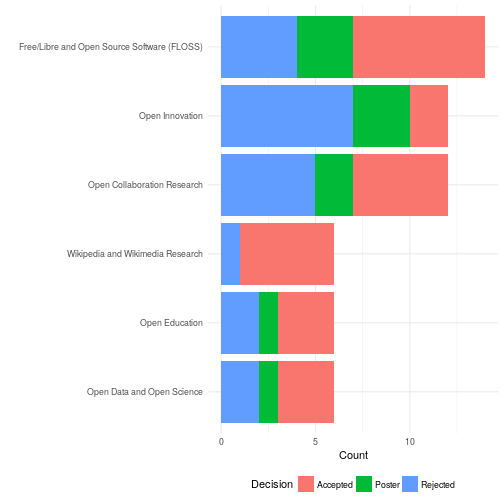
distribution of papers across topics with breakdown by accept/poster/reject

The figure above shows a breakdown of papers in terms of these categories as well as indicators of how many papers in each group were accepted. Papers in multiple categories are counted multiple times. Research on FLOSS and Wikimedia/Wikipedia continue to make up a sizable chunk of OpenSym’s submissions and publications. That said, these now make up a minority of total submissions. Although Wikipedia and Wikimedia research made up a smaller proportion of the submission pool, it was accepted at a higher rate. Also notable is the fact that 2017 saw an uptick in the number of papers on open innovation. I suspect this was due, at least in part, to work by the General Chair Lorraine Morgan’s involvement (she specializes in that area). Somewhat surprisingly to me, we had a number of submission about Bitcoin and blockchains. These are natural areas of growth for OpenSym but have never been a big part of work in our community in the past.

Scores and Reviews

As in previous years, review was single blind in that reviewers’ identities are hidden but authors identities are not. Each paper received between 3 and 4 reviews plus a metareview by the Associate Chair assigned to the paper. All papers received 3 reviews but ACs were encouraged to call in a 4th reviewer at any point in the process. In addition to the text of the reviews, we used a -3 to +3 scoring system where papers that are seen as borderline will be scored as 0. Reviewers scored papers using full-point increments.
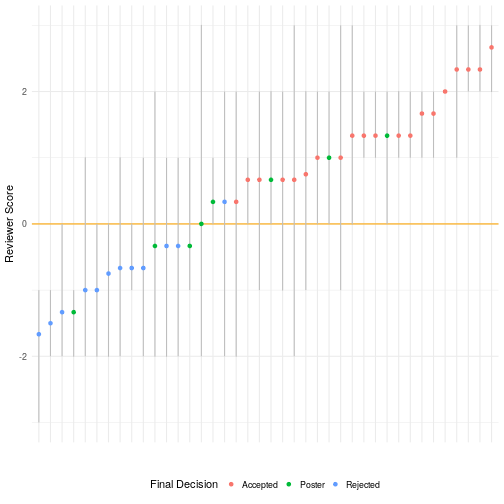
scores for each paper submitted to opensym 2017: average, distribution, etc

The figure above shows scores for each paper submitted. The vertical grey lines reflect the distribution of scores where the minimum and maximum scores for each paper are the ends of the lines. The colored dots show the arithmetic mean for each score (unweighted by reviewer confidence). Colors show whether the papers were accepted, rejected, or presented as a poster. It’s important to keep in mind that two papers were submitted as posters.

Although Associate Chairs made the final decisions on a case-by-case basis, every paper that had an average score of less than 0 (the horizontal orange line) was rejected or presented as a poster and most (but not all) papers with positive average scores were accepted. Although a positive average score seemed to be a requirement for publication, negative individual scores weren’t necessary showstoppers. We accepted 6 papers with at least one negative score. We ultimately accepted 20 papers—45% of those submitted.

Rebuttals

This was the first time that OpenSym used a rebuttal or author response and we are thrilled with how it went. Although they were entirely optional, almost every team of authors used it! Authors of 40 of our 46 submissions (87%!) submitted rebuttals.

Lower Unchanged Higher
6 24 10

The table above shows how average scores changed after authors submitted rebuttals. The table shows that rebuttals’ effect was typically neutral or positive. Most average scores stayed the same but nearly two times as many average scores increased as decreased in the post-rebuttal period. We hope that this made the process feel more fair for authors and I feel, having read them all, that it led to improvements in the quality of final papers.

Page Lengths

In previous years, OpenSym followed most other venues in computer science by allowing submission of two kinds of papers: full papers which could be up to 10 pages long and short papers which could be up to 4. Following some other conferences, we eliminated page limits altogether. This is the text we used in the OpenSym 2017 CFP:

There is no minimum or maximum length for submitted papers. Rather, reviewers will be instructed to weigh the contribution of a paper relative to its length. Papers should report research thoroughly but succinctly: brevity is a virtue. A typical length of a “long research paper” is 10 pages (formerly the maximum length limit and the limit on OpenSym tracks), but may be shorter if the contribution can be described and supported in fewer pages— shorter, more focused papers (called “short research papers” previously) are encouraged and will be reviewed like any other paper. While we will review papers longer than 10 pages, the contribution must warrant the extra length. Reviewers will be instructed to reject papers whose length is incommensurate with the size of their contribution.

The following graph shows the distribution of page lengths across papers in our final program.
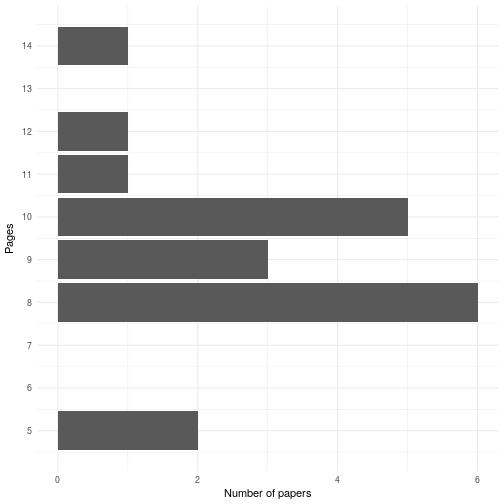
histogram of paper lengths for final accepted papersIn the end 3 of 20 published papers (15%) were over 10 pages. More surprisingly, 11 of the accepted papers (55%) were below the old 10-page limit. Fears that some have expressed that page limits are the only thing keeping OpenSym from publshing enormous rambling manuscripts seems to be unwarranted—at least so far.

Bidding

Although, I won’t post any analysis or graphs, bidding worked well. With only two exceptions, every single assigned review was to someone who had bid “yes” or “maybe” for the paper in question and the vast majority went to people that had bid “yes.” However, this comes with one major proviso: people that did not bid at all were marked as “maybe” for every single paper.

Given a reviewer pool whose diversity of expertise matches that in your pool of authors, bidding works fantastically. But everybody needs to bid. The only problems with reviewers we had were with people that had failed to bid. It might be reviewers who don’t bid are less committed to the conference, more overextended, more likely to drop things in general, etc. It might also be that reviewers who fail to bid get poor matches which cause them to become less interested, willing, or able to do their reviews well and on time.

Having used bidding twice as chair or track-chair, my sense is that bidding is a fantastic thing to incorporate into any conference review process. The major limitations are that you need to build a program committee (PC) before the conference (rather than finding the perfect reviewers for specific papers) and you have to find ways to incentivize or communicate the importance of getting your PC members to bid.

Conclusions

The final results were a fantastic collection of published papers. Of course, it couldn’t have been possible without the huge collection of conference chairs, associate chairs, program committee members, external reviewers, and staff supporters.

Although we tried quite a lot of new things, my sense is that nothing we changed made things worse and many changes made things smoother or better. Although I’m not directly involved in organizing OpenSym 2018, I am on the OpenSym steering committee. My sense is that most of the changes we made are going to be carried over this year.

Finally, it’s also been announced that OpenSym 2018 will be in Paris on August 22-24. The call for papers should be out soon and the OpenSym 2018 paper deadline has already been announced as March 15, 2018. You should consider submitting! I hope to see you in Paris!

This Analysis

OpenSym used the gratis version of EasyChair to manage the conference which doesn’t allow chairs to export data. As a result, data used in this this postmortem was scraped from EasyChair using two Python scripts. Numbers and graphs were created using a knitr file that combines R visualization and analysis code with markdown to create the HTML directly from the datasets. I’ve made all the code I used to produce this analysis available in this git repository. I hope someone else finds it useful. Because the data contains sensitive information on the review process, I’m not publishing the data.

OpenSym 2017 Program Published

A few hours ago, OpenSym 2017 kicked off in Galway. For those that don’t know, OpenSym is the International Symposium on Wikis and Open Collaboration (it was called WikiSym until 2014). Its the premier academic venue focused on research on wikis, open collboration, and peer production.

This year, Claudia Müller-Birn and I served as co-chairs of the academic program. Acting as program chair for an ACM conference like OpenSym is more like being a journal editor than a conference organizer. Claudia and I drafted and publicized a call for papers, recruited Associate Chairs and members of a program committee who would review papers and make decisions, coordinated reviews and final decisions, elicited author responses, sent tons of email to notify everybody about everything, and dealt with problems as they came up. It was a lot of work! With the schedule set, and the proceedings now online, our job is officially over!

OpenSym reviewed 43 papers this year and accepted 20 giving the conference a 46.5% acceptance rate. This is similar to both the number of submissions and the acceptance rates for previous years.

In addition to papers, we received 3 extended abstracts for posters for the academic program and accepted 1. There were an additional 7 promising papers that were not accepted but whose authors were invited to present posters and who will be doing so at the conference. The authors of posters will have extended abstracted about their posters published in the non-archival companion proceedings.

The list of papers being published and presented at OpenSym includes:

The following extended abstracts for posters will be published in the companion to the proceedings:

There was also a doctoral consortium and a non-academic ”industry track” which Claudia and I weren’t involved in coordinating.

As part of running the program, we tried a bunch of new things this year including:

  • A move away from separate tracks back to a singlec combined model with Associate Chairs.
  • Bidding for papers among both Associate Chairs and normal PC members.
  • An author rebuttal/response period where authors got to respond to reviews and reviewers.
  • An elimination of page limits for papers. This meant that the category of notes also disappeared. Reviewers were instructed to evaluate the degree to which papers’ contributions were commensurate to their length.

I’m working on a longer post that will evaluate these changes. Until then, enjoy Galway if you were lucky enough to be there. If you couldn’t make it, enjoy the proceedings online!

You can learn more about OpenSym on it’s Wikipedia article on the OpenSym website. You can find details on the schedule and the program itself at its temporary home on the OpenSym website. I’ll update this page with a link to the ACM Digital Library page when it gets posted.