Science of Community Dialogue: The Impacts of Organizational Interventions in Open Source Software Engineering

This dialogue will take place on November 7th at 12pm CT and will explore how free/libre and open source software (FLOSS) projects adapt their work processes to recruit new contributors and build the project communities that they want, and how FLOSS projects redesign collaboration processes within different environments and moments in project lifecycles. Professor Igor Steinmacher (Northern Arizona University) will be joining Matt Gaughan (Northwestern University) to present recent research on topics including:

  • Documentation practices in FLOSS projects
  • Disconnect between guidelines and reality
  • Sustainability challenges in FOSS communities
  • Community-based governance redevelopment
  • Structural shifts for long-term health

full session description is on our website. Register online.

What is a Dialogue?

The Science of Community Dialogue Series is a series of conversations between researchers, experts, community organizers, and other people who are interested in how communities work, collaborate, and succeed. You can watch this short introduction video with Aaron Shaw.

What is the CDSC?

The Community Data Science Collective (CDSC) is an interdisciplinary research group made of up of faculty and students at the University of Washington Department of Communication, the Northwestern University Department of Communication Studies, the Carleton College Computer Science Department, the School of Information at UT Austin, and the Purdue University School of Communication.

Learn more

If you’d like to learn more or get future updates about the Science of Community Dialogues, please join the low volume announcement list.
Community Dialogue – AI Boundaries: Refusal and Privacy

Join the Community Data Science Collective (CDSC) for our 12th Science of Community Dialogue! This Community Dialogue will take place on October 17th, 2025 at 12:00 pm CT. This dialogue explores how companion chatbots invite deep emotional disclosure while raising concerns about data privacy—and how some communities are pushing back through AI refusal. Professor Jasmine McNealy (University of Florida) will join Hsuen-Chi (Hazel) Chiu (Purdue University) to present recent research on topics including:

  • Emotional disclosure in chatbot interactions
  • Data privacy and AI refusal
  • Designing emotionally intelligent, boundary-aware AI
  • Cultural implications of opting out of AI companionship

full session descriptions is on our website. Register online.

What is a Dialogue?

The Science of Community Dialogue Series is a series of conversations between researchers, experts, community organizers, and other people who are interested in how communities work, collaborate, and succeed. You can watch this short introduction video with Aaron Shaw.

What is the CDSC?

The Community Data Science Collective (CDSC) is an interdisciplinary research group made of up of faculty and students at the University of Washington Department of Communication, the Northwestern University Department of Communication Studies, the Carleton College Computer Science Department, the School of Information at UT Austin, and the Purdue University School of Communication.

Learn more

If you’d like to learn more or get future updates about the Science of Community Dialogues, please join the low volume announcement list.

FOSSY 2025 Wrap-Up: Kaylea Champion “Plausible Slop: Generative AI and Open Source Cybersecurity”

For our final talk of the Science of Community track at FOSSY 2025, Kaylea Champion explored how generative AI tools are disrupting open source cybersecurity—not through advanced attacks, but by flooding communities with “plausible slop,” or misleading, low-effort reports. She shared research on the burden this places on experts, who must balance welcoming newcomers with filtering out noise. Drawing on historical parallels and case studies, she proposed strategies to address these challenges and invited community input to shape future solutions.

This is the final of our 11 part series sharing highlights from the Science of Community track at FOSSY 2025. Visit the FOSSY site for bio details and a full abstract.

FOSSY 2025 Wrap Up: Steve Feng and Anita Sarma “Glue Work Makes the Community Work: Sustaining OSS Through Invisible Labor”

Our tenth talk for the Science of Community Track at FOSSY 2025 featured Zixuan (Steve) Feng and Anita Sarma discussed how glue work —like maintaining code, updating docs, and supporting users—is essential to OSS success but often overlooked and undervalued. The talked about their teams 300+ OSS practitioner studies to define, trace, and elevate these contributions, offering practical strategies to recognize their impact.

This is the 10th of our 11 part series sharing highlights from the Science of Community track at FOSSY 2025. Visit the FOSSY site for bio details and a full abstract.

FOSSY 2025 Wrap Up: Igor Steinmacher “Lessons from a Decade of Open Source Sustainability Research”

Igor Steinmacher walked through lessons learned from a decade of OSS research for our 9th talk of the Science of Community Track. He explored long-term sustainability challenges in FOSS communities, including onboarding, maintainer burnout, and governance. He presented interventions like mentorship strategies, structured contribution paths, and the use of LLMs to support contributors and scale community engagement. Through case studies and longitudinal data, he offered a holistic vision for building more inclusive, resilient, and human-centered open source ecosystems.

This is the 9th of our 11 part series sharing highlights from the Science of Community track at FOSSY 2025. Visit the FOSSY site for bio details and a full abstract.

FOSSY 2025 Wrap Up: Dawn Foster on “Power Dynamics, Rug Pulls, and Other Impacts on FOSS Sustainability

The 8th presenter for the Science of Community track was Dawn Foster, who talked about the power imbalances in FOSS projects, and their potential for disruption. She explored real-world case studies and offered practical steps to help contributors make smarter, more sustainable choices.

This is the 8th of our 11 part series sharing highlights from the Science of Community track at FOSSY 2025. Visit the FOSSY site for bio details and a full abstract .

FOSSY 2025 Wrap-Up: Ben Ford “It’s all about the ecosystem!”

Ben Ford wrapped up Friday as the sixth speaker in the Science of Community track at FOSSY 2025, talking about the idea that the ecosystem is the product and the thing that you build and sell only exists to support it, something OSS companies might learn from.

You can check out Ben’s slide deck here.

This is the 6th of our 11 part series sharing highlights from the Science of Community track at FOSSY 2025. Visit the FOSSY site for bio details and a full abstract.

FOSSY 2025 Wrap Up: Laura Langdon “From Campus to Network: Creating the UC System-Wide OSPO Initiative”

In the fifth talk of the Science of Community track at FOSSY 2025, Laura Langdon shared lessons learned from the early stages of building a network of academic Open Source Program Office’s (OSPO) across the University of California system. She discussed both the benefits and challenges encountered while developing this first-of-its-kind system-wide network. 

This is the 5th of our 12 part series sharing highlights from the Science of Community track at FOSSY 2025. Visit the FOSSY site for bio details and a full abstract.

FOSSY 2025 Wrap Up: Cathy Richards “Designing for Collaboration: A Toolkit for Open and Inclusive Environmental Research”

Our fourth speaker of the Science of Community, Cathy Richards, shared lessons learned from the Open Environmental Data Project (OEDP), focusing on how the toolkit translates open infrastructure into inclusive, practical frameworks that empower communities to use data for local action and advocacy. 

This is the 4th of our 12 part series sharing highlights from the Science of Community track at FOSSY 2025. Visit the FOSSY site for bio details and a full abstract.

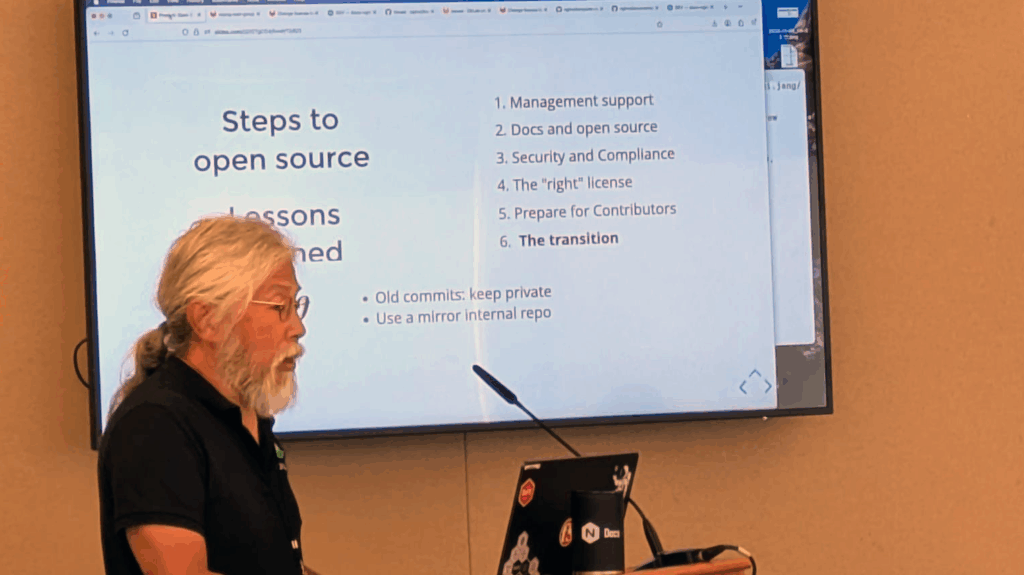
FOSSY 2025 Wrap Up: Mike Jang “Open source your repository: a roadmap”

Mike Jang, the third talk of the Science of Community track at FOSSY 2025, covered how open sourcing existing software is more than just “pushing a button”, it involves things like auditing security, sharing with your community, setting ground rules, and more. Jang shared insights on how to access a template repository, a checklist to follow, tips for hackathons, and how to understand the work required to move to open source. 

This is the 3rd of our 12 part series sharing highlights from the Science of Community track at FOSSY 2025. Visit the FOSSY site for bio details and a full abstract.