Welcome to part 3 of a 7-part series spotlighting the excellent talks we were fortunate enough to host during the Science of Community track at FOSSY 23!
Dr. Anita Sarma gave us an excellent introduction to her and her team’s work on understanding how to make FOSS more inclusive by identifying errors in user interaction design.
Matt Gaughan delivered a rapid introduction to his dataset highlighting the numerous places where the Linux Kernel is using unsafe memory practices.
You can watch the talk HERE and learn more about Dr. Sarma HERE.
Welcome to part 2 of a 7-part series spotlighting the excellent talks we were fortunate enough to host during the Science of Community track at FOSSY 23!
Matt Gaughan delivered a rapid introduction to his dataset highlighting the numerous places where the Linux Kernel is using unsafe memory practices.
You can watch the talk HERE, check out the dataset HERE and learn more about Matt HERE.
Welcome to part 1 of a 7-part series spotlighting the excellent talks we were fortunate enough to host during the Science of Community track at FOSSY 23!
Sophia Vargas presented ‘Can we combat maintainer burnout with proactive metrics?’ In this talk, Sophia takes us through her extensive investigations across multiple projects to weigh the value of different metrics to anticipate when people might be burning out, including some surprising instances where metrics we might think are helpful really don’t tell us what we think they do.
You can watch the talk HERE and learn more about Sophia’s work HERE.
The CDSC hosted the Science of Community Track on July 15th at FOSSY this year — it was an awesome day of learning and conversation with a fantastic group of senior scholars, industry partners, students, practitioners, community members, and more! We are so grateful and eager to build on the discussions we began.
If you missed the sessions, watch this space! Most sessions were recorded, and we’ll post links and materials as they’re released.
Special thanks to Molly de Blanc for all the long distance organizing work; Shauna Gordon McKeon for stepping in to help share some closing thoughts on the Science of Community track at the very last minute, and to the FOSSY organizing team for convening such a warm, welcoming inaugural event (indeed, the warmth was palpable as it nearly hit 100° F on Friday and Saturday in Portland).
One tangible result of a free software conference: new laptop stickers!
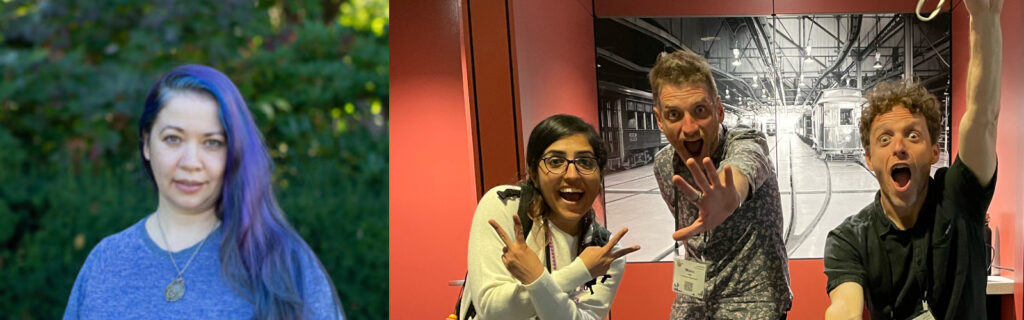
Kaylea Champion, and Benjamin Mako Hill and Aaron Shaw with Sejal Khatri (who won’t be at FOSSY)
The Science of Community track is inspired by the CDSC Science of Community Dialogues, which aim to bring together practitioners and researchers to discuss scholarly work that is relevant to the efforts of practitioners. As researchers, we get so much from the communities we work with and study and we want them to also learn from the research they so generously take part in. While the Dialogues cover a broad range of topics and communities, FOSSY presentations focus on how that work related to free and open source software communities, projects, and practitioners.
At FOSSY, we will have a number of really amazing researchers presenting their work. We wanted to share some highlights from the schedule.
Sophia Vargas, from Google’s Open Source Programs Office, will be presenting on how metrics can help us understand contributor burnout. Professor Shoji Kajita, from Kyoto University, will discuss research data management for FOSS communities. Mariam Guizani, from Oregon State University, will cover research on the why and how of corporate participation in FOSS. We will additionally have lightning talks by Adam Hyde, Anita Sarma, Shauna Gordon-McKeon, and incoming Northwestern Ph.D. student Matthew Gaughan.
We are really excited about our workshop “Let’s Get Real: Putting Research Findings Into Practice.” This workshop, designed for FOSS contributors and practitioners, will help guide you on how to get the most out of the incredible research on and relevant to FOSS. If you want to learn how to navigate the sheer volume of interesting research work happening or how to understand what it means, this is the session for you! Our workshop will be led by Kaylea Chamption and Professors Aaron Shaw and Benjamin Mako Hill. You can read more on our wiki.
Help us build a dynamic and exciting program to facilitate conversations between free and open source software (FOSS) researchers and practitioners! Submit a session proposal for FOSSY! The deadline for submissions is May 14 May 18 (Edit: The deadline has been moved.).
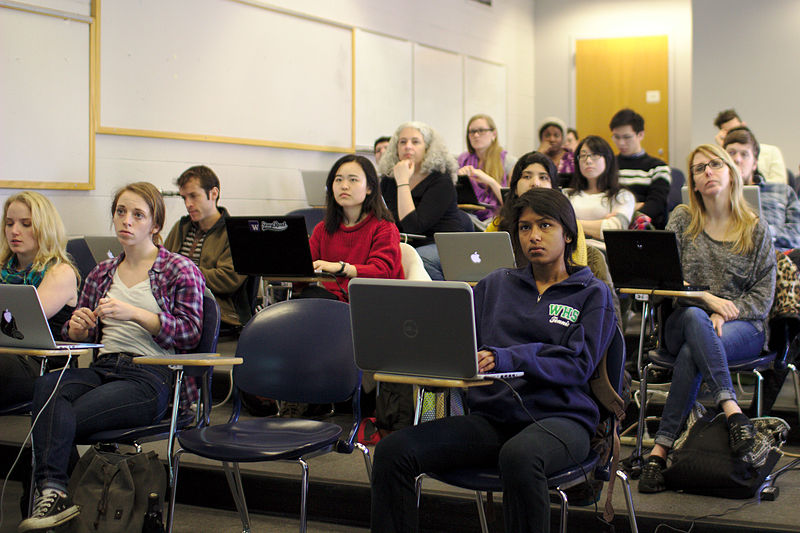
A Spring 2015 CDSC workshop. Photo by Sage Ross, licensed Creative Commons Attribution Share Alike
Although scholars publish hundreds of papers about free and open source software, online governance, licensing, and other topics very relevant to FOSS communities each year, much of this work never makes it out of academic journals and conferences and back to FOSS communities. At the same time, FOSS communities have a range of insights, questions, and data that researchers studying FOSS could benefit from enormously.
The goal of this track is to build bridges between FOSS communities and scientific research conducted with and about FOSS communities. We hope to provide opportunities for community members to hear about exciting results from researchers; opportunities for researchers to learn from the FOSS community members; and spaces for the FOSS community to think together about how to improve FOSS projects by leveraging research insights and research.
This track will include opportunities for:
researchers to talk with practitioners (about their research)
practitioners to talk with researchers (about their needs)
researchers to talk with other researchers (for learning and collaboration)
FOSSY runs July 13 – 16, and we are hoping to have 2-3 days of content. Towards that end, we are seeking proposals! If you are a researcher with work of relevance to FOSS community members; a FOSS community member with experiences or opportunities relevant to research; or just want to be involved in this conversation, please consider proposing in one of the following formats:
Short Talks. Do you have a recent project to share in some depth? A topic that needs time to unpack? Take 20 minutes to present your thoughts. Following each presentation there will be time for group discussion to help participants apply your work to their practice.
Lightning Talks. Want to make a focused point, pitch, or problem report to a great audience? Bring your 5-minute talk to our lightning round.
Panels. We will be facilitating dialogue between researchers and community members. Would you be willing to share your thoughts as a panelist? Let us know your expertise and a few notes on your perspective so that we can develop a diverse and engaging panel. Contact us directly (details below) if you are interested in being on a panel.
If you have an idea that doesn’t fit into these formats, let’s chat! You can reach out to Kaylea (kaylea@uw.edu), Molly (molly.deblanc@northwestern.edu) or submit your idea as a proposal via the FOSSY form.
Submissions are non-archival, so we welcome ongoing, completed, and already published research work. Non-archival means that presentation of work at FOSSY does not constitute a publication. It’s just a way to get your work out there! Work that synthesizes or draws across a body of published papers is particularly welcome.
What kind of research are you looking to have presented?
We are interested in any topic related to FOSS communities! This might include research from computing (including software engineering, computer security, social computing, HCI), the social sciences and humanities (including management, philosophy, law, economics, sociology, communication, and more), information sciences, and beyond.
For example: how to identify undermaintained FOSS packages and what to do about it; community growth and how to find success in small communities; effective rule making and enforcement in online communities.
If it involves FOSS or is of interest to FOSS practitioners, we welcome it! We are eager to help you put your results into the hands of practitioners who can use your findings to inform their own community’s practices and policies on social, governance, and technical topics.
We hope to welcome scholars and researchers from across academia, government, industry, or wherever else you are from!
Who will I be speaking with?
We expect a multi-disciplinary audience. FOSSY will be bringing together free and open source software practitioners including community managers, designers, legal experts, non-profit and project leaders, technical developers, technical writers, and researchers.
The track is being organized by:
Kaylea Champion, Community Data Science Collective and the University of Washington
Molly de Blanc, Community Data Science Collective and Northwestern University
Benjamin Mako Hill, Community Data Science Collective and the University of Washington
Aaron Shaw, Community Data Science Collective and Northwestern University