Worried you didn’t submit your FOSSY proposal on time? Well fear not, the deadline has been extended to Tuesday, June 18th. Submit your proposal today!
Does your work touch open source, communities, technology, or cooperation? Do you want to help bridge the gaps between research and practice? Join us at the Free and Open Source Software Yearly conference (FOSSY) this summer!
We’ll be running the Science of Community track, and are looking for presenters to speak to an audience of FOSS practitioners, developers, community organizers, contributors, and people just generally into and curious about FOSS.
FOSSY is a low-stress opportunity to talk to people who your work can benefit. For topics, consider presenting implications from past papers, synthesizing work from your field overall, or floating ideas and problems (lightning talks! long talks! short talks!). A full track description and answers to common questions is available on our wiki.
The (extraordinary!) panelists were Jaz-Michael King (IFTAS), Christine Lemmer-Webber (Spritely Institute), and Bryan Newbold (BlueSky). The discussion ranged far and wide over some key background on decentralized and federated social media as well as some urgent challenges and opportunities in the space.
The recording of the session is up and you can watch it here (or in the frame below).
Thanks to the panelists, Madison Deyo, and the HCI+D team for making this happen!
Does your work touch open source, communities, technology, or cooperation? Do you want to help bridge the gaps between research and practice? Join us at FOSSY! The Free and Open Source Software Yearly conference (FOSSY) is back this summer and the call for proposals is open!
We’ll be running the Science of Community track, and are looking for presenters to speak to an audience of FOSS practitioners, developers, community organizers, contributors, and people just generally into and curious about FOSS.
The Science of Community track is inspired by the CDSC Science of Community Dialogues, which bring together practitioners and researchers to discuss scholarly work that is relevant to the efforts of practitioners. As researchers, we benefit so much from the communities we work with and study and we want them to also learn from the research they so generously take part in. While the Dialogues cover a broad range of topics and communities, FOSSY presentations will focus on how that work relates to free and open source software communities, projects, and practitioners.
FOSSY is a low-stress opportunity to talk to people who your work can benefit. For topics, consider presenting implications from past papers, synthesizing work from your field overall, or floating ideas and problems (lightning talks! long talks! short talks!). A full track description and answers to common questions is available on our wiki.
How can we create more trustworthy and accountable social media that support diverse communities? Decentralized social media—systems that allow users to connect and communicate across independent services like Mastodon or BlueSky—offer promising alternatives to centralized commercial platforms like Instagram, TikTok, or X. However, decentralized social media also face urgent design challenges, especially when it comes to content integrity, protecting community trust and safety, and forging collective governance. What happens when there is no central authority to review posts or ban abusive users? How can networks of autonomous communities build and adopt systems to govern effectively? What critical infrastructure can prevent the pervaisve harms of existing social media and support the integrity of public discourse?
Join Northwestern’s Center for Human-Computer Interaction + Design (HCI+D) and the Community Data Science Collective (CDSC) for an engaging conversation about the challenges and opportunites of decentralized social media on May 23rd from 4 to 5:15 p.m. CST. This panel features designers, leaders, and researchers involved in federated social media and will address opportunities for effective design and governance in this space.
Panelists include Jaz-Michael King, Bryan Newbold, and Christine Lemmer-Webber. Short presentations will be followed by discussion and Q&A moderated by Aaron Shaw (Northwestern HCI+D, CDSC).
Moderator: Aaron Shaw, photograph by Nikki Ritcher Photography
Speaker: Christine Lemmer-Webber, Executive Director of Spritely Networked Communities Institute
Christine has devoted her life to advancing user freedom. Realizing that the federated social web was fractured by a variety of incompatible protocols, she co-authored and shepherded ActivityPub‘s standardization. She has also contributed to many other free and open source projects, including co-founding MediaGoblin.
Christine established the open source Spritely Project to solve known problems in existing centralized and decentralized social media platforms and to re-imagine the way we build networked applications – work that now continues here at the institute under her guidance as Executive Director.
Speaker: Jaz-Michael King, Executive Director of IFTAS (Federated Trust & Safety)
An accomplished professional with an extraordinary record of enabling data-driven decisions, developing innovative products, creating new business opportunities, driving strong operational performance, and building high-performing, agile teams. Highly versatile, with extensive experience in data and technology from a privacy, improvement, and reporting perspective, Jaz has a proven record in building solutions for non-profit programs. As Executive Director of IFTAS, Jaz is now focused on independent, open Social Web activities, with the aim of creating #BetterSocialMedia by supporting trust and safety at scale in federated social media networks.
Speaker: Bryan Newbold, Protocol Engineer at BlueSky
Bryan works at Bluesky, a startup company building a federated social media protocol called “atproto”. Until a few months ago he worked at the Internet Archive collecting scientific research datasets and publications, and created scholar.archive.org. And before that he worked on infrastructure at Stripe, attended the Recurse Center in New York City, and built Atomic Magnetometers for a small New Jersey company called Twinleaf.
Over that same time period, Bryan climbed up and down the ladder of abstraction, obtaining an undergraduate degree in physics (at MIT), operating under-ice robots in Antarctica, developing open hardware lab instrumentation for large-scale brain probing (at LeafLabs), cataloging hundreds of millions of electronics components (at Octopart), and improved production service reliability at Stripe (a financial infrastructure start-up).
Bryan is a transplant from the East Coast and enjoys the road biking, large trees, generous salads, used bookstores, and world-class tech non-profits. This will be his third year serving on the Code of Conduct team at DWeb Camp.
It’s Ph.D. application season and the Community Data Science Collective is recruiting! As always, we are looking for talented people to join our research group. Applying to one of the Ph.D. programs that the CDSC faculty members are affiliated with is a great way to get involved in research on communities, collaboration, and peer production.
Because we know that you may have questions for us that are not answered in this webpage, we will be hosting an open house and Q&A about the CDSC and Ph.D. opportunities on Friday, October 20 at 18:00 UTC (2:00pm US Eastern, 1:00pm US Central, 11:00am US Pacific). You can register online.
This post provides a very brief run-down on the CDSC, the different universities and Ph.D. programs our faculty members are affiliated with, and some general ideas about what we’re looking for when we review Ph.D. applications.
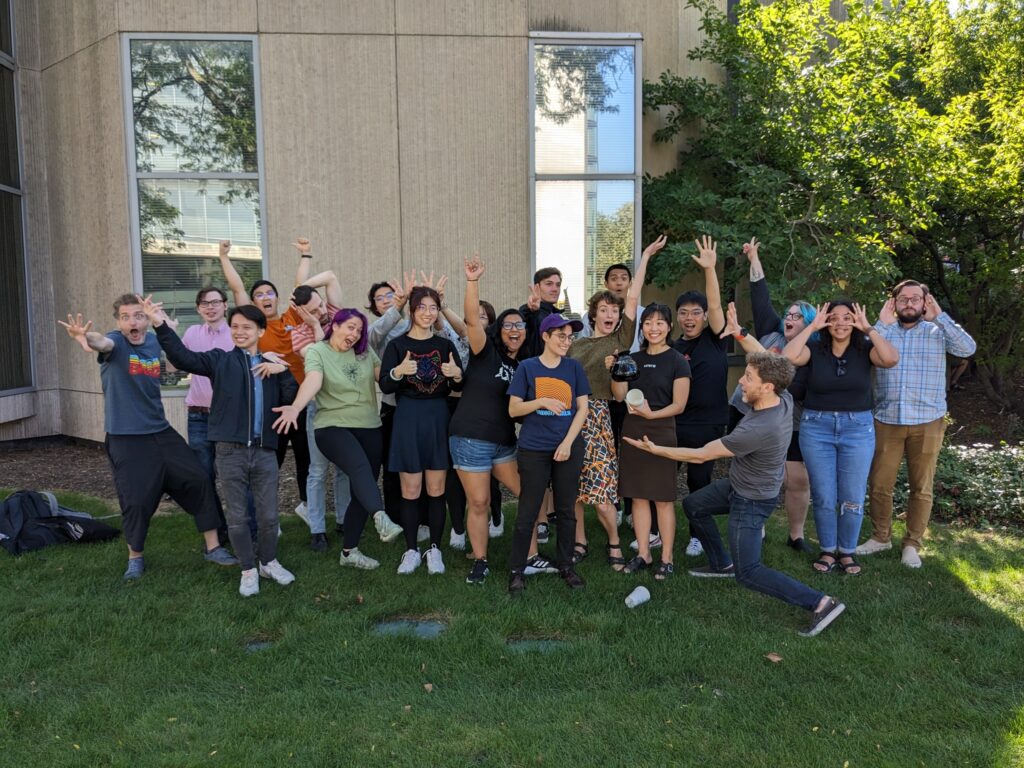
Group photo of the collective at a recent retreat.
What are these different Ph.D. programs? Why would I choose one over the other?
This year the group includes three faculty principal investigators (PIs) who are actively recruiting PhD students: Aaron Shaw (Northwestern University), Benjamin Mako Hill (University of Washington in Seattle), and Jeremy Foote (Purdue University). Each of these PIs advise Ph.D. students in Ph.D. programs at their respective universities. Our programs are each described below.
Although we often work together on research and serve as co-advisors to students in each others’ projects, each faculty person has specific areas of expertise and interests. The reasons you might choose to apply to one Ph.D. program or to work with a specific faculty member could include factors like your previous training, career goals, and the alignment of your specific research interests with our respective skills.
At the same time, a great thing about the CDSC is that we all collaborate and regularly co-advise students across our respective campuses, so the choice to apply to or attend one program does not prevent you from accessing the expertise of our whole group. But please keep in mind that our different Ph.D. programs have different application deadlines, requirements, and procedures!
Faculty who are actively recruiting this year
If you are interested in applying to any of the programs, we strongly encourage you to reach out the specific faculty in that program before submitting an application.
Ph.D. Advisors
Jeremy Foote
Jeremy Foote is an Assistant Professor at the Brian Lamb School of Communication at Purdue University. He is affiliated with the Organizational Communication and Media, Technology, and Society programs. Jeremy’s research focuses on how individuals decide when and in what ways to contribute to online communities, how communities change the people who participate in them, and how both of those processes can help us to understand which things become popular and influential. Most of his research is done using data science methods and agent-based simulations.
Benjamin Mako Hill
Benjamin Mako Hill is an Associate Professor of Communication at the University of Washington. He is also adjunct faculty at UW’s Department of Human-Centered Design and Engineering (HCDE), Computer Science and Engineering (CSE) and Information School. Although many of Mako’s students are in the Department of Communication, he has also advised students in all three other departments—although he typically has more limited ability to admit students into those programs on his own and usually does so with a co-advisor in those departments. Mako’s research focuses on population-level studies of peer production projects, computational social science, efforts to democratize data science, and informal learning. Mako has also put together a webpage for prospective graduate students with some useful links and information..
AaronShaw is an Associate Professor in the Department of Communication Studies at Northwestern. In terms of Ph.D. programs, Aaron’s primary affiliations are with the Media, Technology and Society (MTS) and the Technology and Social Behavior (TSB) Ph.D. programs (please note: the TSB program is a joint degree between Communication and Computer Science). Aaron also has a courtesy appointment in the Sociology Department at Northwestern, but he has not directly supervised any Ph.D. advisees in that department (yet). Aaron’s current projects focus on comparative analysis of the organization of peer production communities and social computing projects, participation inequalities in online communities, and collaborative organizing in pursuit of public goods.
What do you look for in Ph.D. applicants?
There’s no easy or singular answer to this. In general, we look for curious, intelligent people driven to develop original research projects that advance scientific and practical understanding of topics that intersect with any of our collective research interests.
To get an idea of the interests and experiences present in the group, read our respective bios and CVs (follow the links above to our personal websites). Specific skills that we and our students tend to use on a regular basis include consuming and producing social science and/or social computing (human-computer interaction) research; applied statistics and statistical computing, various empirical research methods, social theory and cultural studies, and more.
Formal qualifications that speak to similar skills and show up in your resume, transcripts, or work history are great, but we are much more interested in your capacity to learn, think, write, analyze, and/or code effectively than in your credentials, test scores, grades, or previous affiliations. It’s graduate school and we do not expect you to show up knowing how to do all the things already.
Intellectual creativity, persistence, and a willingness to acquire new skills and problem-solve matter a lot. We think doctoral education is less about executing tasks that someone else hands you and more about learning how to identify a new, important problem; develop an appropriate approach to solving it; and explain all of the above and why it matters so that other people can learn from you in the future. Evidence that you can or at least want to do these things is critical. Indications that you can also play well with others and would make a generous, friendly colleague are really important too.
All of this is to say, we do not have any one trait or skill set we look for in prospective students. We strive to be inclusive along every possible dimension. Each person who has joined our group has contributed unique skills and experiences as well as their own personal interests. We want our future students and colleagues to do the same.
Now what?
Still not sure whether or how your interests might fit with the group? Still have questions? Still reading and just don’t want to stop? Follow the links above for more information. Feel free to send at least one of us an email. We are happy to try to answer your questions and always eager to chat. You can also join our open house on October 20 at 2:00pm ET (UTC-4).
Welcome to a bonus round of our series spotlighting the excellent talks we were fortunate enough to host during the Science of Community track at FOSSY 23!
Eriol Fox presented their talk, “Community lead user research and usability in Science and Research OSS: What we learned,” (due to scheduling issues, this landed in the Wildcard track, but it was definitely on-topic for Science of Community! Eriol introduced us to their work exploring how scientists and researchers think about open source software, including differences in norms and motivations as well as challenges around the structure of labor. They also brought along copies of their 4 super cool zines from this project!
You can watch the talk HERE and learn more about Eriol’s work HERE.
Welcome to part 7 of a 7-part series spotlighting presentations from the Science of Community track at FOSSY 23!
In this interactive session, Dr. Benjamin Mako Hill, Dr. Aaron Shaw, and Kaylea Champion hosted a series of conversations with FOSS community members about finding research, putting it to use, and building partnerships between researchers and communities!
This talk was (intentionally!) not recorded, but we’ve synthesized the resources we shared into this wiki page.
Welcome to part 6 of a 7-part series spotlighting the excellent talks we were fortunate enough to host during the Science of Community track at FOSSY 23!
In this talk, Dr. Guizani shared her work to understand the motivation for companies to participate in open source software development, encompassing the perspective of both small and large firms.
You can watch the talk HERE and learn more about Dr. Guizani HERE.
Welcome to part 5 of our 7-part series reviewing all the great talks we were fortunate enough to host during the Science of Community track at this year’s FOSSY.
In this talk, Dr. Kajita introduced us to the work being done as part of the Apereo (formerly JA-SIG/Sakai) to create FOSS platforms to serve as academic and administrative infrastructure in higher education. Research data management is a skill that emerging scholars must learn to do modern quantitative research — and this skill can be scaffolded and tracked via the Karuta portfolio tool.
Watch the talk HERE, learn more about Karuta HERE, and learn more about Dr. Kajita HERE.
Welcome to part 4 of a 7-part series spotlighting the excellent talks we were fortunate enough to host during the Science of Community track at FOSSY 23!
Kaylea presented on her new research project to identify how packages come to be undermaintained, in particular investigating assumptions that it’s all about “the old stuff” — old packages, old languages. It turns out that’s only part of the story — older packages and software written in older languages do tend to be undermaintained, but old packages in old languages — the tried and true, as it were — do relatively well!
Watch the talk HERE and learn more about Kaylea’s work HERE.