Community Dialogue: Social Drivers of Online Hate

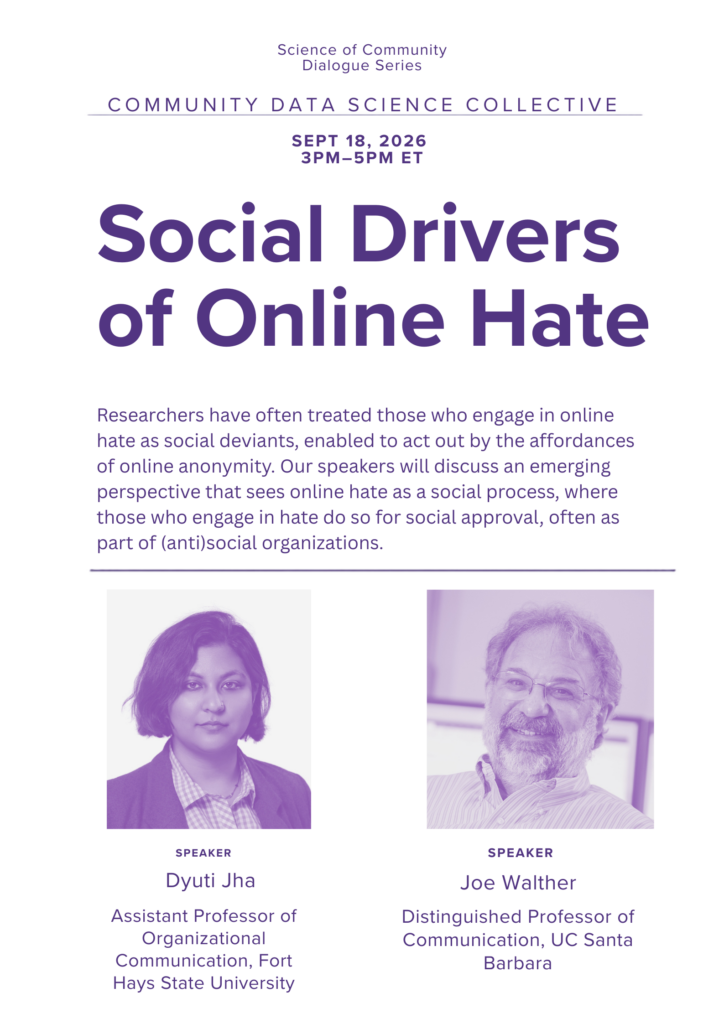
Toxicity, aggression, racism, misogyny, and other forms of hate are unfortunately common in online spaces. Researchers have often treated those who engage in online hate as social deviants, enabled to act out by the affordances of online anonymity. This Friday, we will host two speakers who will discuss an emerging perspective that sees online hate as a social process, where those who engage in hate do so for social approval, often as part of (anti)social organizations.

Dyuti Jha (Fort Hays State University ) will discuss how users engage in online hate as a form of hybrid social action. Although online hate has been conceptualized as a malicious form of individual expression or dyadic interactions, this research explores the way in which users develop collective identities from their membership in online communities of hate, connect with each other based on shared grievances, and engage in expressions of online hate as a social action motivated by moral outrage and the need for social approval. Using AI-facilitated qualitative conversational data collection, her work shows that online hate campaigns are organized as both collective and connective action, with hidden organizing supporting the “grassroots” connective spread of hate campaigns. This research offers useful perspectives on the motivations and organizing strategies of concealed actors behind the execution and sustenance of online hate campaigns.

Joe Walther (UC Santa Barbara) will discuss how conventional research and activism about online hate in social media presumes that its purpose is to antagonize victims. A new approach argues that hate is primarily for haters, and that the incentive for online hate posting is the social approval its providers glean from admirers. This presentation outlines social approval theory, growing empirical evidence supporting and challenging its propositions, and implications for deterrence.

Speaker Bios:

  • Joe Walther holds the Bertelsen Presidential Chair in Technology and Society at the University of California, Santa Barbara, where he is a Distinguished Professor of Communication. He is also a faculty associate at the Berkman Klein Center for Internet & Society at Harvard University. His theoretical and empirical work focuses on interpersonal and intergroup communication in mediated interaction, from relationship development to the spread of online hate. Social Processes of Online Hate (co-edited with R. Rice, Routledge 2025) is available open access.
  • Dyuti Jha is an Assistant Professor of Organizational Communication at Fort Hays State University. Using experiments and AI-facilitated conversations, her doctoral dissertation studied the impact and social organization of online hate. Her other research interests include individual and organizational resilience and the effects of online toxicity on political expression on the internet.

The CDSC is organizing this event and hosting and supporting it, in part, with a National Science Foundation grant (IIS-2045055), so it will be free to attend. We will share a code of conduct with participants before the event. Discussions will be held under Chatham House Rule. Presentations will be recorded, though discussions will not.

Register to Attend

The event will be held on Friday, September 18 from 3pm – 5pm Eastern Time. To get to know the audience a bit better, please fill out this brief survey to register. Those who register will receive a meeting invite with a link to the Zoom room.

What is a Dialogue?

The Science of Community Dialogue Series is a series of conversations among researchers, experts, community organizers, and others interested in how communities work, collaborate, and succeed. To learn more, watch this short introduction video with Aaron Shaw.
FOSSY 2026: Call for Proposals!

The Free and Open Source Software Yearly conference (FOSSY) is back for the fourth year in a row, and we’ll be running the Science of Community track, inspired by the CDSC Science of Community Dialogues, bringing together practitioners and researchers to talk about scholarly work that’s relevant to the efforts of practitioners.

Does your work touch open source, communities, technology, or cooperation? Do you want to help bridge the gaps between research and practice? Join our track! The call for proposals is open and we’re looking for presenters interested in speaking to FOSS practitioners, developers, community organizers, contributors, and people into and curious about FOSS.

As researchers, we benefit so much from the communities we work with and study and we want them to also learn from the research they so generously take part in. While the Dialogues cover a broad range of topics and communities, FOSSY presentations will focus on how that work relates to free and open source software communities, projects, and practitioners.

FOSSY is a low-stress opportunity to talk to people who your work can benefit. For topics, consider presenting implications from past papers, synthesizing work from your field overall, or floating ideas and problems (lightning talks! long talks! short talks!). A full track description and answers to common questions is available on our wiki.

The CFP deadline is May 22nd and uses this form. We can’t wait for you to join us!

Troubleshooting in Computational Research Design: Report from a Workshop Series

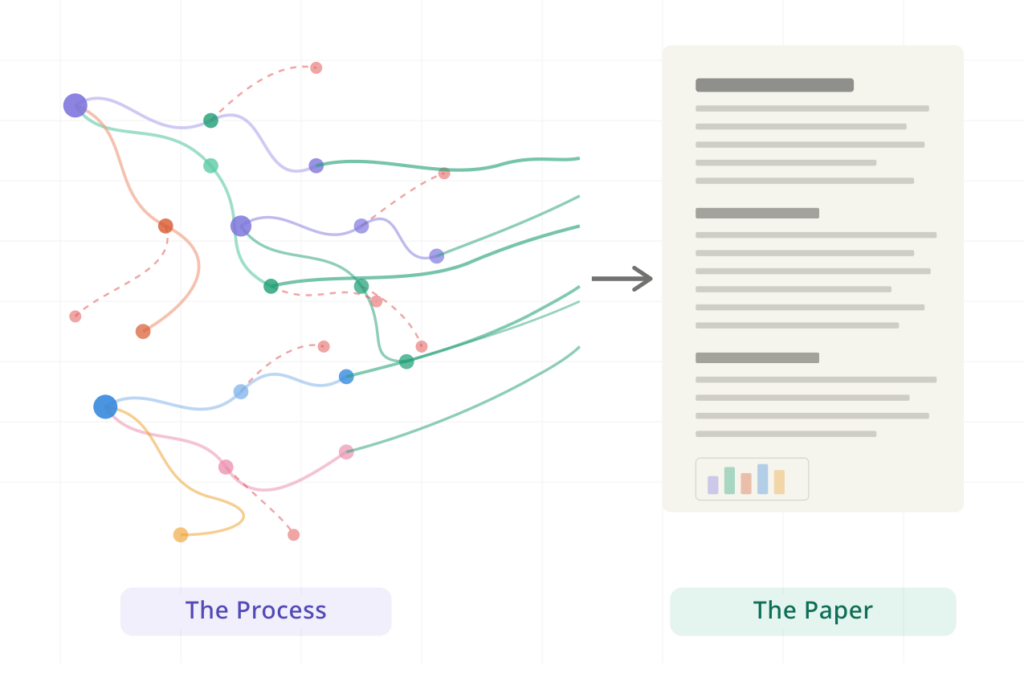
stylized visualization of a messy process turning into a paper
Visualization of the messy process that turns into the polished paper. Image generated by claude.ai.

This winter quarter, a small group of CDSC students at the University of Washington participated in a series of workshops on Troubleshooting in Computational Research Design. The workshops were organized by Yibin Fan. 

Research articles typically present a streamlined account of research design. How should a concept be operationalized? What counts as valid data? The process of producing those designs often involves a series of complex decisions that are rarely documented in detail. To address this gap, this workshop focused on the “troubleshooting” process that is central to computational communication research but is often omitted from published work: How did the authors arrive at particular methodological decisions? What challenges arose at different stages of the research design? How did they navigate the tradeoffs involved in choosing among alternative methods? 

Each session of the workshop focused on a specific aspect of computational research design, including conceptualization and operationalization; the role of generative AI in research design; computational text analysis; network analysis; behavioral analysis; and mixed-methods research. 

Our workshop sparked many interesting discussions, featuring guest speakers from the CDSC community who shared the behind-the-scenes decision-making processes of their work. Examples include:

For researchers working with computational methods, the workshop’s focus on troubleshooting offered a practical perspective on how rigorous research designs are developed in practice.

I’m writing this up, in part, because I think this might be a useful general model for other groups. Although the specifics vary, we found that asking computational researchers to bring their “real problems” to the table led to valuable conversations—especially for the early-career scholars. Yibin Fan is happy to have anybody reach out if they are interested in chatting about replicating the model at their own institution.

When AI Feels Like a Confidant: The Illusion of Shared Privacy in AI Companions

AI companions like Replika and Character.AI are increasingly experienced not as tools, but as relational partners. They remember conversations, express empathy, and respond with emotional continuity. For many users, talking to an AI feels closer to confiding in someone than interacting with software.

But what happens to privacy when a system feels like a relationship?

In interviews with long-term AI companion users, we found that people often treated their disclosures as relationally shared. Much like in human relationships, when users opened up to their AI, they experienced the information as something co-held within the relationship — not simply transmitted to a database.

We describe this dynamic as simulated co-ownership — a situation where users apply interpersonal privacy norms to relationships that are technically infrastructural systems.

In interpersonal privacy theory, sharing information can create co-ownership: both parties become responsible for managing that information. Our participants applied this same relational logic to AI companions. They experienced privacy not as an individual possession, but as something negotiated within a bond.

Yet the co-ownership is simulated.

Unlike human partners, AI companions do not have agency over boundaries. The platform does. Memory is persistent, storage is infrastructural, and governance is corporate. What feels like relational boundary management at the horizontal level is simultaneously data capture at the vertical level.

Interestingly, users were aware of this tension. Many expressed distrust toward platform policies while still trusting the AI as a “partner.” Emotional engagement often outweighed institutional concern. Some adopted layered strategies — pseudonyms, selective disclosure, avoiding images — while others consciously prioritized emotional comfort over abstract data risks.

What this reveals is a shift in how privacy is experienced in AI-mediated contexts. Privacy becomes relational and affective — shaped by anthropomorphic design, memory continuity, and perceived intimacy.

When people treat privacy as something co-owned within a relationship, but the relationship itself is engineered and infrastructural, boundary management becomes unstable.

The question for designers and policymakers is no longer just how to disclose data practices clearly. It is how to account for the fact that users experience privacy through the logic of relationships — even when those relationships are simulated.

Research Brief
Research Article (Pre-print)

Science of Community Dialogue: The Impacts of Organizational Interventions in Open Source Software Engineering

This dialogue will take place on November 7th at 12pm CT and will explore how free/libre and open source software (FLOSS) projects adapt their work processes to recruit new contributors and build the project communities that they want, and how FLOSS projects redesign collaboration processes within different environments and moments in project lifecycles. Professor Igor Steinmacher (Northern Arizona University) will be joining Matt Gaughan (Northwestern University) to present recent research on topics including:

  • Documentation practices in FLOSS projects
  • Disconnect between guidelines and reality
  • Sustainability challenges in FOSS communities
  • Community-based governance redevelopment
  • Structural shifts for long-term health

A full session description is on our website. Register online.

What is a Dialogue?

The Science of Community Dialogue Series is a series of conversations between researchers, experts, community organizers, and other people who are interested in how communities work, collaborate, and succeed. You can watch this short introduction video with Aaron Shaw.
What is the CDSC?

The Community Data Science Collective (CDSC) is an interdisciplinary research group made of up of faculty and students at the University of Washington Department of Communication, the Northwestern University Department of Communication Studies, the Carleton College Computer Science Department, the School of Information at UT Austin, and the Purdue University School of Communication.

Learn more

If you’d like to learn more or get future updates about the Science of Community Dialogues, please join the low volume announcement list.

Community Dialogue – AI Boundaries: Refusal and Privacy

Join the Community Data Science Collective (CDSC) for our 12th Science of Community Dialogue! This Community Dialogue will take place on October 17th, 2025 at 12:00 pm CT. This dialogue explores how companion chatbots invite deep emotional disclosure while raising concerns about data privacy—and how some communities are pushing back through AI refusal. Professor Jasmine McNealy (University of Florida) will join Hsuen-Chi (Hazel) Chiu (Purdue University) to present recent research on topics including:

  • Emotional disclosure in chatbot interactions
  • Data privacy and AI refusal
  • Designing emotionally intelligent, boundary-aware AI
  • Cultural implications of opting out of AI companionship

A full session descriptions is on our website. Register online.

What is a Dialogue?

The Science of Community Dialogue Series is a series of conversations between researchers, experts, community organizers, and other people who are interested in how communities work, collaborate, and succeed. You can watch this short introduction video with Aaron Shaw.

What is the CDSC?

The Community Data Science Collective (CDSC) is an interdisciplinary research group made of up of faculty and students at the University of Washington Department of Communication, the Northwestern University Department of Communication Studies, the Carleton College Computer Science Department, the School of Information at UT Austin, and the Purdue University School of Communication.

Learn more

If you’d like to learn more or get future updates about the Science of Community Dialogues, please join the low volume announcement list.

FOSSY 2025 Wrap-Up: Kaylea Champion “Plausible Slop: Generative AI and Open Source Cybersecurity”

For our final talk of the Science of Community track at FOSSY 2025, Kaylea Champion explored how generative AI tools are disrupting open source cybersecurity—not through advanced attacks, but by flooding communities with “plausible slop,” or misleading, low-effort reports. She shared research on the burden this places on experts, who must balance welcoming newcomers with filtering out noise. Drawing on historical parallels and case studies, she proposed strategies to address these challenges and invited community input to shape future solutions.

This is the final of our 11 part series sharing highlights from the Science of Community track at FOSSY 2025. Visit the FOSSY site for bio details and a full abstract.

FOSSY 2025 Wrap Up: Steve Feng and Anita Sarma “Glue Work Makes the Community Work: Sustaining OSS Through Invisible Labor”

Our tenth talk for the Science of Community Track at FOSSY 2025 featured Zixuan (Steve) Feng and Anita Sarma discussed how glue work —like maintaining code, updating docs, and supporting users—is essential to OSS success but often overlooked and undervalued. The talked about their teams 300+ OSS practitioner studies to define, trace, and elevate these contributions, offering practical strategies to recognize their impact.

This is the 10th of our 11 part series sharing highlights from the Science of Community track at FOSSY 2025. Visit the FOSSY site for bio details and a full abstract.

FOSSY 2025 Wrap Up: Igor Steinmacher “Lessons from a Decade of Open Source Sustainability Research”

Igor Steinmacher walked through lessons learned from a decade of OSS research for our 9th talk of the Science of Community Track. He explored long-term sustainability challenges in FOSS communities, including onboarding, maintainer burnout, and governance. He presented interventions like mentorship strategies, structured contribution paths, and the use of LLMs to support contributors and scale community engagement. Through case studies and longitudinal data, he offered a holistic vision for building more inclusive, resilient, and human-centered open source ecosystems.

This is the 9th of our 11 part series sharing highlights from the Science of Community track at FOSSY 2025. Visit the FOSSY site for bio details and a full abstract.

FOSSY 2025 Wrap Up: Dawn Foster on “Power Dynamics, Rug Pulls, and Other Impacts on FOSS Sustainability

The 8th presenter for the Science of Community track was Dawn Foster, who talked about the power imbalances in FOSS projects, and their potential for disruption. She explored real-world case studies and offered practical steps to help contributors make smarter, more sustainable choices.

This is the 8th of our 11 part series sharing highlights from the Science of Community track at FOSSY 2025. Visit the FOSSY site for bio details and a full abstract .