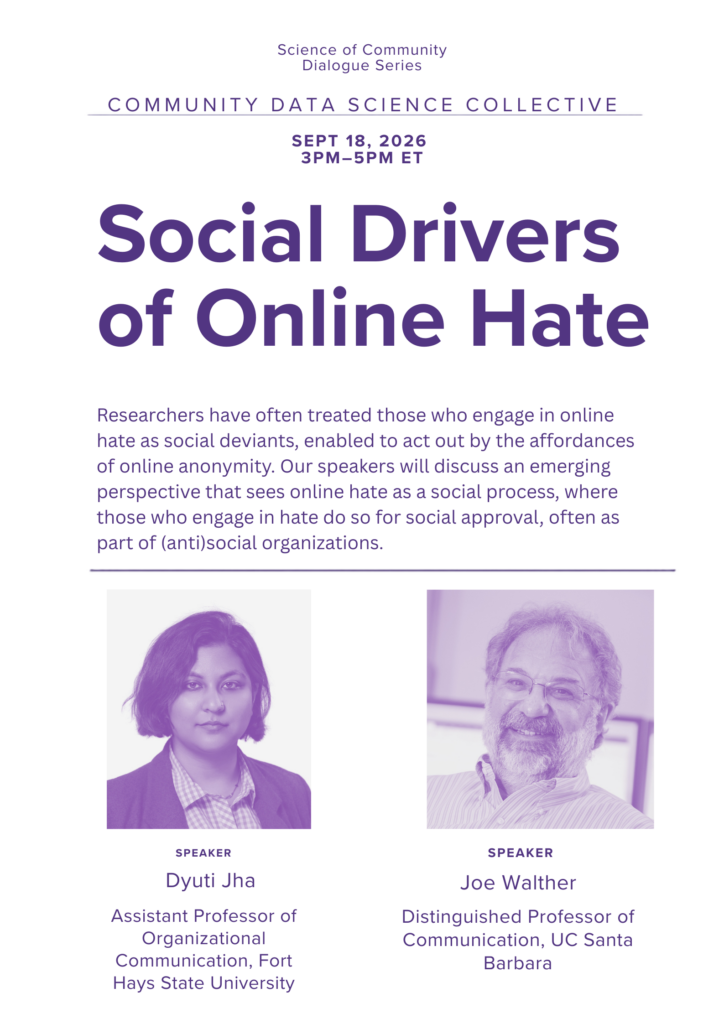
Toxicity, aggression, racism, misogyny, and other forms of hate are unfortunately common in online spaces. Researchers have often treated those who engage in online hate as social deviants, enabled to act out by the affordances of online anonymity. This Friday, we will host two speakers who will discuss an emerging perspective that sees online hate as a social process, where those who engage in hate do so for social approval, often as part of (anti)social organizations.
Dyuti Jha (Fort Hays State University ) will discuss how users engage in online hate as a form of hybrid social action. Although online hate has been conceptualized as a malicious form of individual expression or dyadic interactions, this research explores the way in which users develop collective identities from their membership in online communities of hate, connect with each other based on shared grievances, and engage in expressions of online hate as a social action motivated by moral outrage and the need for social approval. Using AI-facilitated qualitative conversational data collection, her work shows that online hate campaigns are organized as both collective and connective action, with hidden organizing supporting the “grassroots” connective spread of hate campaigns. This research offers useful perspectives on the motivations and organizing strategies of concealed actors behind the execution and sustenance of online hate campaigns.
Joe Walther (UC Santa Barbara) will discuss how conventional research and activism about online hate in social media presumes that its purpose is to antagonize victims. A new approach argues that hate is primarily for haters, and that the incentive for online hate posting is the social approval its providers glean from admirers. This presentation outlines social approval theory, growing empirical evidence supporting and challenging its propositions, and implications for deterrence.
Speaker Bios:
- Joe Walther holds the Bertelsen Presidential Chair in Technology and Society at the University of California, Santa Barbara, where he is a Distinguished Professor of Communication. He is also a faculty associate at the Berkman Klein Center for Internet & Society at Harvard University. His theoretical and empirical work focuses on interpersonal and intergroup communication in mediated interaction, from relationship development to the spread of online hate. Social Processes of Online Hate (co-edited with R. Rice, Routledge 2025) is available open access.
- Dyuti Jha is an Assistant Professor of Organizational Communication at Fort Hays State University. Using experiments and AI-facilitated conversations, her doctoral dissertation studied the impact and social organization of online hate. Her other research interests include individual and organizational resilience and the effects of online toxicity on political expression on the internet.
The CDSC is organizing this event and hosting and supporting it, in part, with a National Science Foundation grant (IIS-2045055), so it will be free to attend. We will share a code of conduct with participants before the event. Discussions will be held under Chatham House Rule. Presentations will be recorded, though discussions will not.
Register to Attend
The event will be held on Friday, September 18 from 3pm – 5pm Eastern Time. To get to know the audience a bit better, please fill out this brief survey to register. Those who register will receive a meeting invite with a link to the Zoom room.
What is a Dialogue?
The Science of Community Dialogue Series is a series of conversations among researchers, experts, community organizers, and others interested in how communities work, collaborate, and succeed. To learn more, watch this short introduction video with Aaron Shaw.
Discover more from Community Data Science Collective
Subscribe to get the latest posts sent to your email.