The Community Data Science Collective is heading to CSCW 2026 in Salt Lake City, Utah, October 10–14. Mako Hill, Kaylea Champion, Nate TeBlunthuis, and Yiwei Wu will be there. We hope you’ll join us at any of the sessions below.
Nate TeBlunthuis will present “The Relational Origins of Rules in Online Communities,” a paper with an all-CDSC author list of Charles Kiene, Sohyeon Hwang, Carl Colglazier, Nathan TeBlunthuis, Aaron Shaw, and Benjamin Mako Hill. Although Charles Kiene sadly won’t be there to present it, the paper reflects his excellent dissertation work. (full paper)
In the same session, Leah Ajmani will present “Sanctioned by Others: Remediating Knowledge Exclusion on Wikipedia Through Design” by Leah Ajmani, Moyan Zhou, Tanja Andic, Amber Berson, Isaac Johnson, Benjamin Mako Hill, Rebecca Maung, Sneha Narayan, Sarah Severson, Loren Terveen, and Stevie Chancellor. The paper received a DEI Recognition. (full paper)
Wednesday, October 14, 9:00 am (Salon E, Decentralized Social Media)
Yiwei Wu will present “AI Didn’t Start the Fire: Examining the Stack Exchange Moderator and Contributor Strike” by Yiwei Wu, Leah Ajmani, Nathan TeBlunthuis, and Hanlin Li. (blog post, full paper)
The same session will also have “Understanding Community-Level Blocklists in Decentralized Social Media” by Owen Xingjian Zhang, Sohyeon Hwang (CDSC alum and affiliate), Yuhan Liu, Manoel Horta Ribeiro, and Andrés Monroy-Hernández (CDSC affiliate). (full paper)
Wednesday, October 14, 11:00 am (Salon D, Lasting Impact Award)
Benjamin Mako Hill will give a talk in the Lasting Impact Award session honoring Aniket Kittur and Robert Kraut’s now-classic CSCW 2008 paper, “Harnessing the wisdom of crowds in Wikipedia: Quality through coordination.”
Saturday, October 10, 9:00 am–5:30 pm (Snowbird)
Beyond the main conference, Matt Gaughan, Kaylea Champion, and Benjamin Mako Hill are co-organizing the workshop Beyond Productivity: AI, Community, and Sustainability in Open Source Software with Eli Min, Hana Frluckaj, Kevin Crowston, and James Howison. The workshop looks at how generative AI and agentic coding are changing newcomer participation, maintainer burden, trust, and sustainability in open source communities.
We look forward to meeting you all in person at CSCW!
It seems natural to think that online political discussion happens in political spaces: comment sections under news articles, campaign pages, partisan forums, or video-sharing communities built around elections and public affairs.
But anyone who spends time online knows that politics does not stay neatly contained in those spaces. It shows up in local forums, hobby groups, gaming communities, entertainment discussions, and personal social media feeds. A conversation that begins with everyday life can suddenly become a debate about policy, rights, or government.
Communication scholars call this incidental political discussion: political talk that emerges in spaces not primarily organized around politics. I was interested in a simple question: what happens when people talk about politics in non-political online communities?
A common expectation in political communication research is that these conversations might be less polarized and more civil than political talk in explicitly political spaces. The logic goes: in non-political communities, people may not arrive with partisan identities already activated. They may also be guided by community norms built around shared interests, local concerns, or social connection rather than political conflict.
We wanted to test whether political talk in non-political spaces was actually less polarized, and perhaps less uncivil in real-world digital communities. To do so, I led an effort (with the support of Benjamin Mako Hill and Patricia Moy) to examine Reddit discussions about mass shootings and gun control in October 2017. Sampling over 100,000 comments on gun control issues across the platform that month, we compared comments from 15 explicitly political communities with those from 15 non-political communities, including culture-, location-, and game-based ones, among others.
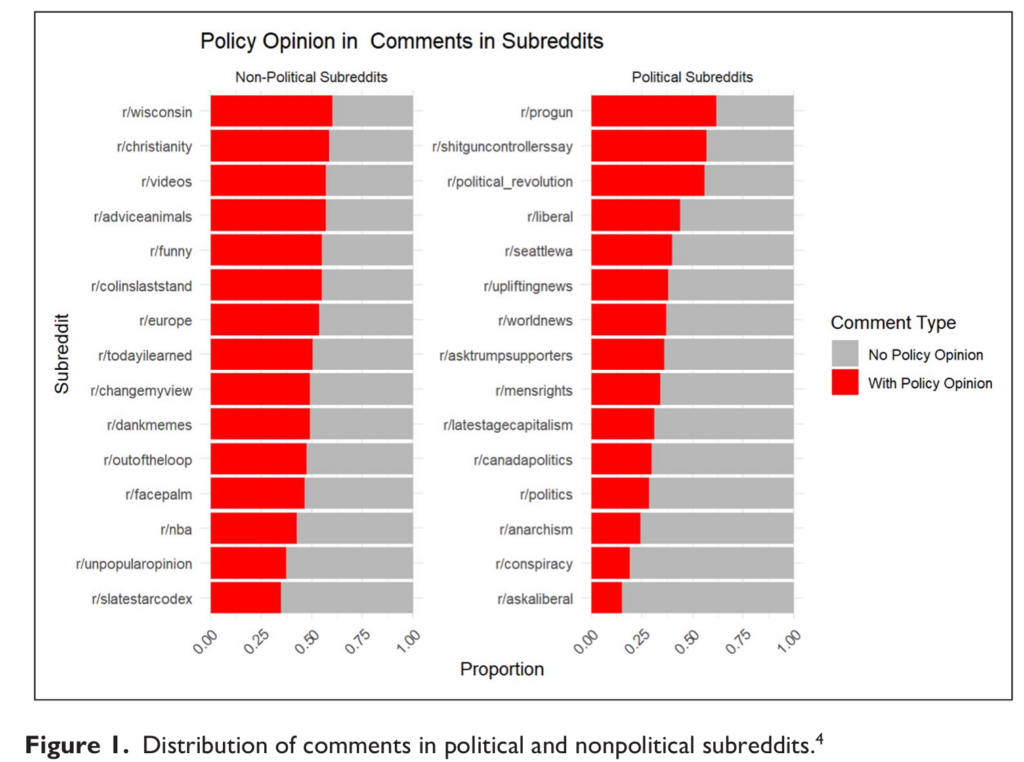
The results surprised us. As the figure below from our study shows, policy opinion expression was, on average, more common in non-political communities than in political ones. Several non-political subreddits—including r/Wisconsin, r/Christianity, r/videos, and r/funny—had especially high levels of policy opinion expression. In total, 10 non-political subreddits had policy opinions in more than half of the sampled comments. By contrast, only three political subreddits—r/progun, r/ShitGunControllersSay, and r/Political_Revolution—crossed the same 50% threshold. This pattern suggests that policy talk is not confined to explicitly political spaces; in some cases, it appears even more frequently in communities organized around local life, religion, entertainment, or humor.
After accounting for a range of factors in our regression model, we found that comments in non-political communities were more likely to contain a clear policy opinion than comments in explicitly political communities. The model estimated that the predicted probability of expressing a clear policy position was about 34% in political communities, compared with 51% in non-political communities. This difference was statistically significant. At the same time, we found no significant difference in incivility between political and non-political communities.
This combination of findings was especially interesting and contrasts with what’s most commonly reported in the current social science literature on digital political communication.
One possible explanation is that participants in explicitly political communities are often immersed in ongoing political debate. Their comments may include detailed argumentation, interpretation, irony, criticism of political actors, or discussion of the news cycle without always stating a clear policy position. By contrast, when a major political issue enters a non-political community, participants may be more likely to be newly exposed to it and react by saying what they think should be done.
Another explanation for incivility is that Reddit’s community-based moderation matters. Many communities, political and non-political alike, rely on rules, moderators, and shared expectations that can limit openly uncivil behavior. This helps explain why we did not find a significant difference in incivility: both types of communities show a low level of uncivil comments (around 6% of the sample).
The broader lesson is that political communication does not only happen where politics is expected. It also happens in the ordinary spaces of digital life, where people gather to talk about games, cities, hobbies, entertainment, or shared interests. If we want to understand democracy online, we need to pay attention not only to where people go to talk about politics, but also to where politics shows up uninvited.
AI companions like Replika and Character.AI are increasingly experienced not as tools, but as relational partners. They remember conversations, express empathy, and respond with emotional continuity. For many users, talking to an AI feels closer to confiding in someone than interacting with software.
But what happens to privacy when a system feels like a relationship?
In interviews with long-term AI companion users, we found that people often treated their disclosures as relationally shared. Much like in human relationships, when users opened up to their AI, they experienced the information as something co-held within the relationship — not simply transmitted to a database.
We describe this dynamic as simulated co-ownership — a situation where users apply interpersonal privacy norms to relationships that are technically infrastructural systems.
In interpersonal privacy theory, sharing information can create co-ownership: both parties become responsible for managing that information. Our participants applied this same relational logic to AI companions. They experienced privacy not as an individual possession, but as something negotiated within a bond.
Yet the co-ownership is simulated.
Unlike human partners, AI companions do not have agency over boundaries. The platform does. Memory is persistent, storage is infrastructural, and governance is corporate. What feels like relational boundary management at the horizontal level is simultaneously data capture at the vertical level.
Interestingly, users were aware of this tension. Many expressed distrust toward platform policies while still trusting the AI as a “partner.” Emotional engagement often outweighed institutional concern. Some adopted layered strategies — pseudonyms, selective disclosure, avoiding images — while others consciously prioritized emotional comfort over abstract data risks.
What this reveals is a shift in how privacy is experienced in AI-mediated contexts. Privacy becomes relational and affective — shaped by anthropomorphic design, memory continuity, and perceived intimacy.
When people treat privacy as something co-owned within a relationship, but the relationship itself is engineered and infrastructural, boundary management becomes unstable.
The question for designers and policymakers is no longer just how to disclose data practices clearly. It is how to account for the fact that users experience privacy through the logic of relationships — even when those relationships are simulated.
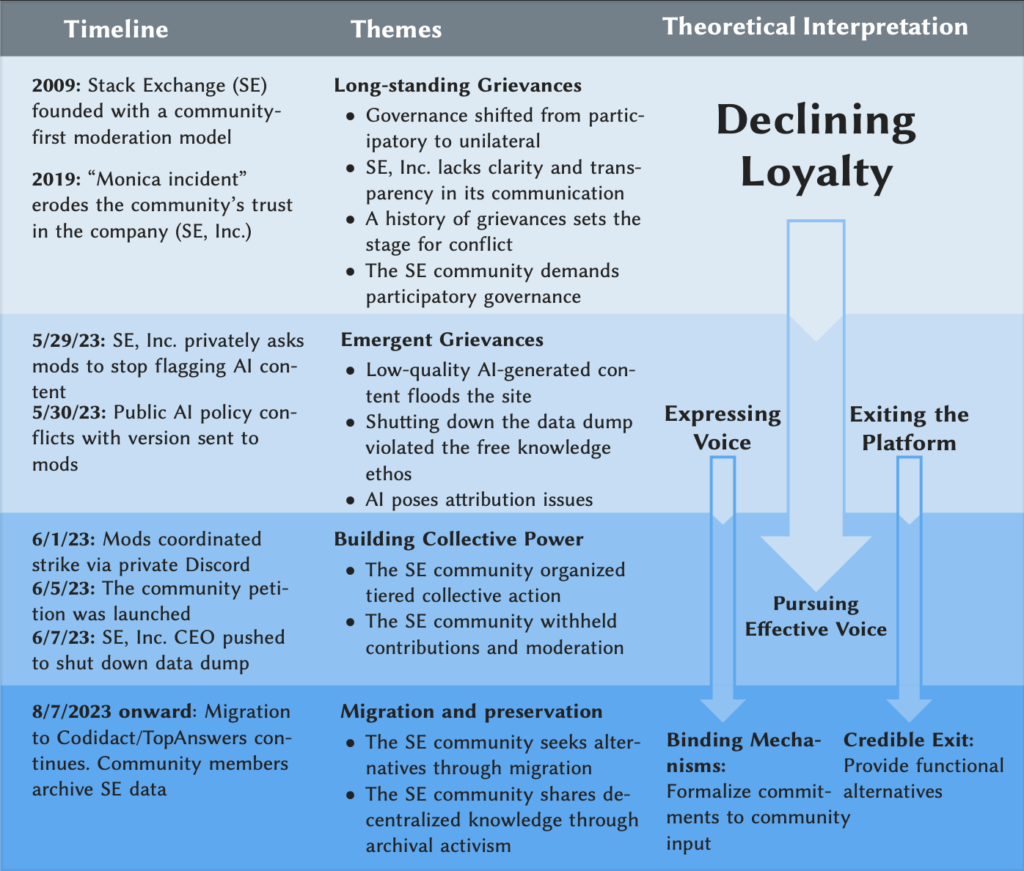
How historical tensions on Stack Exchange (SE) between the community and platform (SE, Inc.) and strike-related events align with the SE community’s grievances, their actions, and our theoretical interpretations of loyalty, voice, and exit.
Generative AI technologies rely on content from knowledge communities as their training data. However, these communities receive little in return and instead experience increasing moderation burdens imposed by an influx of AI-generated content. Moreover, as platform operators sell their content to AI developers whose products may substitute for their work, these communities see a decrease in web traffic and new content and struggle with maintaining the vibrancy of their knowledge repositories. According to The Pragmatic Engineer, a prominent technology newsletter covering software engineering, the traffic on Stack Overflow declined dramatically to the point that the platform now generates roughly the same amount of new content as it did when it first launched in 2008, mostly driven by the impact of generative AI.
Even before AI technologies posed new threats, relationships between online communities and their host platforms were often uneasy. Past research on platforms such as Reddit, Stack Exchange, Tumblr, and DeviantArt reveals a recurring pattern: when platform policies conflict with community values, communities tend to push back. Community members have organized blackouts, suspended moderation, or migrated to alternative platforms altogether. However, less understood is how these conflicts unfold over time, especially in the context of generative AI. So how do knowledge contributors resist AI-related policies that conflict with their values? And what happens in the aftermath of such collective action, especially for a community’s governance, including how rules are set, whose voices are recognized, and how participation is enabled?
To answer these questions, we examined a major conflict between SE, Inc. and the community that occurred in 2023 around an emergency arising from the release of LLMs. Drawing on a qualitative analysis of over 2,000 messages posted on Meta Stack Exchange (the Stack Exchange site designated for policy discussions), as well as interviews with 14 community members, we traced how this conflict emerged, escalated, and evolved. What we found was not a sudden backlash driven solely by AI, but the accumulation of long-standing grievances.
According to our interviews, SE community members described years of frustration over declining transparency, accountability, and participatory governance. Although the platform historically supported community self-regulation through mechanisms such as moderator elections and shared moderation responsibilities for users with high reputation, community members increasingly perceived that key decisions were being made by SE, Inc. without meaningful community input. Tensions escalated when SE, Inc. introduced policies related to AI-generated content without consulting moderators or contributors, which many interpreted as a long-standing exclusion and disregard. In response, moderators and contributors coordinated collective action by suspending moderation activity, signing public petitions, and updating discussions on Meta Stack Exchange. Some also chose to exit the platform, migrating to alternative spaces such as Codidact, which is an open-source, community-governed platform. The collective action was organized through a tiered communication structure, beginning with a small, enclosed group of moderators and then spreading across the network’s users.
We interpret findings through the lens of Albert O. Hirschman’s Exit, Voice, Loyaltyframework. According to Hirschman, members of an organization face two options to express their dissatisfaction when loyalty towards the organization decreases: one is exit, and the other is voice. In the Stack Exchange case, loyalty had already degraded due to the accumulation of unresolved grievances rather than a single triggering event. As community members came to believe that their voices were no longer heard, dissatisfaction manifested in two distinct responses: coordinated collective voice through organized resistance, and exit through permanent disengagement from the platform. This pattern highlights how governance crises can emerge even in platforms that formally support community self-regulation, and how declining loyalty can transform routine disagreement into large-scale collective action or exit.
In retrospect, the Stack Exchange strike highlights a broader lesson: community grievances around AI are not just about technical issues, but about deeper governance issues about relationships between platforms and the communities that sustain them. Thus, managing these crises requires more than better moderation tools or more transparent AI policies. Platforms and big tech companies need to support participatory governance in a more systematic way. For example, creating mechanisms for effective voice by binding platforms into an agreement where community input can help shape decision-making processes. Another possible solution would be credible exit, where contributors have alternatives if governance on the original platforms fails. When communities can leave without their data being locked in, platforms are more likely to listen. Credible exit not only empowers the communities, but also reduces long-term governance risks for platform operators. Conflict is expensive for platforms, and maintaining loyalty requires long-term investment in moderation, communication, and policy enforcement. Conversely, the exit process can function as a self-binding mechanism that mediates platform behavior and mitigates costly disputes when users have functional alternatives. And when platforms bind themselves to community accountability, conflicts are less likely to escalate into strikes in the first place.
In conclusion, the SE moderation strike was not a sudden backlash driven solely by AI, but the accumulation of long-standing grievances. As generative AI continues to reshape the internet, the future of knowledge production will depend not only on what AI can generate, but also on whether volunteer contributors who built our shared knowledge commons are given the right to decide what comes next. We need to institutionalize participatory governance with binding mechanisms and create more credible exit options for communities to sustain this future.
Note: We have missed publishing blog posts about academic papers over the past few years. To ensure that my blog contains a more comprehensive record of our published papers and to surface these for folks who missed them, I will be periodically publishing blog posts about some “older” published projects.
It seems natural to think of online communities competing for the time and attention of their participants. Over the last few years, I’ve worked with a team of collaborators—led by Nathan TeBlunthuis—to use mathematical and statistical techniques from ecology to understand these dynamics. What we’ve found surprised us: competition between online communities is rare and typically short-lived.
When we started this research, we figured competition would be most likely among communities discussing similar topics. As a first step, we identified clusters of such communities on Reddit. One surprising thing we noticed in our Reddit data was that many of these communities that used similar language also had very high levels of overlap among their users. This was puzzling: why were the same groups of people talking to each other about the same things in different places? And why don’t they appear to be in competition with each other for their users’ time and activity?
We didn’t know how to answer this question using quantitative methods. As a result, we recruited and interviewed 20 active participants in clusters of highly related subreddits with overlapping user bases (for example, one cluster was focused on vintage audio).
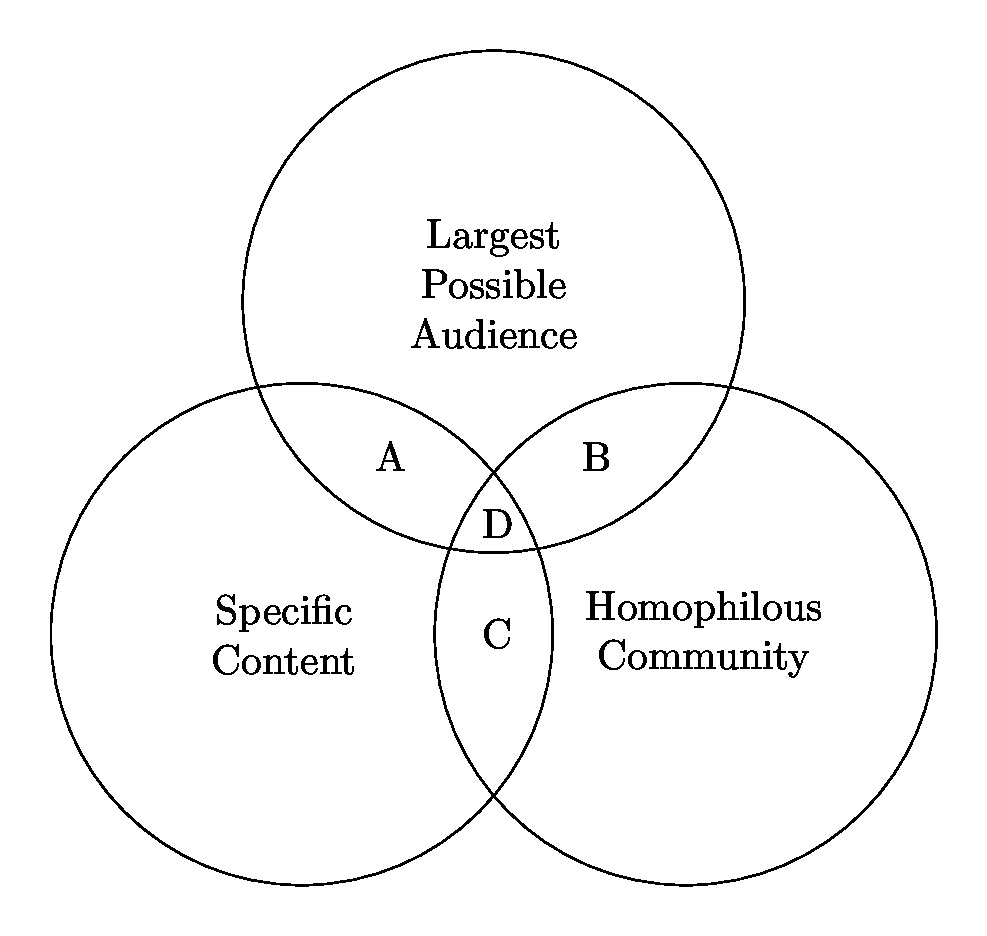
We found that the answer to the puzzle lay in the fact that the people we talked to were looking for three distinct things from the communities they worked in:
The ability to connect to specific information and narrowly scoped discussions.
The ability to socialize with people who are similar to themselves.
Attention from the largest possible audience.
Critically, we also found that these three things represented a “trilemma,” and that no single community can meet all three needs. You might find two of the three in a single community, but you could never have all three.
Figure from “No Community Can Do Everything: Why People Participate in Similar Online Communities” depicts three key benefits that people seek from online communities and how individual communities tend not to optimally provide all three. For example, large communities tend not to afford a tight-knit homophilous community.
The end result is something I recognize in how I engage with online communities on platforms like Reddit. People tend to engage with a portfolio of communities that vary in size, specialization, topical focus, and rules. Compared with any single community, such overlapping systems can provide a wider range of benefits. No community can do everything.
This work was published as a paper at CSCW: TeBlunthuis, Nathan, Charles Kiene, Isabella Brown, Laura (Alia) Levi, Nicole McGinnis, and Benjamin Mako Hill. 2022. “No Community Can Do Everything: Why People Participate in Similar Online Communities.” Proceedings of the ACM on Human-Computer Interaction 6 (CSCW1): 61:1-61:25. https://doi.org/10.1145/3512908.
This work was supported by the National Science Foundation (awards IIS-1908850, IIS-1910202, and GRFP-2016220885). A full list of acknowledgements is in the paper.
Often, several different online communities exist where similar people talk about similar things. This is really easy to observe from browsing platforms like Reddit or Facebook groups.
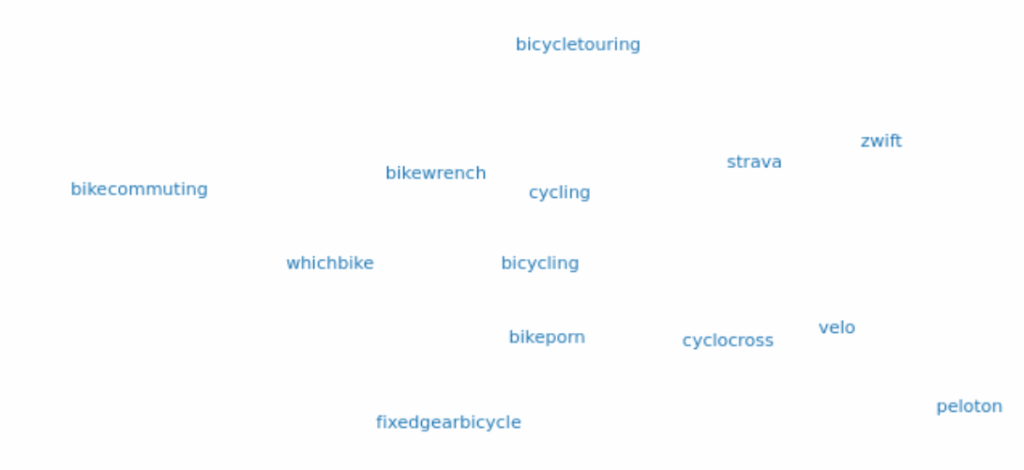
Names of bicycle-related subreddits in cluster of subreddits with many overlapping users.
For example, as we can see from this visualization of clustered subreddits with overlapping users, there are many different subreddits related to cycling. We see some communities have different emphases in complementary ways like “fixedgearbicycle” and “bicycletouring” — these are different types of cycling. But why have a community for “cycling” and a different one for “bicycling”? A number of puzzles appear when we reflect on the existence of such related communities.
How do online communities relate to each other?
Why not have one large community that does everything?
How do people construct these systems of related online communities?
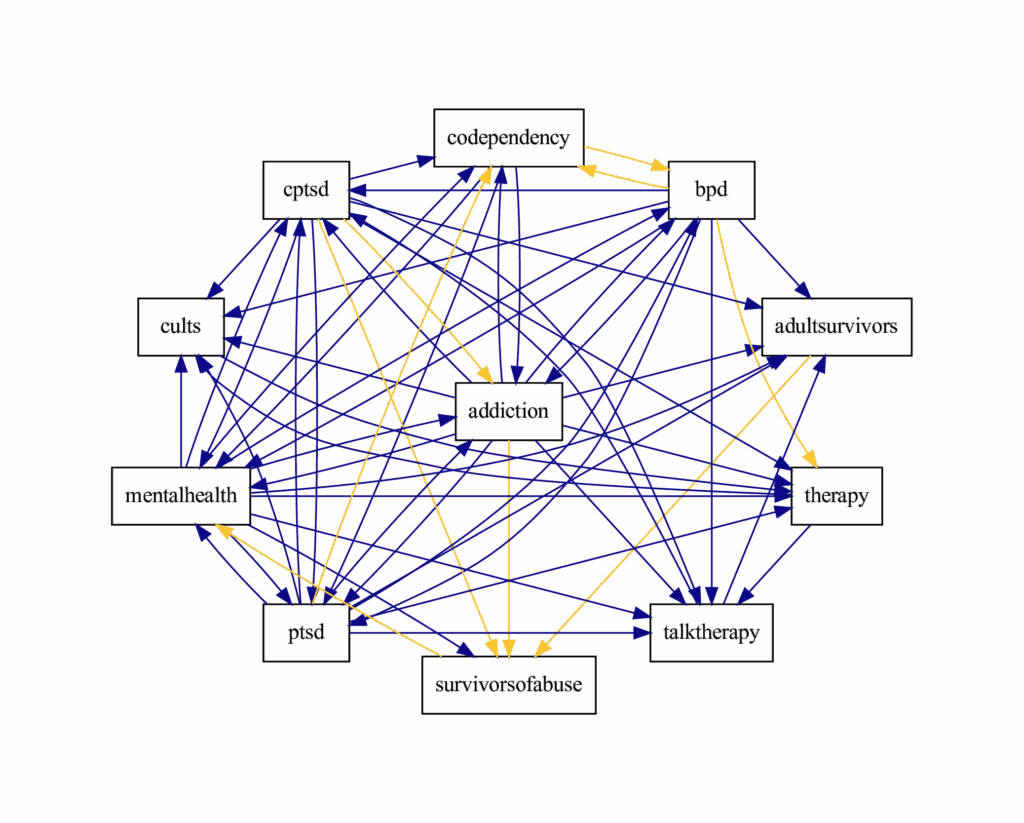
I investigated these questions in my dissertation using the theoretical lens of organizational ecology drawn from organizational sociology. This new paper explored some findings from earlier projects in more depth. The paper I published in ICWSM 2022 (pdf), takes up the question of ecological relationships among online communities. I used time series models to infer networks of competition and mutualism between overlapping online communities. This work found evidence that they tended to be mutualistic. For example, the diagram below shows a network of mental health subreddits that is dense with mutualism.
Ecological network of a cluster of mental subreddits. Blue arrows indicate mutualism and yellow arrows indicate competition according to a vector autoregression model.
However, this method, based on vector autoregression (VAR) models of activity, assumes that these relationships are static and constant over time. But dynamics of attention online are often bursty, and online communities grow, decline, and change over time in other ways. So, in this new work, I adopted nonlinear models called (regularized) S-map that can model more complex dynamics.
Since I found in the previous work that mutualism tended to happen more often than competition, I wanted to find out if that result was robust using the S-map. Since the S-map breaks these relationships down into episodes of competition or mutualism it afforded testing a more nuanced hypothesis about this tendency towards mutualism.
H1: Mutualistic interactions will be more frequent and longer lasting than competitive interactions.
In the another empirical paper previously published at CSCW 2022 (acm dl), we focused on the question of why people build overlapping online communities and found that they complementary sets of benefits to members, as illustrated below. Trade-offs between the benefits lead to specialized roles for different types of communities.
Figure from “No Community Can Do Everything: Why People Participate in Similar Online Communities” depicts three key benefits that people seek from online communities and how individual communities tend not to optimally provide all three. For example, large communities tend not to afford tight-knit homophilous community.
This reflects propositions from ecology that specialization can be a strategy to avoid competition. The new study seeks to provide more generalizable quantitative evidence about how online communities find their specialized niches. Ecology theory suggests that online communities, similar to organizations or organisms, might adapt to increase specialization and thereby promote more mutualistic relationships. To investigate whether people build specialized online communities through such an adaptive feedback process, I set out to test the following two hypotheses:
H2: Two communities having greater competition (mutualism) will subsequently have greater decreases (increases) in overlap.
H3: Two subreddits having decreasing (increasing) overlap will subsequently have greater mutualism (competition).
Methods and measures
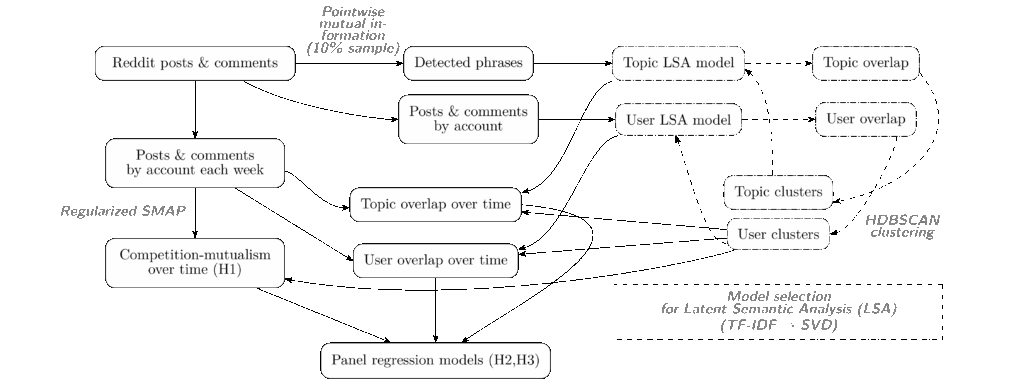
To test these three hypotheses, I had to measure competition/mutualism, and overlap within clusters of related subreddits over time. I made topic- and user-overlap measures based on a community embedding via the LSA algorithm. To create the clusters I reused the approach from the earlier paper by using the HDBSCAN algorithm based on user overlap. As mentioned above I used the Regularized S-MAP algorithm to create a dynamic measure of ecological influence. With these longitudinal measures in hand I could test the hypotheses using two-way fixed-effects panel data estimators with dyad-robust standard errors. That’s a brief and dense summary of the methods. The chart below might help you make sense of it, but if you care to fully understand you’ll want to check out the full paper.
This flowchart illustrates the dataset and measures in the study. On the left-hand side, nonline “Regularized S-Map models” are fit to time series of posts and comments in clusters of subreddits with high user-overlap to test hypothesis 1. In the middle, competition and mutualism from the S-Map models are used with longitidunal measures of topic and user overlap based on community embeddings in panel regression models to test hypotheses 2 and 3. Model selection is on the right-hand side.
Here are a few final notes on the data and methods. The data came from the Pushshift Reddit archive of submissions and comments from December 5th 2015 to April 13th 2020. I Started with the 19,533 subreddits that were active during at least 20% of study period weeks, excluding NSFW subreddits. HDBSCAN clustering discovered related 1,919 clusters of 8,806 subreddits having 48,484 relationships measured 17,374,116 times over 758 weeks.
Results
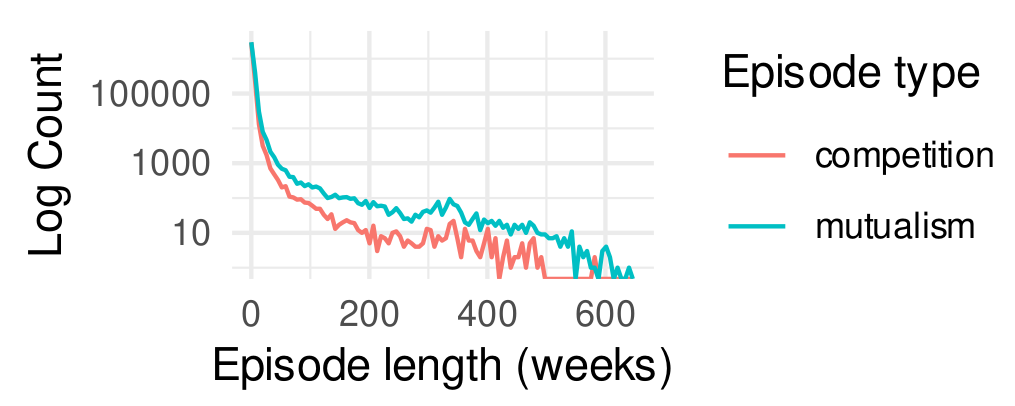
I found support for H1, which predicted that mutualistic interactions will be more frequent and longer lasting than competitive interactions. The plot below shows evidence in favor of the hypothesis. First, we can see clearly that the longest episodes tend to be mutualistic. Notably, these ecological relationships are often bursty and short-lived. The average length of a mutualistic episode was 2.13 weeks and the average length of a competitive episode was just 1.83 weeks.
Frequency plot of the durations of competition and mutualism episodes. Mutualism tends to last longer than competition. The y-axis is log-transformed. The axes truncated to omit outliers for visibility.
I also found support for H2, which predicted that I’d find positive coefficients for previous ecological interaction indicating that competition predicts decreases in overlap. Indeed, the panel regression models found that online communities tend to increase their specialization a bit in relatively competitive conditions, by about 0.02 standard deviations in term or user overlap for every 1-unit increase in competition.
Do increasingly specialized communities tend to decrease their competition as predicted by H3? My analysis didn’t find evidence for this. In fact, according to the panel regression models, after specialization increases, competition actually tends to increase as well.
Discussion
What to take away from all this? I still think the most important finding from this work to me is the robustness of the tendency toward mutualism among online communities. Unlike firms or other organizations that demand relatively exclusive commitments from their members, it is easy to participate in many online communities. Where classical organizations (imagine firms, churches, sports teams, nonprofit, and state organizations) seem likely to compete over employees, customers, or members online communities seem to benefit to some extant from sharing users with each other. I suspect this has to do with the ease with which nonrival content, ideas, and knowledge move between communities.
A second important takeaway from this work is that I think the evidence it finds for the adaptation explanation for the tendency toward mutualism isn’t all that convincing. Sure, communities in competition tend to become more specialized, but the effect size is pretty small and the fact that specialization doesn’t reduce competition suggests that it isn’t truly adaptive in the strongest sense. Put another way, specialized online communities might be made via an adaptive process, or they might be born out of the intentions and designs of their founders and early joiners. This work finds a bit of evidence for how specialization might be made, but the born process merits more investigation.
One clue about the significance of design for specialization comes from fellow CDSC-er Jeremy Foote‘s a nice CHI paper (acm dl) last year on how the early stages of a subreddit’s development are important to its trajectory and found that most subreddit creators didn’t set out to create a large community. Another study (arxiv.org), by Chenhao Tan on “community genealogy” shows how the growth of new subreddits often seems to depend on having high overlap with a “parent” subreddit. These papers don’t focus on specialization, but it would be cool to see future work take up these ideas.
If you enjoyed reading this summary or want to learn more, please check out the full paper. I got the chance to speculate a bit about what sorts of future technology designs might assist community leaders in crafting online communities to fill ecological roles. I also got to engage with ecological theory in a new way writing this. I hope you read and enjoy.
Finally, I wasn’t able to attend ICWSM in person this year, so I want to thank Kristen Engel for presenting on my behalf. I also want to note that CDSC-er Kaylea Champion and I were both recognized as “best reviewers” at the conference.
This work started as a chapter of my dissertation. Thanks to the committee — Professors Benjamin Mako Hill, Kirsten Foot, Aaron Shaw, David McDonald and Emma Spiro.
I also gratefully acknowledge support by NSF grants IIS-1908850 and IIS-1910202 and GRFP \#2016220885. This work was facilitated through the use of the advanced computational infrastructure provided by the Hyak supercomputer system at the University of Washington and TACC at the University of Texas.
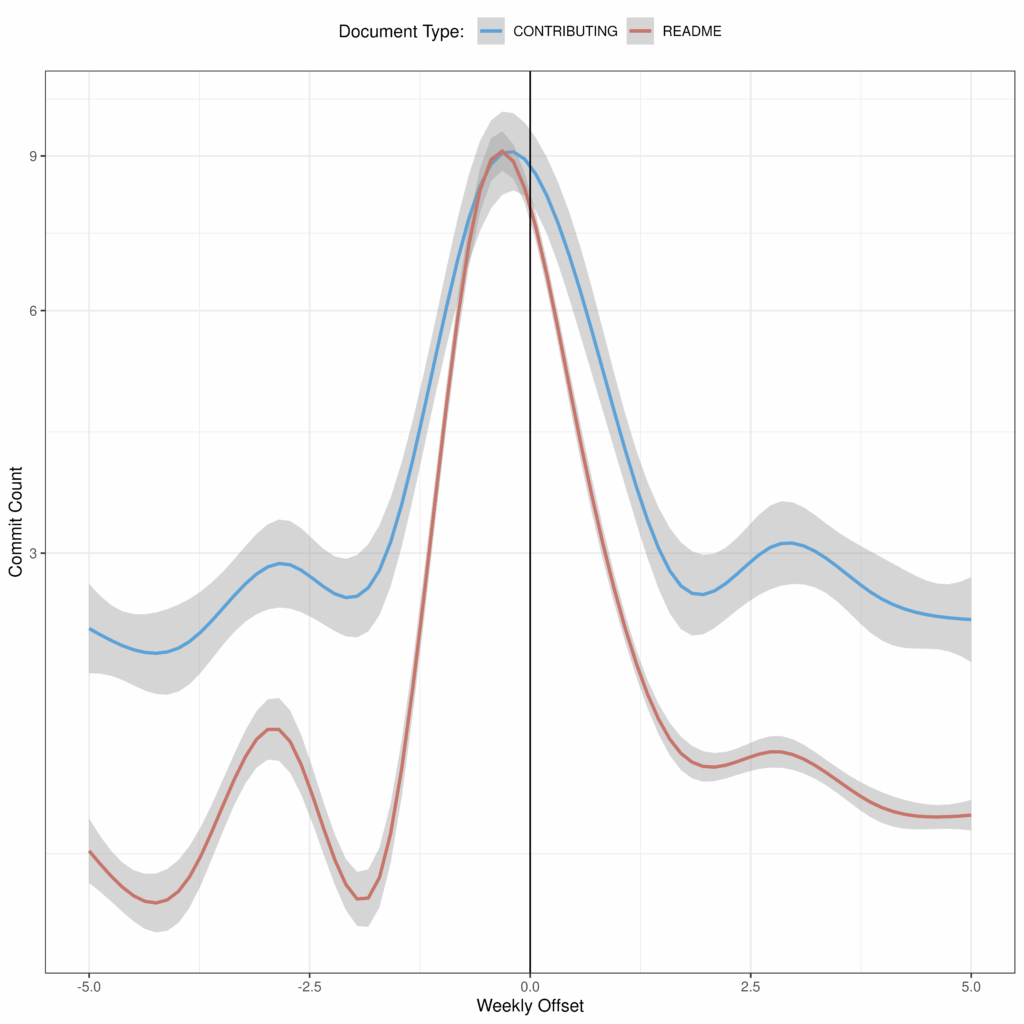
Community decay and abandonment are persistent risks to free/libre and open source software (FLOSS) projects. As such, large institutions such as GitHub or Mozilla offer advice to FLOSS projects on how to organize their work for sustainability and community-building. Guides recommend the production of README files and CONTRIBUTING guides as useful tools in recruiting new project contributors and driving activity. Yet though the development of these documents is widely-suggested, there is little empirical study of how projects use these files and what happens when documents are introduced to projects.
Plot of average (log-transformed) weekly contribution counts over time around the point of document introduction (weeks offset from document publication date) for README (red) and CONTRIBUTING (blue) files. The Y-axis has been scaled to real count values.
In one of the first empirical studies of the initial publication of documentation files, our findings suggest a disconnect between institutional recommendations and FLOSS projects’ actual use the documents. Instead of being proactively developed and community-oriented, first-version files are published following an increase of activity and focus on the functional details of using or contributing to the library. Often, documents are published with hardly any content at all, with projects publishing empty or minimal files. We found no support for any causal claims around the nature of a document’s depth or focus and subsequent project activity.
Our results suggest that projects may use these documents to perform a norm. The publication of empty documentation files implies that an empty file in their home directory was more important to projects than any benefits of document contents. Our results also suggest that projects may use these documents to ‘get their house in order’ after an influx of activity.
The guides and recommendations that we examined did not specify when projects should take what actions to grow sustainably. This lack of specificity limits the utility for projects trying to figure out how to sustain themselves in ever-changing environments. The work necessary to develop meticulous, community-oriented files may not be a good time investment for early-stage projects with only a handful of contributors. More research is necessary to develop useful context-situated recommendations to support FLOSS projects adaptation.
This paper was presented a few weeks ago in Ottawa at the International Conference on Cooperative and Human Aspects of Software Engineering (CHASE) 2025. A pre-print of the paper can be found here; the data and code for the project can be found here.
This research wouldn’t be possible without the work of the volunteers producing FLOSS who have made their work available for inspection. We also gratefully acknowledge support from the Ford/Sloan Digital Infrastructure Initiative (Sloan Award 2018-113560) and the National Science Foundation (Grant IIS-2045055). This work was conducted using the Hyak supercomputer at the University of Washington as well as research computing resources at Northwestern University.
If you are attending the ACM conference on Computer-supported Cooperative Work and Social Computing (CSCW) this year CSCW in San José, Costa Rica. You are warmly invited to join CDSC members during our talks and other scheduled events. Please come say hi!
This CDSC has four papers at CSCW, which we will be presenting over the next three days:
Monday: At 11:00 am in Talamanca, Kaylea Champion will be presenting “Life Histories of Taboo Knowledge Artifacts” (full paper)
Tuesday: At 11:00 am in Central 3, Zarine Kharazian will be presenting “Governance Capture in a Self-Governing Community: A Qualitative Comparison of the Croatian, Serbian, Bosnian, and Serbo-Croatian Wikipedias” (full paper, blog post), followed by Sohyeon Hwang presenting “Adopting third-party bots for managing online communities” (full paper, blog post)
Wednesday: At 2:30 pm in Guanacaste 3, Kaylea Champion will be co-presenting “Challenges in Restructuring Community-based Moderation” (full paper, preprint)
If you’re at CSCW, feel free to get in touch in person or via Discord!
A screenshot of the configuration panel for Moderator functions of a popular end-user bot called Dyno, adopted by millions of communities on Discord.
Bots made by end users are crucial to the success of online communities, helping community leaders moderate content as well as manage membership and engagement. But most folks don’t have the resources to develop custom bots and turn to existing bots shared by their peers. For example, on Discord, some especially popular bots are adopted by millions of communities. However, because these bots are ultimately third-party tools — made by neither the platform nor the community leader in question — they still come with several challenges. In particular, community leaders need to develop the right understandings about a bot’s nature, value, and use in order to adopt it into their community’s existing processes and culture.
In organizational research, these “understandings” are sometimes described as technological frames, a concept developed by Orlikowski & Gash (1994) as they studied why technologies became used in unexpected ways in organizational settings. When your technological frames are well-aligned with a tool’s design, you can imagine that it is easier to assess whether that tool will be useful and can be smoothly incorporated into your organization as intended. In the context of online communities, well-aligned frames can not only reduce the labor and time of bot adoption, but also help community leaders anticipate issues that might cause harm to the community. Our new paper looks to communities on Discord and asks: How do community leaders shift their technology frames of third-party bots and leverage them to address community needs?
Emergent social ecosystems around bot adoption
Our study interviewed 16 community leaders on Discord, walking through their experiences adopting third-party bots for their communities. These interviews underscore how community leaders have developed social ecosystems around bots: organicuser-to-user networks of resources, aid, and knowledge about bots across communities.
Despite the decentralized arrangement of communities on Discord, users devised and took advantage of formal and informal opportunities to revise their understandings about bots, both supporting and constraining how bots became used. This was particularly important because third-party bots pose heightened uncertainties about their reliability and security, especially for bots used to protect the community from external threads (such as scammers). For example, interviewees laid out concerns about whether a bot developer could be trusted to keep their bot online, to respond to problems users had, and to manage sensitive information. The emergent social ecosystems helped users get recommendations from others, assess the reputation of bot developers, and consider whether the bot was a good fit for them along much more nuanced dimensions (in the case of one interviewee, the values of the bot developer mattered as well). They also created opportunities for people to directly get help in setting up bots and troubleshooting them, such as via engaged discussions with other users who had more experience.
Our findings underscore a couple of core reasons why we should care about these social ecosystems:
Closing gaps in bot-related skills and knowledge. Across interviews, we saw patterns of people leveraging the resources and aid in social ecosystems to move towards using more powerful but complex bots. Ultimately, people with diverse technical backgrounds (including those who stated they had no technical background) were able to adopt and use bots — even bots involving code-like configurations in markdown languages that might normally pose barriers. We suggest that the diffusion of end-user tools on social platforms be matched with efforts to provide bottom-up social scaffoldings that support exploration, learning, and user discussion of those tools.
Changing perceptions of the labor involved in bot adoption. The process of bot adoption as a deeply social one appeared to impact how people saw the labor they invested into it, shifting it into something fun and satisfying. Bot adoption was both collaborative, involving many individuals as a user discovered, evaluated, set up, and fine-tuned bots; and communal, with community members themselves taking part in some of these steps. We suggest that bot adoption can provide one avenue to deepen community engagement by creating new ways of participating and generating meta discussions about the community, as well as the platform.
Shaping the assumptions around third-party tools. Social ecosystems enabled people to cherry-pick functions across bots, enabling creative wiggle room in curating a set of preferred functions. At the same time, people were constrained by social signals about what bots are and can do, why certain bots are worth adopting, and how the bot is used. For example, people often talked about genres of bots even though no such formal categories existed. We suggest that spaces where leaders from different communities interact with one another to discuss strategies and experiences can be impactful settings for further research, intervention, and design ideas.
Ultimately, the social nature of adopting third-party bots in our interviews offers insight into how we can better support the adoption of valuable user-facing tools across online communities. As online harms become more and more technically sophisticated (e.g., the recent rise of AI-generated disinformation), user-made bots that quickly respond to emerging issues will play an important role in managing communities — and will be even more valuable if they can be shared across communities. Further attention to the dynamics that enable tools to be used across communities with diverse norms and goals will be important as the risks that communities face, and the tools available to them, evolve.
Engage with us!
If you have thoughts, ideas, questions, we are always happy to talk – especially if you think there are community-facing resources we can develop from this work. There are a few ways to engage with us:
Hundreds of new subreddits are created every day, but most of them go nowhere, and never receive more than a few posts or comments. On the other hand, some become wildly popular. If we want to figure out what helps some things to get attention, then looking at new and small online communities is a great place to start. Indeed, the whole focus of my dissertation was trying to understand who started new communities, and why. So, I was super excited when Sanjay Kairam at Reddit told me that Reddit was interested in studying founders of new subreddits!
The research that Sanjay and I (but mostly Sanjay!) did was accepted at CHI 2024, a leading conference for human-computer interaction research. The goal of the research is to understand 1) founders’ motivations for starting new subreddits, 2) founders’ goals for their communities, 3) founders’ plans for making their community successful, and 4) how all of these relate to what happens to a community in the first month of its existence. To figure this out, we surveyed nearly 1,000 redditors one week after they created a new subreddit.
Lots of Motivations and Goals
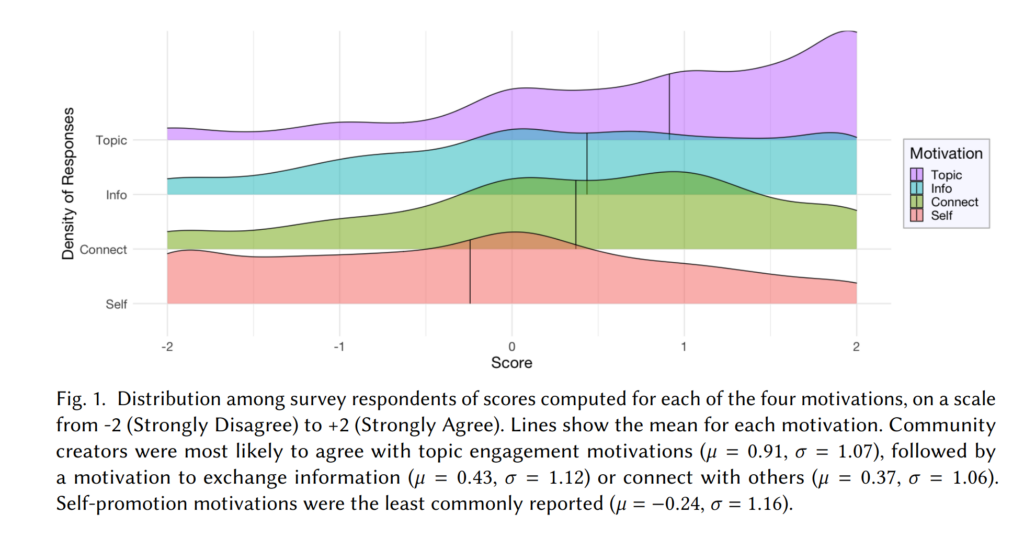
So, what did we learn? First, that founders have diverse motivations, but the most common is interest in the topic. As shown in the figure above, most founders reported being motivated by topic engagement, information exchange, and connecting with others, while self-promotion was much more rare.
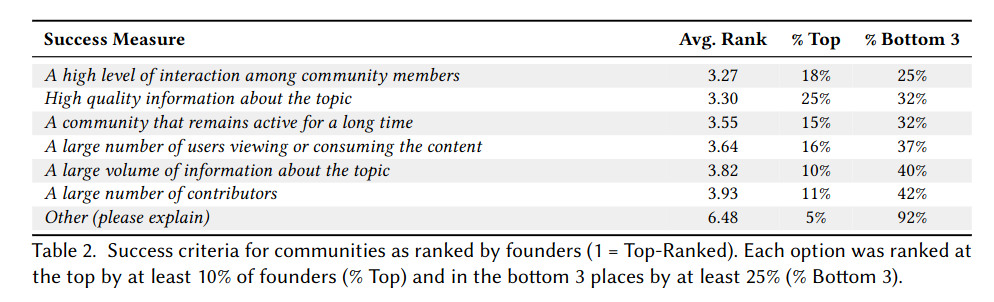
When we asked about their goals for the community, founders were split, and each of the options we gave was ranked as a top goal by a good chunk of participants. While there is some nuance between the different versions of success, we grouped them into “quantity-oriented” and “quality-oriented”, and looked at how motivations related to goals. Somewhat unsurprisingly, folks interested in self-promotion had quantity-oriented goals, while those interested in exchanging information were more focused on quality.
Diversity in plans
We then asked founders about what plans they had for building their community, based on recommendations from the online community literature, such as raising awareness, welcoming newcomers, encouraging contributions, and regulating bad behavior. Surprisingly, for each activity, about half of people said they planned to engage in doing that thing.
Early Community Outcomes
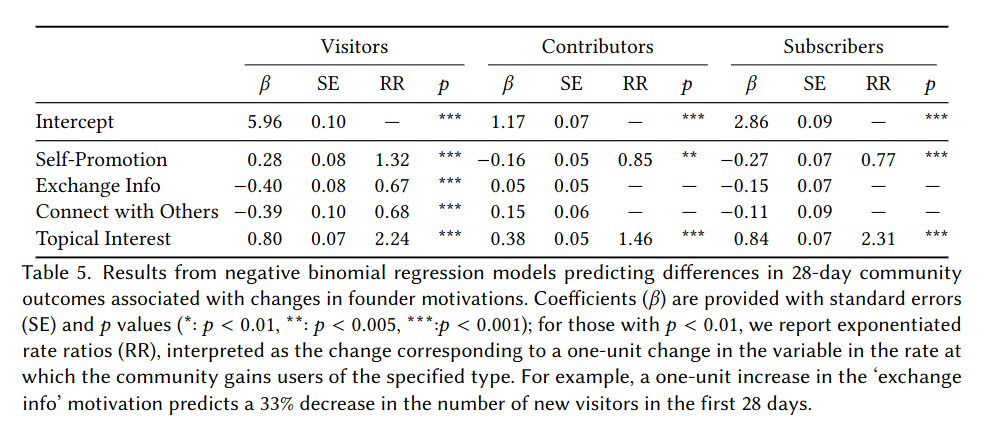
So, how do these motivations, goals, and plans relate to community outcomes? We looked at the first 28 days of each founded subreddit, and counted the number of visitors, number of contributors, and number of subscribers. We then ran regression analyses analyzing how well each aspect of motivations, goals, and plans predicted each outcome. High-level results and regression tables are shown below. For each row, when β is positive, that means that the given feature has a positive relationship with the given outcome. The exponentiated rate ratio (RR) column provides a point estimate of the effect size. For example, Self-Promotion has an RR of 1.32, meaning that if a given person’s self-promotion motivation was one unit higher the model predicts that their community would receive 32% more visitors.
A number of motivations predicted each of the outcomes we measured. The only consistently positive predictor was topical interest. Those who started a community because of interest in a topic had more visitors, more contributors, and more subscribers than others. Interestingly, those motivated by self-promotion had more visitors, but fewer contributors and subscribers.
Goals had a less pronounced relationship with outcomes. Those with quality-oriented goals had more contributors but fewer visitors than those with quantity-oriented goals. There was no significant difference in subscribers for founders with different types of goals.
Finally, raising awareness was the strategy most associated with our success metrics, predicting all three of them. Surprisingly, encouraging contributions was associated with more contributors, but fewer visitors. While we don’t know the mechanism for sure, asking for contributions seems to provide a barrier that discourages newcomers from taking interest in a community.
So what?
We think that there are some key takeaways for platform designers and those starting new communities. Sanjay outlined many of them on the Reddit engineering blog, but I’ll recap a few.
First, topical knowledge and passion is important. This isn’t a causal study, so we don’t know the mechanisms for sure, but people who are passionate about a topic may be aware of other communities in the space and are able to find the right niche; they are also probably better at writing the kinds of welcome messages, initial posts, etc. that appeal to people interested in the topic.
Second, our work is yet more evidence that communities require different things at different points in their lifecycle. Founders should probably focus on building awareness at first, and worry less about encouraging contributions or regulating behavior.
Finally, we think there are a lot of opportunities for designers to take diverse motivations and goals seriously. This could include matching people by their motivations for using a community, developing dashboards that capture different aspects of success and community health and quality, etc.
Learn More
If you want to learn more about the paper, you have options!
If you’re at CHI, come to the talk. It will be at 9:45 in room 319 on Tuesday, May 14