Why do people start new online communities and projects?

Online communities have become ubiquitous, providing not only entertainment but wielding increasing cultural and political influence. While news organizations and researchers have focused a lot of attention on online communities after they become influential, very little is known about how or why they get started. Our survey of hundreds of Wikia.com founders shows that typical online communities are actually very different from the communities that are “in the news”. Online community founders have diverse motivations, but typically have modest goals which are focused on filling their own needs, and they don’t necessarily care if their projects ever get very big. Our research suggests that rather than being failures, small online communities are both intentional and common.

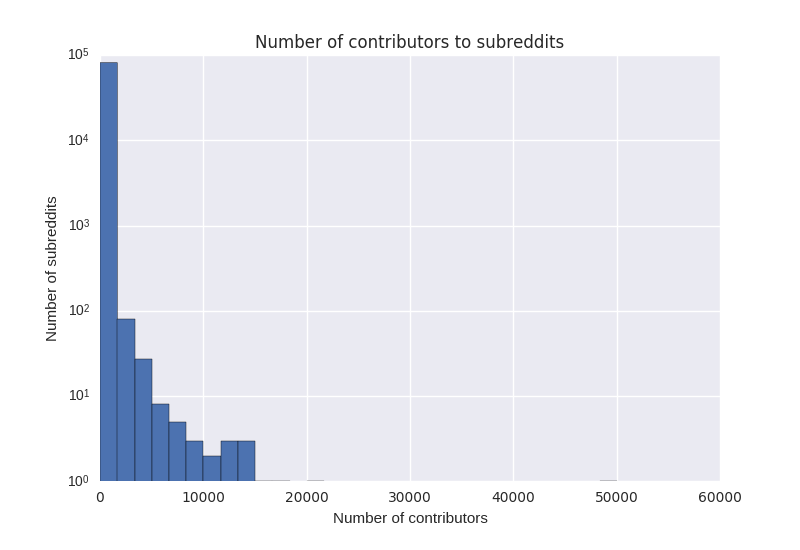
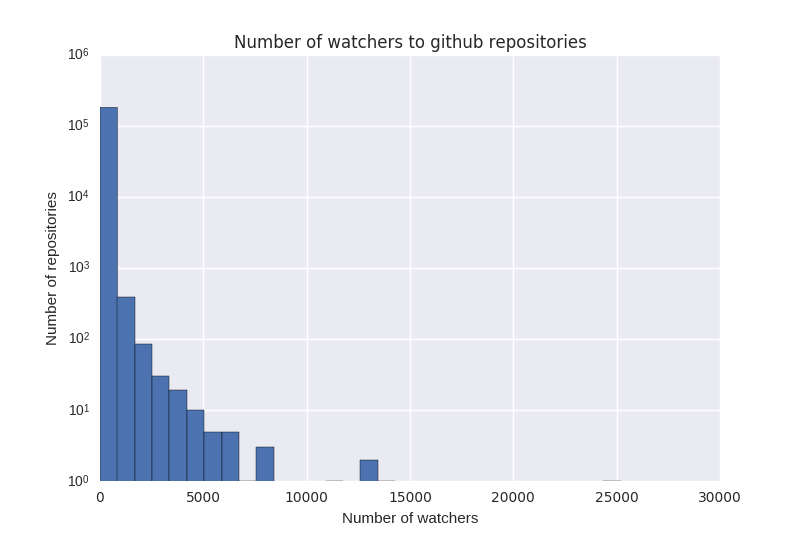
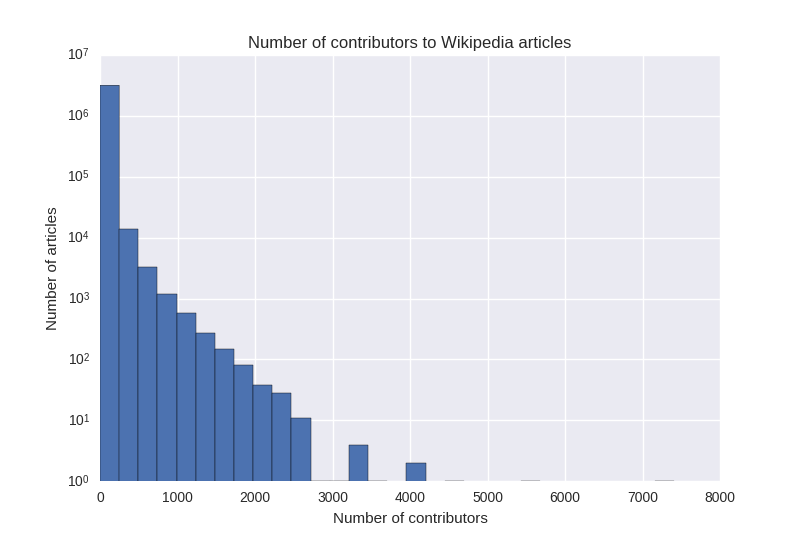
Most online communities are small —Our research is inspired by the skewed distribution of attention online. For example, these three graphs show the number of contributors to each subreddit, github project, and Wikipedia page. (Note the log scale – the reality is even more skewed than these plots make it appear).

Reddit graph


Github graph

Wikipedia graphIn every case, there is a “long tail” of projects with very few contributions or attention, while the most popular projects get the lion’s share. It is perhaps unsurprising, then, that they also garner the majority of scholarly attention. However, what these graphs also show is that most online communities are very small.

Even when scholars include smaller communities in their analysis, they typically treat longevity and size as measures of success. Using this metric, the vast majority of new projects fail. So why do people start new online communities? Are they simply naive, not realizing that large-scale success is so rare? Are community founders trying to win the attention lottery?

Our Survey —We worked with some great folks at Wikia to send a survey to community founders right after they started their community. We received partial or full responses from hundreds of founders.

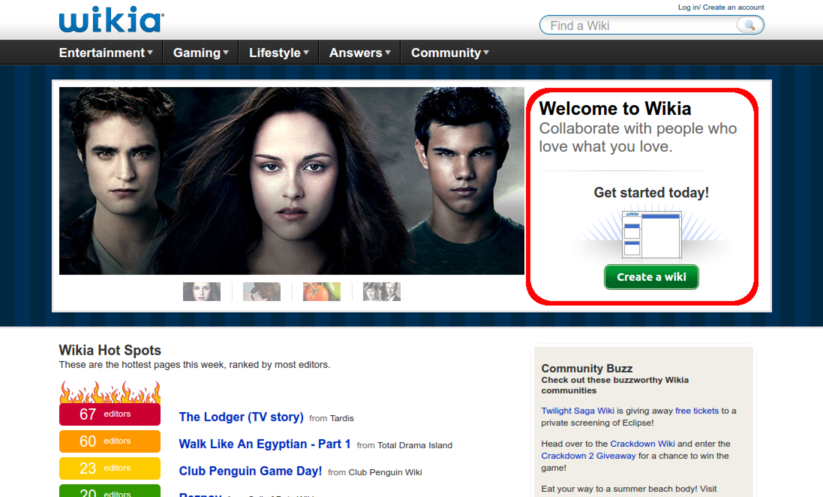
Wikia homepage
Wikia homepage as it appeared during our data collection (via archive.org) with the invitation to found a new wiki highlighted. Twilight was really big in 2010.


In addition to demographic information, we asked a set of thirteen questions about the motivations of founders, based on the contributor motivation literature, and seven questions about their goals for their community. We also asked founders about their plans for their community, and whether they were planning to follow some of the best practices for building and running online communities.

Founders have diverse motivations and modest goals — We found that Wikia founders have diverse motivations. We used PCA to identify four main motivations for creating new wikis: spreading information and building a community, problems with existing wikis, for fun or learning, and creating and publicizing personal content. Spreading information and building a community was the most common motivation, but each of these was marked as a primary motivation by multiple respondents.

We also found that the barriers to starting a new community – both technological and cognitive – are very low. Only 32% of founders reported planning on starting their wiki for a few weeks or longer, while fully 46% of founders had only planned it for a few hours or a few minutes.

As with motivations, founders had diverse goals. The most common top goal was the creation of high-quality information, with nearly half of respondents selecting it. Community longevity/activity and growth were also common goals.

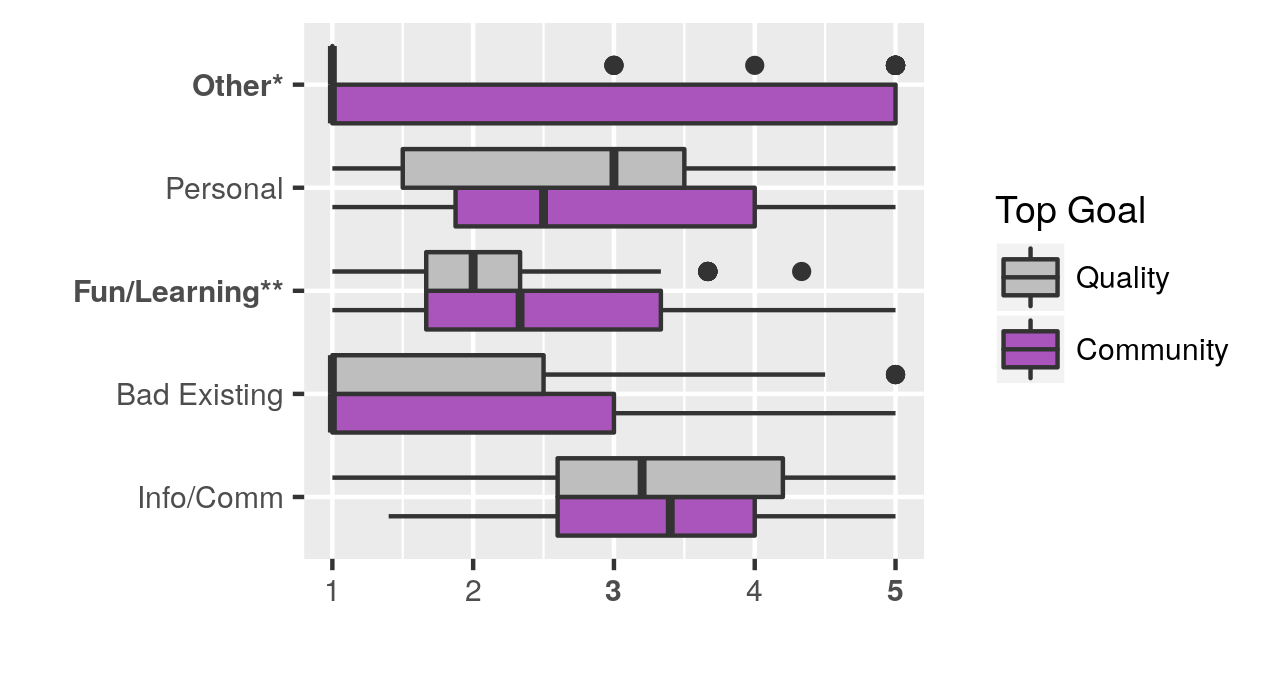
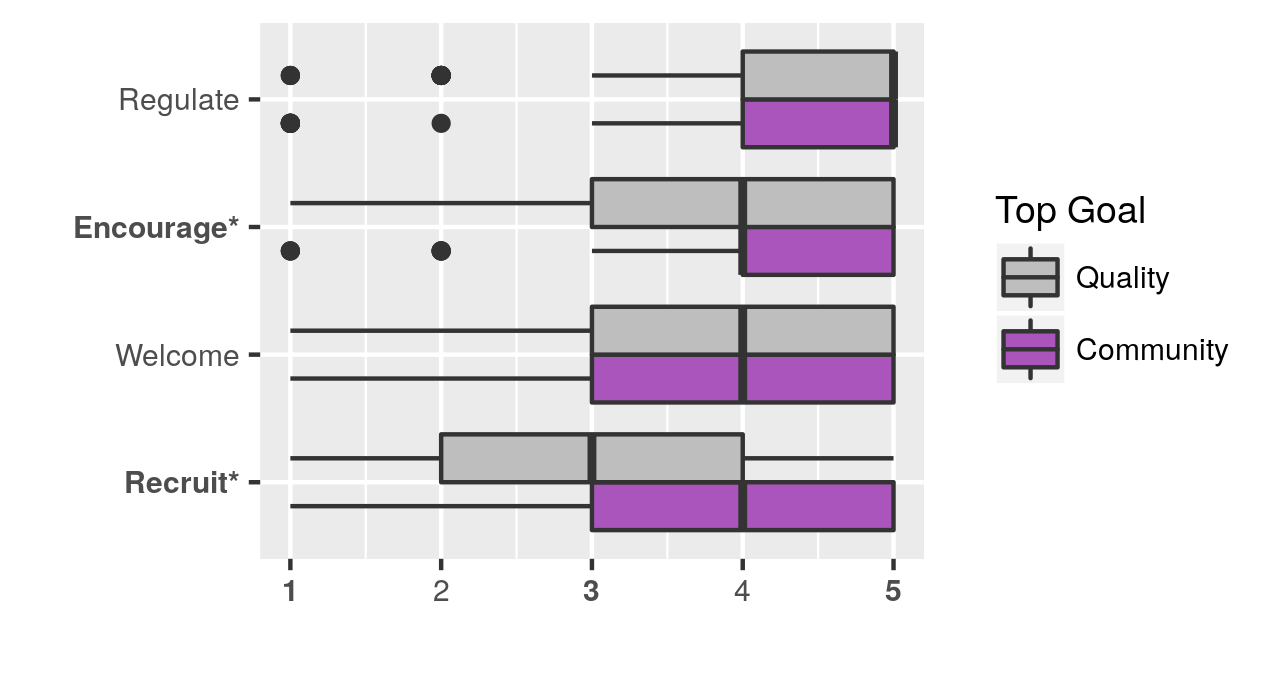
Finally, we looked at whether there was a relationship between motivations and goals, and between goals and plans for community building. We found that those whose top goal was information quality were less likely to be motivated by fun and learning, and that they were less likely to plan on recruiting contributors or encouraging contributions. In future research, we are looking at how a founder’s goals and plans relate to membership and contribution growth.

Motivations by goals
Plans by goals
Distribution of founder motivations and plans, based on whether their top goal is community or information quality.

So what? —We believe that platform designers and researchers should focus more of their resources on understanding small and short-lived communities. Our research suggests that the attention paid to the more popular and long-lived online communities has perpetuated a false assumption that all communities seek to become large and powerful. Indeed, our respondents are typically not seeking or even hoping for large-scale “success”.

In addition, we believe that in many contexts, understanding online communities can be augmented by focusing on founders. Platform designers can study founders to understand how users would like to use a system and researchers can do more to understand the differences between founders and other contributors.

There is also a need to generalize this research – founders on other online platforms (Reddit, github, etc.) may have a different set of motivations and goals (although we suspect that they will be similarly modest in their ambitions). Overall, there is lots of room for additional research on how and why things get started online.

The paper and data — If you liked this blog post, then you’ll love the full paper: Starting online communities: Motivations and goals of wiki founders. Even better, if you are planning to be at CHI 2017, come watch the talk!

This post (and the paper) were written by Jeremy Foote, Aaron Shaw and Darren Gergle. The charts at the beginning of the post were created using data from the great public datasets at Big Query. Anonymized results of the survey are publicly available, and code is coming.


New Dataset: Five Years of Longitudinal Data from Scratch

Scratch is a block-based programming language created by the Lifelong Kindergarten Group (LLK) at the MIT Media Lab. Scratch gives kids the power to use programming to create their own interactive animations and computer games. Since 2007, the online community that allows Scratch programmers to share, remix, and socialize around their projects has drawn more than 16 million users who have shared nearly 20 million projects and more than 100 million comments. It is one of the most popular ways for kids to learn programming and among the larger online communities for kids in general.

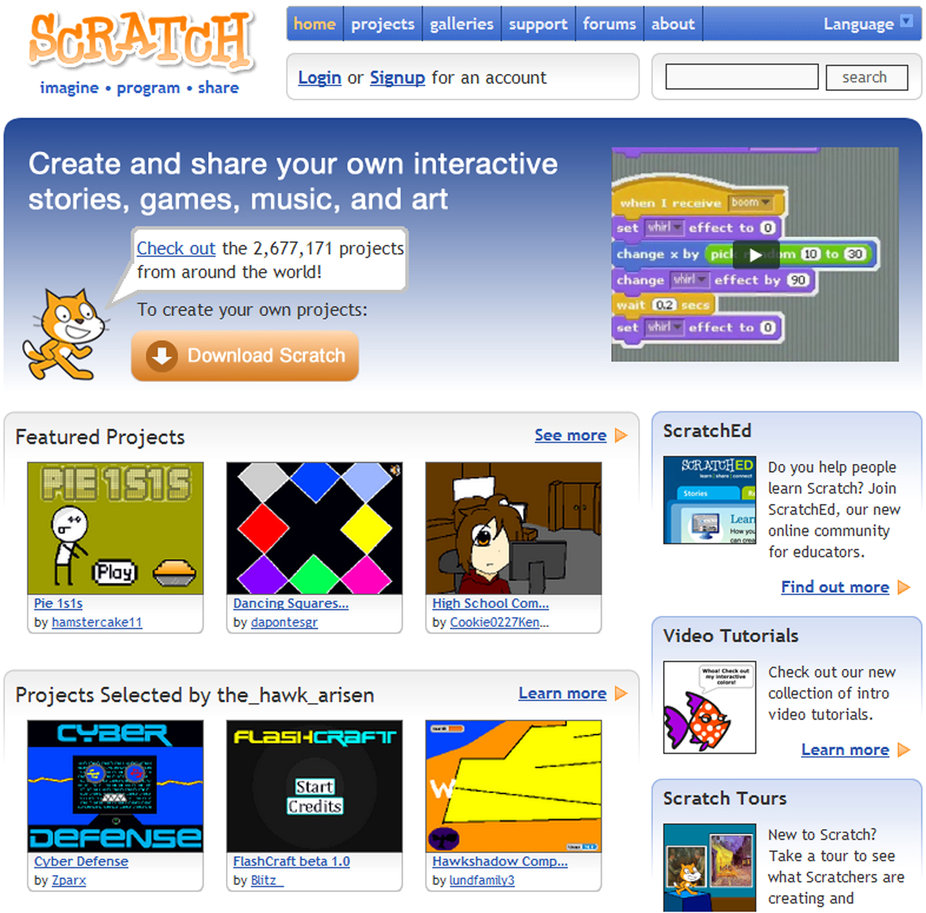
Front page of the Scratch online community (https://scratch.mit.edu) during the period covered by the dataset.

Since 2010, I have published a series of papers using quantitative data collected from the database behind the Scratch online community. As the source of data for many of my first quantitative and data scientific papers, it’s not a major exaggeration to say that I have built my academic career on the dataset.

I was able to do this work because I happened to be doing my masters in a research group that shared a physical space (“The Cube”) with LLK and because I was friends with Andrés Monroy-Hernández, who started in my masters cohort at the Media Lab. A year or so after we met, Andrés conceived of the Scratch online community and created the first version for his masters thesis project. Because I was at MIT and because I knew the right people, I was able to get added to the IRB protocols and jump through the hoops necessary to get access to the database.

Over the years, Andrés and I have heard over and over, in conversation and in reviews of our papers, that we were privileged to have access to such a rich dataset. More than three years ago, Andrés and I began trying to figure out how we might broaden this access. Andrés had the idea of taking advantage of the launch of Scratch 2.0 in 2013 to focus on trying to release the first five years of Scratch 1.x online community data (March 2007 through March 2012) — most of the period that the codebase he had written ran the site.

After more work than I have put into any single research paper or project, Andrés and I have published a data descriptor in Nature’s new journal Scientific Data. This means that the data is now accessible to other researchers. The data includes five years of detailed longitudinal data organized in 32 tables with information drawn from more than 1 million Scratch users, nearly 2 million Scratch projects, more than 10 million comments, more than 30 million visits to Scratch projects, and much more. The dataset includes metadata on user behavior as well the full source code for every project. Alongside the data is the source code for all of the software that ran the website and that users used to create the projects as well as the code used to produce the dataset we’ve released.

Releasing the dataset was a complicated process. First, we had navigate important ethical concerns about the the impact that a release of any data might have on Scratch’s users. Toward that end, we worked closely with the Scratch team and the the ethics board at MIT to design a protocol for the release that balanced these risks with the benefit of a release. The most important features of our approach in this regard is that the dataset we’re releasing is limited to only public data. Although the data is public, we understand that computational access to data is different in important ways to access via a browser or API. As a result, we’re requiring anybody interested in the data to tell us who they are and agree to a detailed usage agreement. The Scratch team will vet these applicants. Although we’re worried that this creates a barrier to access, we think this approach strikes a reasonable balance.

Beyond the the social and ethical issues, creating the dataset was an enormous task. Andrés and I spent Sunday afternoons over much of the last three years going column-by-column through the MySQL database that ran Scratch. We looked through the source code and the version control system to figure out how the data was created. We spent an enormous amount of time trying to figure out which columns and rows were public. Most of our work went into creating detailed codebooks and documentation that we hope makes the process of using this data much easier for others (the data descriptor is just a brief overview of what’s available). Serializing some of the larger tables took days of computer time.

In this process, we had a huge amount of help from many others including an enormous amount of time and support from Mitch Resnick, Natalie Rusk, Sayamindu Dasgupta, and Benjamin Berg at MIT as well as from many other on the Scratch Team. We also had an enormous amount of feedback from a group of a couple dozen researchers who tested the release as well as others who helped us work through through the technical, social, and ethical challenges. The National Science Foundation funded both my work on the project and the creation of Scratch itself.

Because access to data has been limited, there has been less research on Scratch than the importance of the system warrants. We hope our work will change this. We can imagine studies using the dataset by scholars in communication, computer science, education, sociology, network science, and beyond. We’re hoping that by opening up this dataset to others, scholars with different interests, different questions, and in different fields can benefit in the way that Andrés and I have. I suspect that there are other careers waiting to be made with this dataset and I’m excited by the prospect of watching those careers develop.

You can find out more about the dataset, and how to apply for access, by reading the data descriptor on Nature’s website.

The paper and work this post describes is collaborative work with Andrés Monroy-Hernández. The paper is released as open access so anyone can read the entire paper here. This blog post was also posted on Benjamin Mako Hill’s blog.

Supporting children in doing data science

As children use digital media to learn and socialize, others are collecting and analyzing data about these activities. In school and at play, these children find that they are the subjects of data science. As believers in the power of data analysis, we believe that this approach falls short of data science’s potential to promote innovation, learning, and power.

Motivated by this fact, we have been working over the last three years as part of a team at the MIT Media Lab and the University of Washington to design and build a system that attempts to support an alternative vision: children as data scientists. The system we have built is described in a new paper—Scratch Community Blocks: Supporting Children as Data Scientists—that will be published in the proceedings of CHI 2017.

Our system is built on top of Scratch, a visual, block-based programming language designed for children and youth. Scratch is also an online community with over 15 million registered members who share their Scratch projects, remix each others’ work, have conversations, provide feedback, bookmark or “love” projects they like, follow other users, and more. Over the last decade, researchers—including us—have used the Scratch online community’s database to study the youth using Scratch. With Scratch Community Blocks, we attempt to put the power to programmatically analyze these data into the hands of the users themselves.

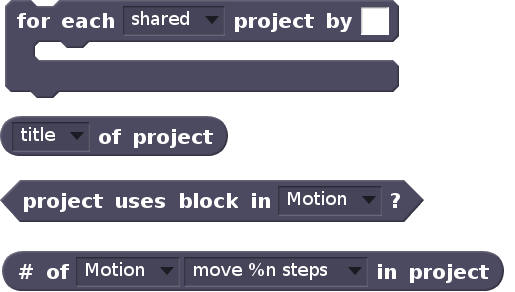
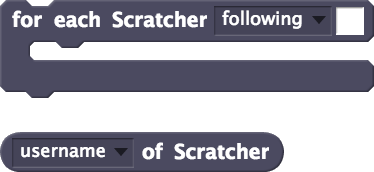
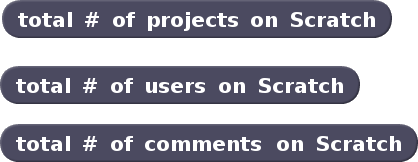
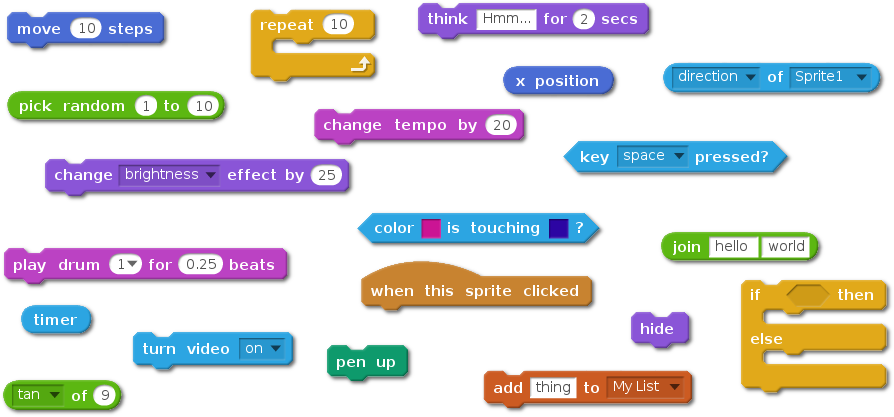
To do so, our new system adds a set of new programming primitives (blocks) to Scratch so that users can access public data from the Scratch website from inside Scratch. Blocks in the new system gives users access to project and user metadata, information about social interaction, and data about what types of code are used in projects. The full palette of blocks to access different categories of data is shown below.

Project metadata
User metadata
Site-wide statistics

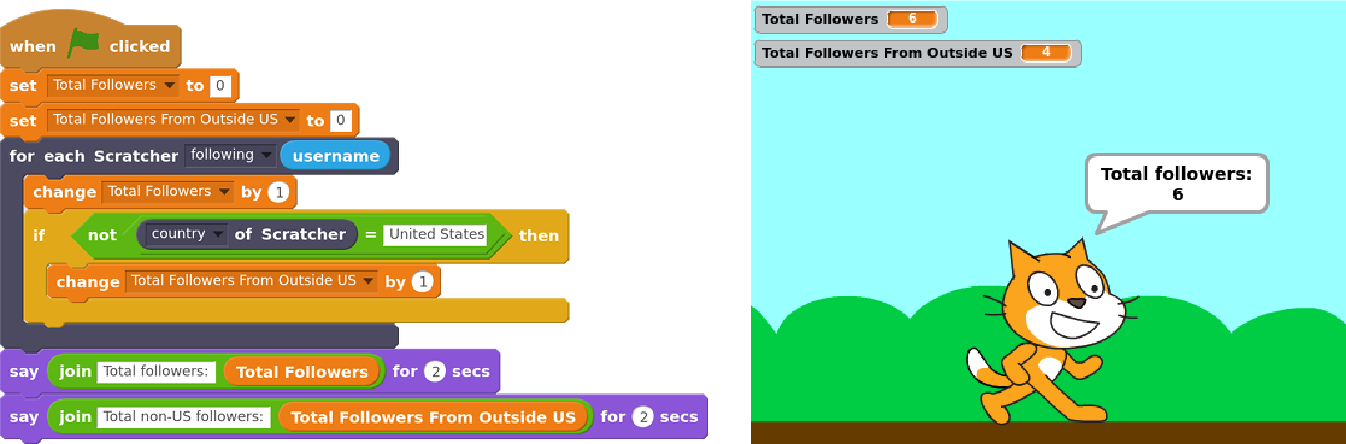
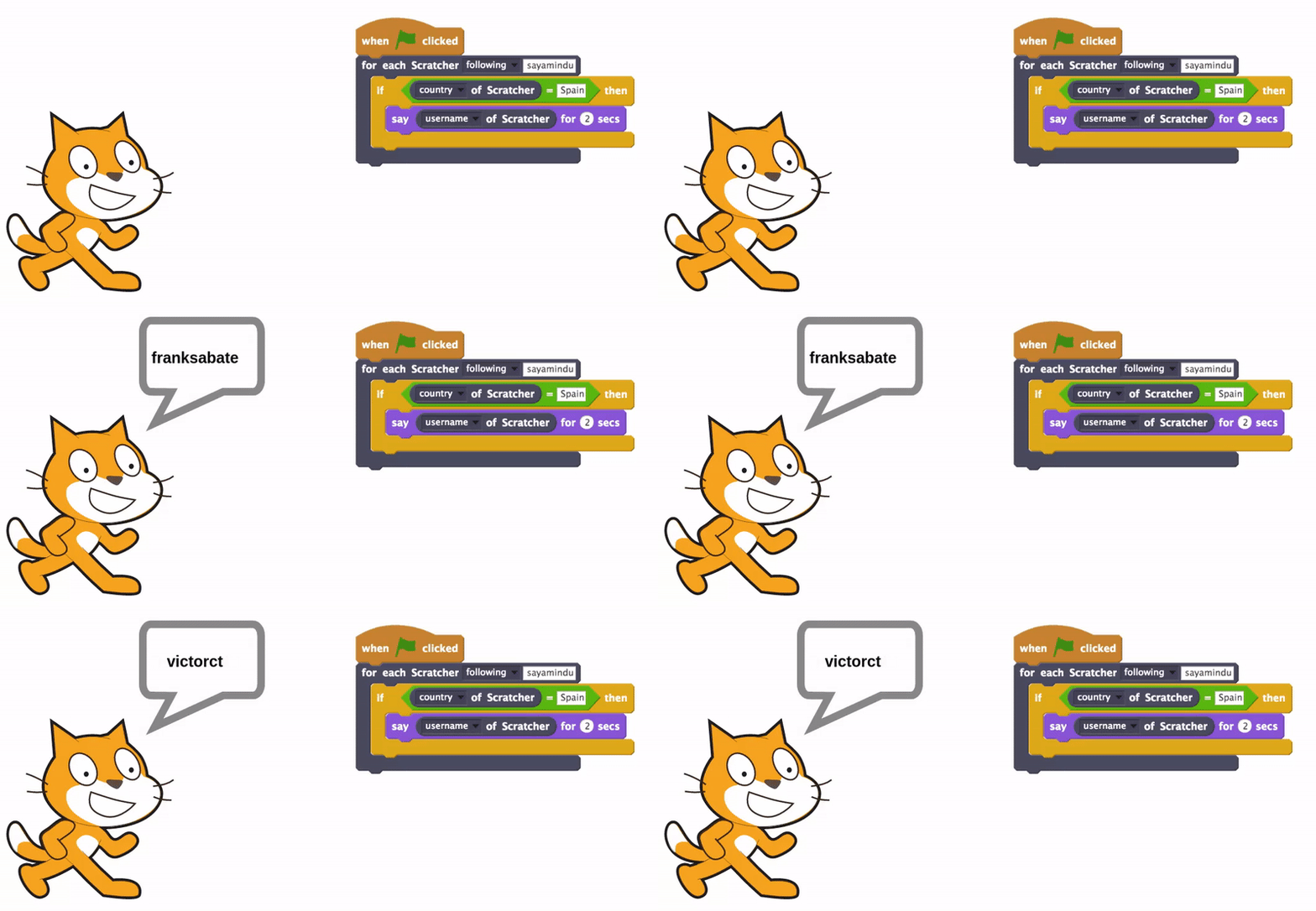
The new blocks allow users to programmatically access, filter, and analyze data about their own participation in the community. For example, with the simple script below, we can find whether we have followers in Scratch who report themselves to be from Spain, and what their usernames are.

Simple demonstration of Scratch Community Blocks

In designing the system, we had two primary motivations. First, we wanted to support avenues through which children can engage in curiosity-driven, creative explorations of public Scratch data. Second, we wanted to foster self-reflection with data. As children looked back upon their own participation and coding activity in Scratch through the project they and their peers made, we wanted them to reflect on their own behavior and learning in ways that shaped their future behavior and promoted exploration.

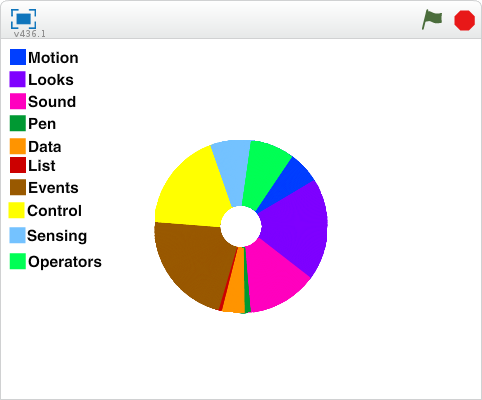
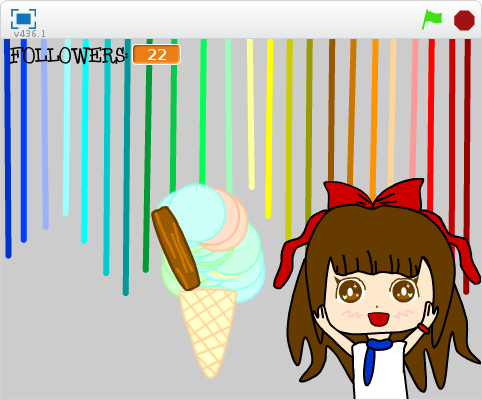
After designing and building the system over 2014 and 2015, we invited a group of active Scratch users to beta test the system in early 2016. Over four months, 700 users created more than 1,600 projects. The diversity and depth of users creativity with the new blocks surprised us. Children created projects that gave the viewer of the project a personalized doughnut-chart visualization of their coding vocabulary on Scratch, rendered the viewer’s number of followers as scoops of ice-cream on a cone, attempted to find whether “love-its” for projects are more common on Scratch than “favorites”, and told users how “talkative” they were by counting the cumulative string-length of project titles and descriptions.

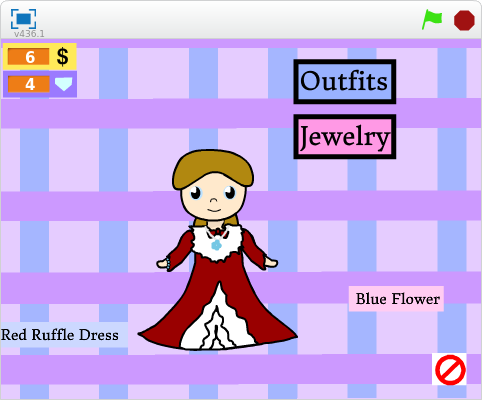
We found that children, rather than making canonical visualizations such as pie-charts or bar-graphs, frequently made information representations that spoke to their own identities and aesthetic sensibilities. A 13-year-old girl had made a virtual doll dress-up game where the player’s ability to buy virtual clothes and accessories for the doll was determined by the level of their activity in the Scratch community. When we asked about her motivation for making such a project, she said:

I was trying to think of something that somebody hadn’t done yet, and I didn’t see that. And also I really like to do art on Scratch and that was a good opportunity to use that and mix the two [art and data] together.

We also found at least some evidence that the system supported self-reflection with data. For example, after seeing a project that showed its viewers a visualization of their past coding vocabulary, a 15-year-old realized that he does not do much programming with the pen-related primitives in Scratch, and wrote in a comment, “epic! looks like we need to use more pen blocks. :D.”

Doughnut visualization
Ice-cream visualization
Data-driven doll dress up

Additionally, we noted that that as children made and interacted with projects made with Scratch Community Blocks, they started to critically think about the implications of data collection and analysis. These conversations are the subject of another paper (also being published in CHI 2017).

In a 1971 article called “Teaching Children to be Mathematicians vs. Teaching About Mathematics”, Seymour Papert argued for the need for children doing mathematics vs. learning about it. He showed how Logo, the programming language he was developing at that time with his colleagues, could offer children a space to use and engage with mathematical ideas in creative and personally motivated ways. This, he argued, enabled children to go beyond knowing about mathematics to “doing” mathematics, as a mathematician would.

Scratch Community Blocks has not yet been launched for all Scratch users and has several important limitations we discuss in the paper. That said, we feel that the projects created by children in our the beta test demonstrate the real potential for children to do data science, and not just know about it, provide data for it, and to have their behavior nudged and shaped by it.

This blog-post and the work that it describes is a collaborative project between Sayamindu Dasgupta and Benjamin Mako Hill. We have also received support and feedback from members of the Scratch team at MIT (especially Mitch Resnick and Natalie Rusk), as well as from Hal Abelson from MIT CSAIL. Financial support came from the US National Science Foundation. We will be presenting this paper at CHI in May, and will be thrilled to talk more about our work and about future directions.
Studying the relationship between remixing & learning

With more than 10 million users, the Scratch online community is the largest online community where kids learn to program. Since it was created, a central goal of the community has been to promote “remixing” — the reworking and recombination of existing creative artifacts. As the video above shows, remixing programming projects in the current web-based version of Scratch is as easy is as clicking on the “see inside” button in a project web-page, and then clicking on the “remix” button in the web-based code editor. Today, close to 30% of projects on Scratch are remixes.

Remixing plays such a central role in Scratch because its designers believed that remixing can play an important role in learning. After all, Scratch was designed first and foremost as a learning community with its roots in the Constructionist framework developed at MIT by Seymour Papert and his colleagues. The design of the Scratch online community was inspired by Papert’s vision of a learning community similar to Brazilian Samba schools (Henry Jenkins writes about his experience of Samba schools in the context of Papert’s vision here), and a comment Marvin Minsky made in 1984:

Adults worry a lot these days. Especially, they worry about how to make other people learn more about computers. They want to make us all “computer-literate.” Literacy means both reading and writing, but most books and courses about computers only tell you about writing programs. Worse, they only tell about commands and instructions and programming-language grammar rules. They hardly ever give examples. But real languages are more than words and grammar rules. There’s also literature – what people use the language for. No one ever learns a language from being told its grammar rules. We always start with stories about things that interest us.

In a new paper — titled “Remixing as a pathway to Computational Thinking” — that was recently published at the ACM Conference on Computer Supported Collaborative Work and Social Computing (CSCW) conference, we used a series of quantitative measures of online behavior to try to uncover evidence that might support the theory that remixing in Scratch is positively associated with learning.

scratchblocks

Of course, because Scratch is an informal environment with no set path for users, no lesson plan, and no quizzes, measuring learning is an open problem. In our study, we built on two different approaches to measure learning in Scratch. The first approach considers the number of distinct types of programming blocks available in Scratch that a user has used over her lifetime in Scratch (there are 120 in total) — something that can be thought of as a block repertoire or vocabulary. This measure has been used to model informal learning in Scratch in an earlier study. Using this approach, we hypothesized that users who remix more will have a faster rate of growth for their code vocabulary.

Controlling for a number of factors (e.g. age of user, the general level of activity) we found evidence of a small, but positive relationship between the number of remixes a user has shared and her block vocabulary as measured by the unique blocks she used in her non-remix projects. Intriguingly, we also found a strong association between the number of downloads by a user and her vocabulary growth. One interpretation is that this learning might also be associated with less active forms of appropriation, like the process of reading source code described by Minksy.

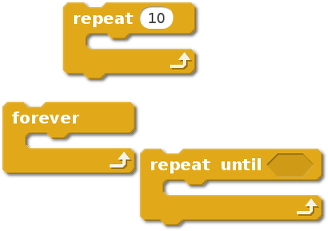
The second approach we used considered specific concepts in programming, such as loops, or event-handling. To measure this, we utilized a mapping of Scratch blocks to key programming concepts found in this paper by Karen Brennan and Mitchel Resnick. For example, in the image below are all the Scratch blocks mapped to the concept of “loop”.

scratchblocksct

We looked at six concepts in total (conditionals, data, events, loops, operators, and parallelism). In each case, we hypothesized that if someone has had never used a given concept before, they would be more likely to use that concept after encountering it while remixing an existing project.

Using this second approach, we found that users who had never used a concept were more likely to do so if they had been exposed to the concept through remixing. Although some concepts were more widely used than others, we found a positive relationship between concept use and exposure through remixing for each of the six concepts. We found that this relationship was true even if we ignored obvious examples of cutting and pasting of blocks of code. In all of these models, we found what we believe is evidence of learning through remixing.

Of course, there are many limitations in this work. What we found are all positive correlations — we do not know if these relationships are causal. Moreover, our measures do not really tell us whether someone has “understood” the usage of a given block or programming concept.However, even with these limitations, we are excited by the results of our work, and we plan to build on what we have. Our next steps include developing and utilizing better measures of learning, as well as looking at other methods of appropriation like viewing the source code of a project.

This blog post and the paper it describes are collaborative work with Sayamindu Dasgupta, Andrés Monroy-Hernández, and William Hale. The paper is released as open access so anyone can read the entire paper here. This blog post was also posted on Benjamin Mako Hill’s blog, on Sayamindu Dasgupta’s blog and on Medium by the MIT Media Lab.

New Paper: Consider the Redirect

This post was originally published on Benjamin Mako Hill‘s blog Copyrighteous.

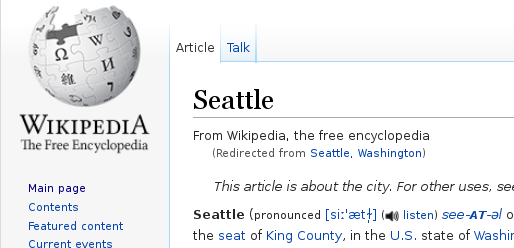
In wikis, redirects are special pages that silently take readers from the page they are visiting to another page. Although their presence is noted in tiny gray text (see the image below) most people use them all the time and never know they exist. Redirects exist to make linking between pages easier, they populate Wikipedia’s search autocomplete list, and are generally helpful in organizing information. In the English Wikipedia, redirects make up more than half of all article pages.

seattle_redirectOver the years, I’ve spent some time contributing to to Redirects for Discussion (RfD). I think of RfD as like an ultra-low stakes version of Articles for Deletion where Wikipedians decide whether to delete or keep articles. If a redirect is deleted, viewers are taken to a search results page and almost nobody notices. That said, because redirects are almost never viewed directly, almost nobody notices if a redirect is kept either!

I’ve told people that if they want to understand the soul of a Wikipedian, they should spend time participating in RfD. When you understand why arguing about and working hard to come to consensus solutions for how Wikipedia should handle individual redirects is an enjoyable way to spend your spare time — where any outcome is invisible — you understand what it means to be a Wikipedian.

That said, wiki researchers rarely take redirects into account. For years, I’ve suspected that accounting for redirects was important for Wikipedia research and that several classes of findings were noisy or misleading because most people haven’t done so. As a result, I worked with my colleague Aaron Shaw at Northwestern earlier this year to build a longitudinal dataset of redirects that can capture the dynamic nature of redirects. Our work was published as a short paper at OpenSym several months ago.

It turns out, taking redirects into account correctly (especially if you are looking at activity over time) is tricky because redirects are stored as normal pages by MediaWiki except that they happen to start with special redirect text. Like other pages, redirects can be updated and changed over time are frequently are. As a result, taking redirects into account for any study that looks at activity over time requires looking at the text of every revision of every page.

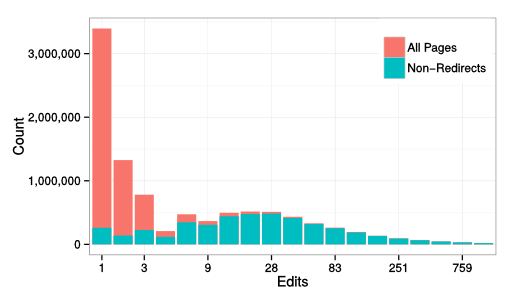
Using our dataset, Aaron and I showed that the distribution of edits across pages in English Wikipedia (a relationships that is used in many research projects) looks pretty close to log normal when we remove redirects and very different when you don’t. After all, half of articles are really just redirects and, and because they are just redirects, these “articles” are almost never edited.

edits_over_pagesAnother puzzling finding that’s been reported in a few places — and that I repeated myself several times — is that edits and views are surprisingly uncorrelated. I’ll write more about this later but the short version is that we found that a big chunk of this can, in fact, be explained by considering redirects.

We’ve published our code and data and the article itself is online because we paid the ACM’s open access fee to ransom the article.


For more details see the paper: Hill, Benjamin Mako, and Aaron Shaw. (2014) “Consider the Redirect: A Missing Dimension of Wikipedia Research.” In Proceedings of the 10th International Symposium on Open Collaboration (OpenSym 2014). ACM Press, 2014.