New Research on How Anonymity is Perceived in Open Collaboration

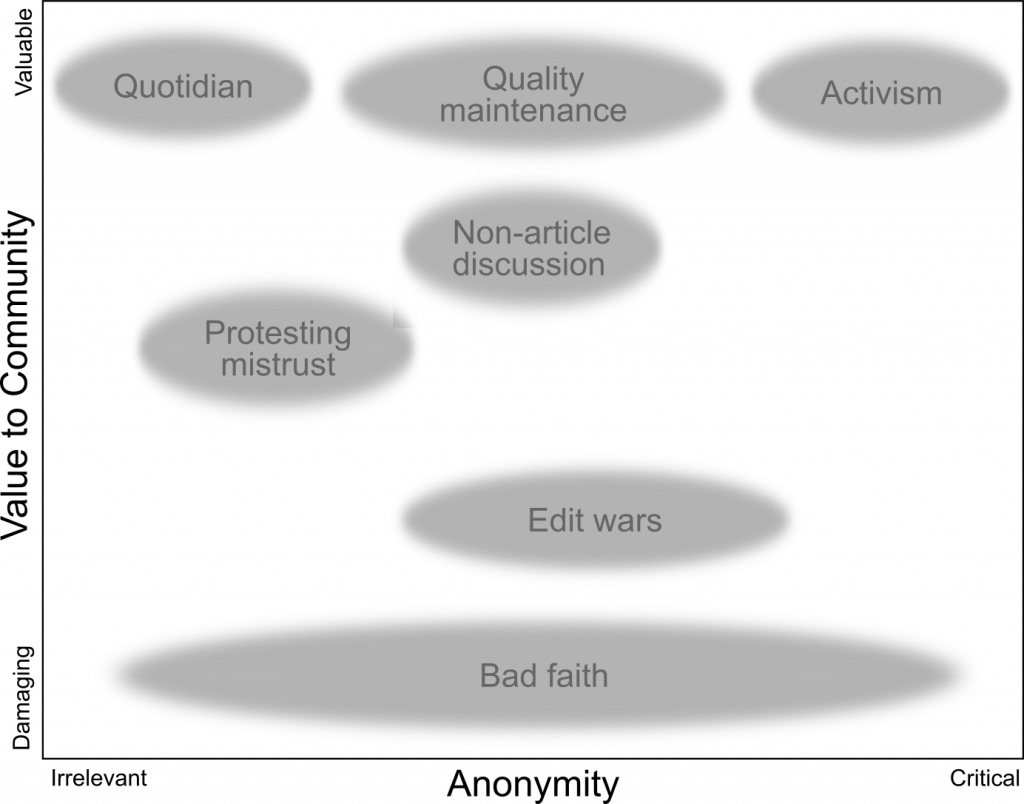
Online anonymity often gets a bad rap and complaints about antisocial behavior from anonymous Internet users are as old as the Internet itself. On the other hand, research has shown that many Internet users seek out anonymity to protect their privacy while contributing things of value. Should people seeking to contribute to open collaboration projects like open source software and citizen science projects be required to give up identifying information in order to participate?

We conducted a two-part study to better understand how open collaboration projects balance the threats of bad behavior with the goal of respecting contributors’ expectations of privacy. First, we interviewed eleven people from five different open collaboration “service providers” to understand what threats they perceive to their projects’ mission and how these threats shape privacy and security decisions when it comes to anonymous contributions. Second, we analyzed discussions about anonymous contributors on publicly available logs of the English language Wikipedia mailing list from 2010 to 2017.

In the interview study, we identified three themes that pervaded discussions of perceived threats. These included threats to:

  1. community norms, such as harrassment;
  2. sustaining participation, such as loss of or failure to attract volunteers; and
  3. contribution quality, low-quality contributions drain community resources.

We found that open collaboration providers were most concerned with lowering barriers to participation to attract new contributors. This makes sense given that newbies are the lifeblood of open collaboration communities. We also found that service providers thought of anonymous contributions as a way of offering low barriers to participation, not as a way of helping contributors manage their privacy. They imagined that anonymous contributors who wanted to remain in the community would eventually become full participants by registering for an account and creating an identity on the site. This assumption was evident in policies and technical features of collaboration platforms that barred anonymous contributors from participating in discussions, receiving customized suggestions, or from contributing at all in some circumstances. In our second study of the English language Wikipedia public email listserv, we discovered that the perspectives we encountered in interviews also dominated discussions of anonymity on Wikipedia. In both studies, we found that anonymous contributors were seen as “second-class citizens.”

This is not the way anonymous contributors see themselves. In a study we published two years ago, we interviewed people who sought out privacy when contributing to open collaboration projects. Our subjects expressed fears like being doxed, shot at, losing their job, or harassed. Some were worried about doing or viewing things online that violated censorship laws in their home country. The difference between the way that anonymity seekers see themselves and the way they are seen by service providers was striking.

One cause of this divergence in perceptions around anonymous contributors uncovered by our new paper is that people who seek out anonymity are not able to participate fully in the process of discussing and articulating norms and policies around anonymous contribution. People whose anonymity needs means they cannot participate in general cannot participate in the discussions that determine who can participate.

We conclude our paper with the observation that, although social norms have played an important role in HCI research, relying on them as a yardstick for measuring privacy expectations may leave out important minority experiences whose privacy concerns keep them from participating in the first place. In online communities like open collaboration projects, social norms may best reflect the most privileged and central users of a system while ignoring the most vulnerable


Both this blog post and the paper, Privacy, Anonymity, and Perceived Risk in Open Collaboration: A Study of Service Providers, was written by Nora McDonald, Benjamin Mako Hill, Rachel Greenstadt, and Andrea Forte and will be published in the Proceedings of the 2019 ACM CHI Conference on Human Factors in Computing Systems next week. The paper will be presented at the CHI conference in Glasgow, UK on Wednesday May 8, 2019. The work was supported by the National Science Foundation (awards CNS-1703736 and CNS-1703049).

Why organizational culture matters for online communities

Leaders and scholars of online communities tend of think of community growth as the aggregate effect of inexperienced individuals arriving one-by-one. However, there is increasing evidence that growth in many online communities today involves newcomers arriving in groups with previous experience together in other communities. This difference has deep implications for how we think about the process of integrating newcomers. Instead of focusing only on individual socialization into the group culture, we must also understand how to manage mergers of existing groups with distinct cultures. Unfortunately, online community mergers have, to our knowledge, never been studied systematically.

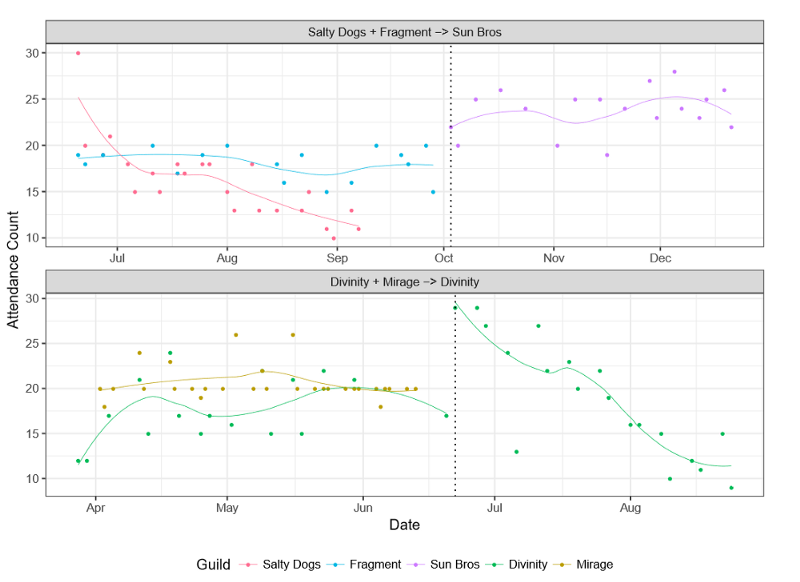
To better understand mergers, I spent six months in 2017 conducting ethnographic participant observation in two World of Warcraft raid guilds planning and undergoing mergers. The results—visible in the attendance plot below—shows that the top merger led to a thriving and sustainable community while the bottom merger led to failure and the eventual dissolution of the group. Why did one merger succeed while the other failed? What can managers of other communities learn from these examples?

In my new paper that will be published in the Proceedings of of the ACM Conference on Computer-supported Cooperative Work and Social Computing (CSCW) and that I will present in New Jersey next month, my coauthors and I try to answer these questions.

Raid team attendance before and after merging. Guilds were given pseudonyms to protect the identity of the research subjects.

In my research setting, World of Warcraft (WoW), players form organized groups called “guilds” to take on the game’s toughest bosses in virtual dungeons that are called “raids.” Raids can be extremely challenging, and they require a large number of players to be successful. Below is a video demonstrating the kind of communication and coordination needed to be successful as a raid team in WoW.

Because participation in a raid guild requires time, discipline, and emotional investment, raid guilds are constantly losing members and recruiting new ones to resupply their ranks. One common strategy for doing so is arranging formal mergers. My study involved following two such groups as they completed mergers. To collect data for my study, I joined both groups, attended and recorded all activities, took copious field notes, and spent hours interviewing leaders.

Although I did not anticipate the divergent outcomes shown in the figure above when I began, I analyzed my data with an eye toward identifying themes that might point to reasons for the success of one merger and the failure of the other. The answers that emerged from my analysis suggest that the key differences that led one merger to be successful and the other to fail revolved around differences in the ways that the two mergers managed organizational culture. This basic insight is supported by a body of research about organizational culture in firms but seem to have not made it onto the radar of most members or scholars of online communities. My coauthors and I think more attention to the role that organizational culture plays in online communities is essential.

We found evidence of cultural incompatibility in both mergers and it seems likely that some degree of cultural clashes is inevitable in any merger. The most important result of our analysis are three observations we drew about specific things that the successful merger did to effectively manage organizational culture. Drawn from our analysis, these themes point to concrete things that other communities facing mergers—either formal or informal—can do.

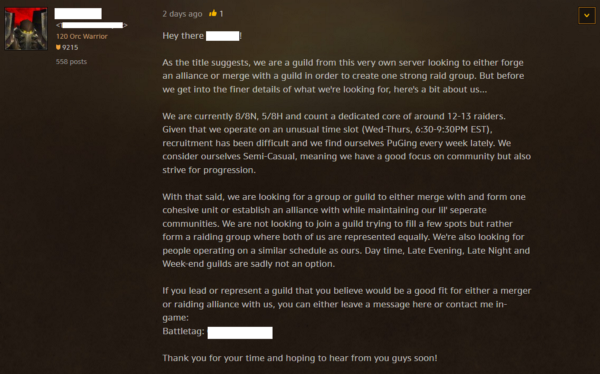
A recent, random example of a guild merger recruitment post found on the WoW forums.

First, when planning mergers, groups can strategically select other groups with similar organizational culture. The successful merger in our study involved a carefully planned process of advertising for a potential merger on forums, testing out group compatibility by participating in “trial” raid activities with potential guilds, and selecting the guild that most closely matched their own group’s culture. In our settings, this process helped prevent conflict from emerging and ensured that there was enough common ground to resolve it when it did.

Second, leaders can plan intentional opportunities to socialize members of the merged or acquired group. The leaders of the successful merger held community-wide social events in the game to help new members learn their community’s norms. They spelled out these norms in a visible list of rules. They even included the new members in both the brainstorming and voting process of changing the guild’s name to reflect that they were a single, new, cohesive unit. The leaders of the failed merger lacked any explicitly stated community rules, and opportunities for socializing the members of the new group were virtually absent. Newcomers from the merged group would only learn community norms when they broke one of the unstated social codes.

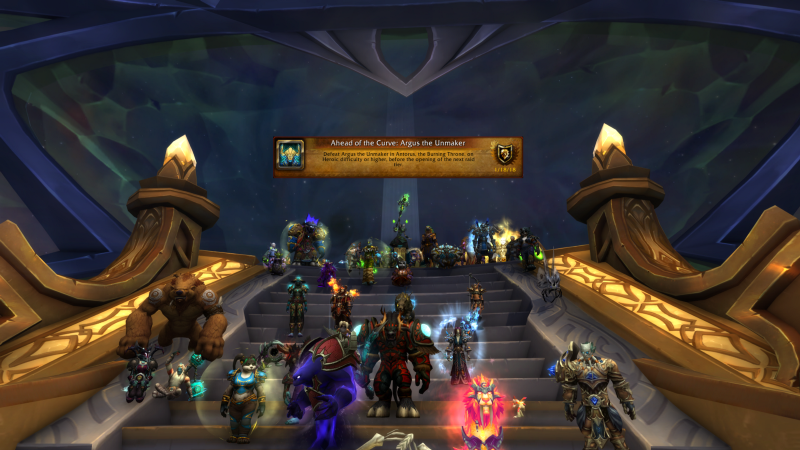
The guild leaders in the successful merger documented every successful high end raid boss achievement in a community-wide “Hall of Fame” journal. A screenshot is taken with every guild member who contributed to the achievement and uploaded to a “Hall of Fame” page.

Third and finally, our study suggested that social activities can be used to cultivate solidarity between the two merged groups, leading to increased retention of new members. We found that the successful guild merger organized an additional night of activity that was socially-oriented. In doing so, they provided a setting where solidarity between new and existing members can cultivate and motivate their members to stick around and keep playing with each other — even when it gets frustrating.

Our results suggest that by preparing in advance, ensuring some degree of cultural compatibility, and providing opportunities to socialize newcomers and cultivate solidarity, the potential for conflict resulting from mergers can be mitigated. While mergers between firms often occur to make more money or consolidate resources, the experience of the failed merger in our study shows that mergers between online communities put their entire communities at stake. We hope our work can be used by leaders in online communities to successfully manage potential conflict resulting from merging or acquiring members of other groups in a wide range of settings.

Much more detail is available our paper which will be published open access and which is currently available as a preprint.


Both this blog post and  the paper it is based on are collaborative work by Charles Kiene from the University of Washington, Aaron Shaw from Northwestern University, and Benjamin Mako Hill from the University of Washington. We are also thrilled to mention that the paper received a Best Paper Honorable Mention award at CSCW 2018!

Testing the “wide walls” design principle in the wild

Seymour Papert is credited as saying that tools to support learning should have “high ceilings” and “low floors.” The phrase is meant to suggest that tools should allow learners to do complex and intellectually sophisticated things but should also be easy to begin using quickly. Mitchel Resnick extended the metaphor to argue that learning toolkits should also have “wide walls” in that they should appeal to diverse groups of learners and allow for a broad variety of creative outcomes. In a new paper, Benjamin Mako Hill and I attempted to provide the first empirical test of Resnick’s wide walls theory. Using a natural experiment in the Scratch online community, we found causal evidence that “widening walls” can, as Resnick suggested, increase both engagement and learning.

Over the last ten years, the “wide walls” design principle has been widely cited in the design of new systems. For example, Resnick and his collaborators relied heavily on the principle in the design of the Scratch programming language. Scratch allows young learners to produce not only games, but also interactive art, music videos, greetings card, stories, and much more. As part of that team, I was guided by “wide walls” principle when I designed and implemented the Scratch cloud variables system in 2011-2012.

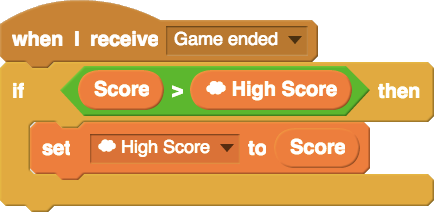
While designing the system, I hoped to “widen walls” by supporting a broader range of ways to use variables and data structures in Scratch. Scratch cloud variables extend the affordances of the normal Scratch variable by adding persistence and shared-ness. A simple example of something possible with cloud variables, but not without them, is a global high-score leaderboard in a game (example code is below). After the system was launched, I saw many young Scratch users using the system to engage with data structures in new and incredibly creative ways.

cloud-variable-script
Example of Scratch code that uses a cloud variable to keep track of high-scores among all players of a game.

Although these examples reflected powerful anecdotal evidence, I was also interested in using quantitative data to reflect the causal effect of the system. Understanding the causal effect of a new design in real world settings is a major challenge. To do so, we took advantage of a “natural experiment” and some clever techniques from econometrics to measure how learners’ behavior changed when they were given access to a wider design space.

Understanding the design of our study requires understanding a little bit about how access to the Scratch cloud variable system is granted. Although the system has been accessible to Scratch users since 2013, new Scratch users do not get access immediately. They are granted access only after a certain amount of time and activity on the website (the specific criteria are not public). Our “experiment” involved a sudden change in policy that altered the criteria for who gets access to the cloud variable feature. Through no act of their own, more than 14,000 users were given access to feature, literally overnight. We looked at these Scratch users immediately before and after the policy change to estimate the effect of access to the broader design space that cloud variables afforded.

We found that use of data-related features was, as predicted, increased by both access to and use of cloud variables. We also found that this increase was not only an effect of projects that use cloud variables themselves. In other words, learners with access to cloud variables—and especially those who had used it—were more likely to use “plain-old” data-structures in their projects as well.

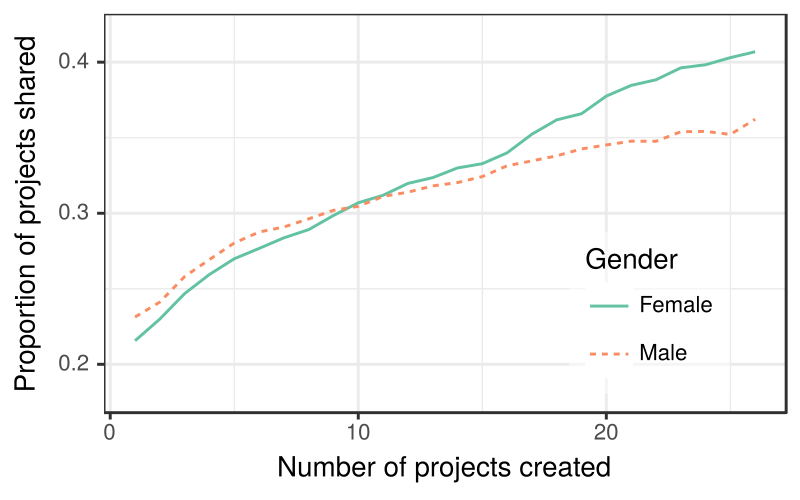
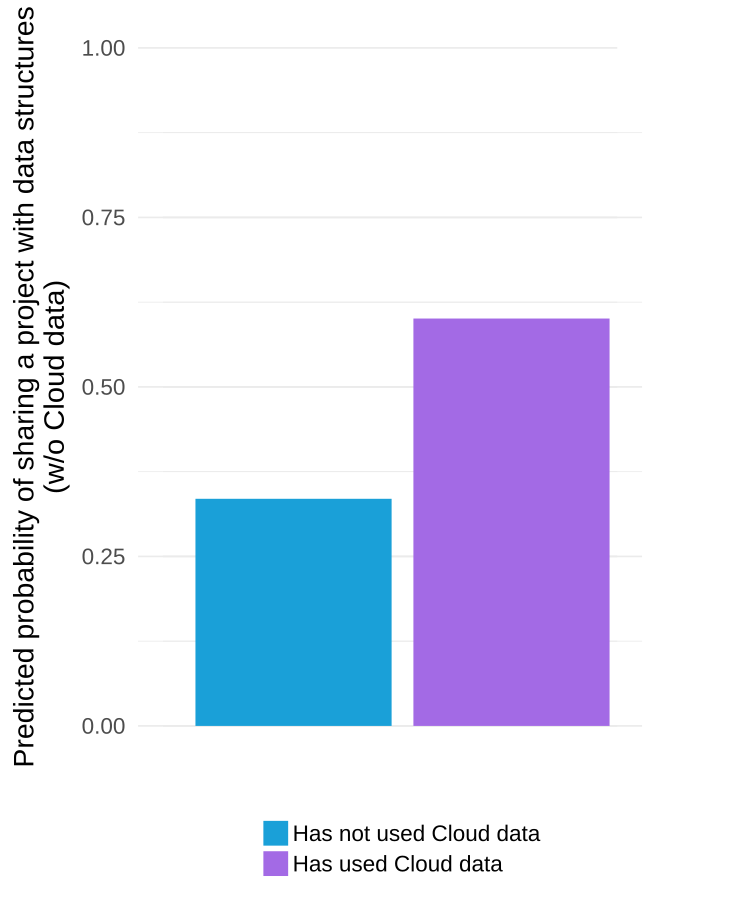
The graph below visualizes the results of one of the statistical models in our paper and suggests that we would expect that 33% of projects by a prototypical “average” Scratch user would use data structures if the user in question had never used used cloud variables but that we would expect that 60% of projects by a similar user would if they had used the system.

Model-predicted probability that a project made by a prototypical Scratch user will contain data structures (w/o counting projects with cloud variables)

It is important to note that the estimated effective above is a “local average effect” among people who used the system because they were granted access by the sudden change in policy (this is a subtle but important point that we explain this in some depth in the paper). Although we urge care and skepticism in interpreting our numbers, we believe our results are encouraging evidence in support of the “wide walls” design principle.

Of course, our work is not without important limitations. Critically, we also found that rate of adoption of cloud variables was very low. Although it is hard to pinpoint the exact reason for this from the data we observed, it has been suggested that widening walls may have a potential negative side-effect of making it harder for learners to imagine what the new creative possibilities might be in the absence of targeted support and scaffolding. Also important to remember is that our study measures “wide walls” in a specific way in a specific context and that it is hard to know how well our findings will generalize to other contexts and communities. We discuss these caveats, as well as our methods, models, and theoretical background in detail in our paper which now available for download as an open-access piece from the ACM digital library.


This blog post, and the open access paper that it describes, is a collaborative project with Benjamin Mako Hill. Financial support came from the eScience Institute and the Department of Communication at the University of Washington. Quantitative analyses for this project were completed using the Hyak high performance computing cluster at the University of Washington.

Revisiting the ‘Rise and Decline’

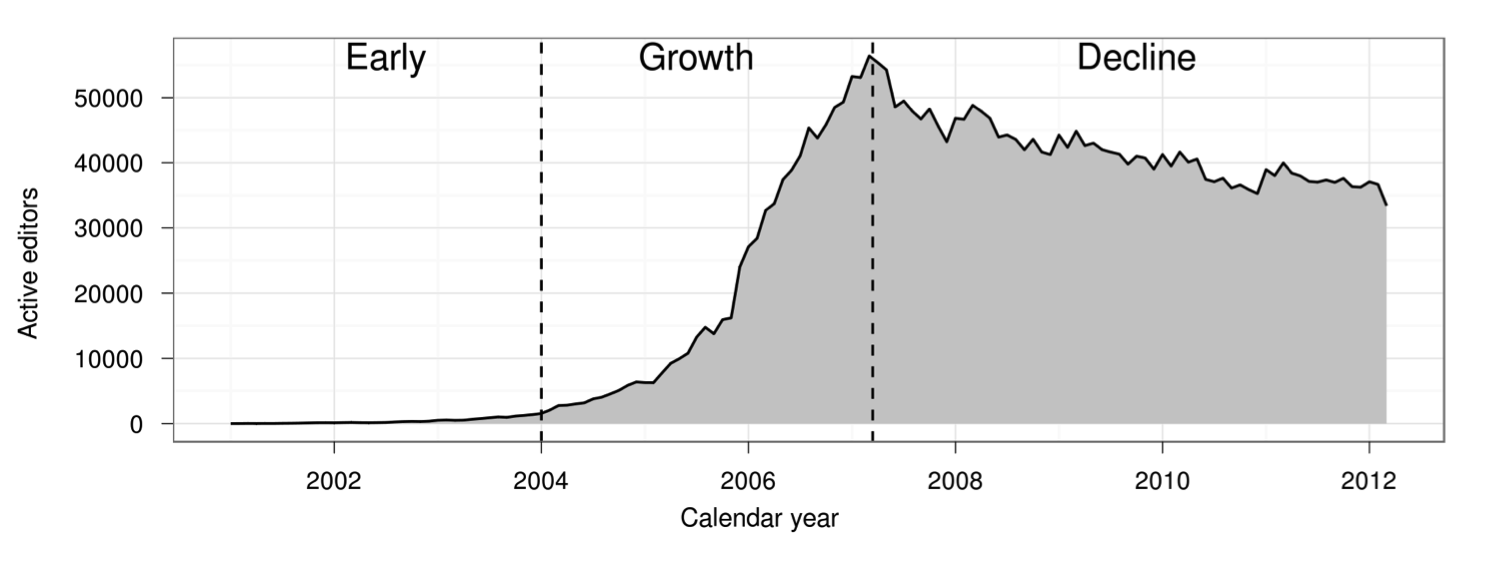
This graph shows the number of people contributing to Wikipedia over time:

The Rise and Decline of Wikipedia
The number of active Wikipedia contributors exploded, suddenly stalled, and then began gradually declining. (Figure taken from Halfaker et al. 2013)

The figure comes from “The Rise and Decline of an Open Collaboration System,” a well-known 2013 paper that argued that Wikipedia’s transition from rapid growth to slow decline in 2007 was driven by an increase in quality control systems. Although many people have treated the paper’s finding as representative of broader patterns in online communities, Wikipedia is a very unusual community in many respects. Do other online communities follow Wikipedia’s pattern of rise and decline? Does increased use of quality control systems coincide with community decline elsewhere?

In a paper I am presenting Thursday morning at  the Association for Computing Machinery (ACM) Conference on Human Factors in Computing Systems (CHI),  a group of us have replicated and extended the 2013 paper’s analysis in 769 other large wikis. We find that the dynamics observed in Wikipedia are a strikingly good description of the average Wikia wiki. They appear to reoccur again and again in many communities.

The original “Rise and Decline” paper (I’ll abbreviate it “RAD”) was written by Aaron Halfaker, R. Stuart Geiger, Jonathan T. Morgan, and John Riedl. They analyzed data from English Wikipedia and found that Wikipedia’s transition from rise to decline was accompanied by increasing rates of newcomer rejection as well as the growth of bots and algorithmic quality control tools. They also showed that newcomers whose contributions were rejected were less likely to continue editing and that community policies and norms became more difficult to change over time, especially for newer editors.

Our paper, just published in the CHI 2018 proceedings, replicates most of RAD’s analysis on a dataset of 769 of the  largest wikis from Wikia that were active between 2002 to 2010.  We find that RAD’s findings generalize to this large and diverse sample of communities.

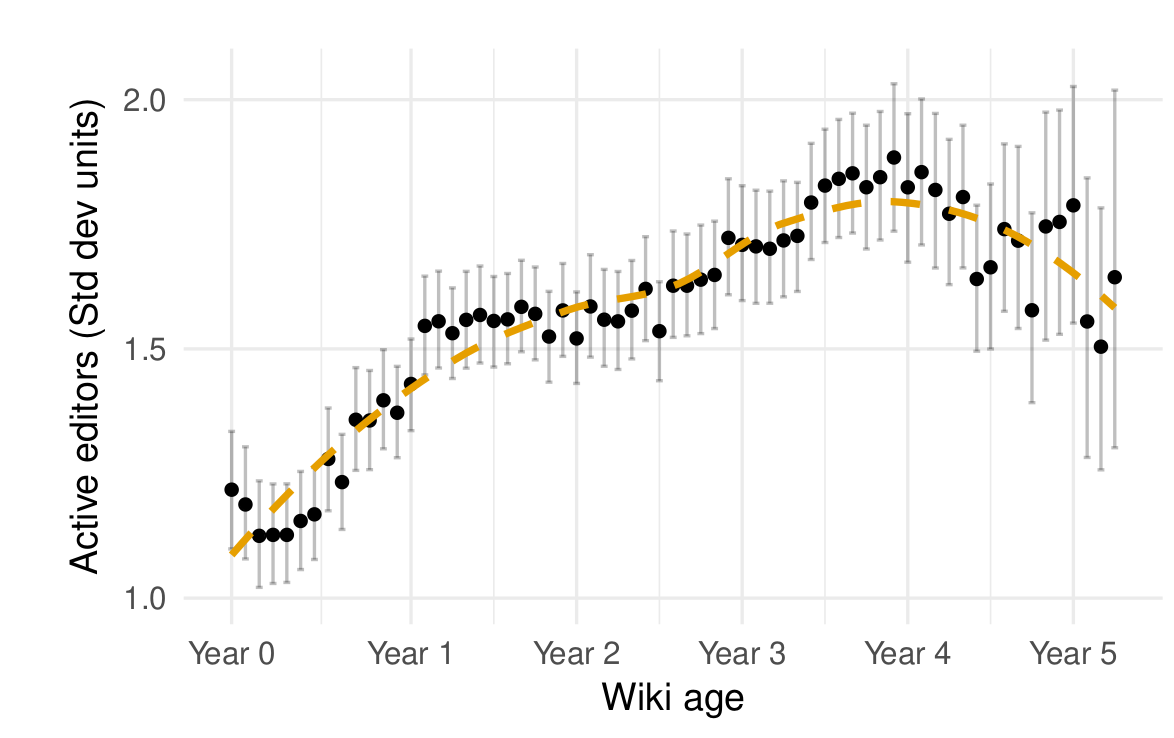
I can walk you through some of the key findings. First, the growth trajectory of the average wiki in our sample is similar to that of English Wikipedia. As shown in the figure below, an initial period of growth stabilizes and leads to decline several years later.

Rise and Decline on Wikia
The average Wikia wikia also experience a period of growth followed by stabilization and decline (from TeBlunthuis, Shaw, and Hill 2018).

We also found that newcomers on Wikia wikis were reverted more and continued editing less. As on Wikipedia, the two processes were related. Similar to RAD, we also found that newer editors were more likely to have their contributions to the “project namespace” (where policy pages are located) undone as wikis got older. Indeed, the specific estimates from our statistical models are very similar to RAD’s for most of these findings!

There were some parts of the RAD analysis that we couldn’t reproduce in our context. For example, there are not enough bots or algorithmic editing tools in Wikia to support statistical claims about their effects on newcomers.

At the same time, we were able to do some things that the RAD authors could not.  Most importantly, our findings discount some Wikipedia-specific explanations for a rise and decline. For example, English Wikipedia’s decline coincided with the rise of Facebook, smartphones, and other social media platforms. In theory, any of these factors could have caused the decline. Because the wikis in our sample experienced rises and declines at similar points in their life-cycle but at different points in time, the rise and decline findings we report seem unlikely to be caused by underlying temporal trends.

The big communities we study seem to have consistent “life cycles” where stabilization and/or decay follows an initial period of growth. The fact that the same kinds of patterns happen on English Wikipedia and other online groups implies a more general set of social dynamics at work that we do not think existing research (including ours) explains in a satisfying way. What drives the rise and decline of communities more generally? Our findings make it clear that this is a big, important question that deserves more attention.

We hope you’ll read the paper and get in touch by commenting on this post or emailing me if you’d like to learn or talk more. The paper is available online and has been published under an open access license. If you really want to get into the weeds of the analysis, we will soon publish all the data and code necessary to reproduce our work in a repository on the Harvard Dataverse.

I will be presenting the project this week at CHI in Montréal on Thursday April 26 at 9am in room 517D.  For those of you not familiar with CHI, it is the top venue for Human-Computer Interaction. All CHI submissions go through double-blind peer review and the papers that make it into the proceedings are considered published (same as journal articles in most other scientific fields). Please feel free to cite our paper and send it around to your friends!


This blog post, and the open access paper that it describes, is a collaborative project with Aaron Shaw, and Benjamin Mako Hill. Financial support came from the US National Science Foundation (grants IIS-1617129,  IIS-1617468, and GRFP-2016220885 ), Northwestern University, the Center for Advanced Study in the Behavioral Sciences at Stanford University, and the University of Washington. This project was completed using the Hyak high performance computing cluster at the University of Washington.

Introducing Computational Methods to Social Media Scientists

The ubiquity of large-scale data and improvements in computational hardware and algorithms have provided enabled researchers to apply computational approaches to the study of human behavior. One of the richest contexts for this kind of work is social media datasets like Facebook, Twitter, and Reddit.

We were invited by Jean BurgessAlice Marwick, and Thomas Poell to write a chapter about computational methods for the Sage Handbook of Social Media. Rather than simply listing what sorts of computational research has been done with social media data, we decided to use the chapter to both introduce a few computational methods and to use those methods in order to analyze the field of social media research.

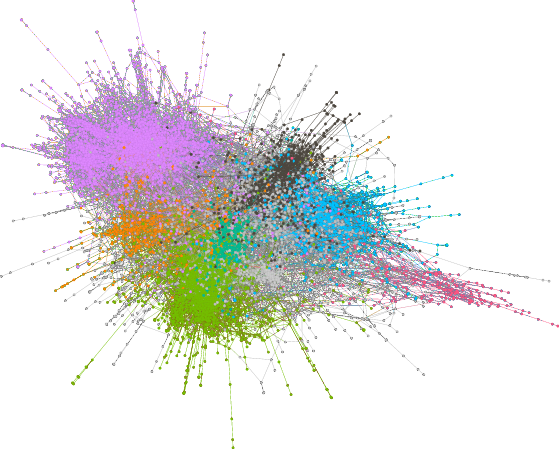
A “hairball” diagram from the chapter illustrating how research on social media clusters into distinct citation network neighborhoods.

Explanations and Examples

In the chapter, we start by describing the process of obtaining data from web APIs and use as a case study our process for obtaining bibliographic data about social media publications from Elsevier’s Scopus API.  We follow this same strategy in discussing social network analysis, topic modeling, and prediction. For each, we discuss some of the benefits and drawbacks of the approach and then provide an example analysis using the bibliographic data.

We think that our analyses provide some interesting insight into the emerging field of social media research. For example, we found that social network analysis and computer science drove much of the early research, while recently consumer analysis and health research have become more prominent.

More importantly though, we hope that the chapter provides an accessible introduction to computational social science and encourages more social scientists to incorporate computational methods in their work, either by gaining computational skills themselves or by partnering with more technical colleagues. While there are dangers and downsides (some of which we discuss in the chapter), we see the use of computational tools as one of the most important and exciting developments in the social sciences.

Steal this paper!

One of the great benefits of computational methods is their transparency and their reproducibility. The entire process—from data collection to data processing to data analysis—can often be made accessible to others. This has both scientific benefits and pedagogical benefits.

To aid in the training of new computational social scientists, and as an example of the benefits of transparency, we worked to make our chapter pedagogically reproducible. We have created a permanent website for the chapter at https://communitydata.science/social-media-chapter/ and uploaded all the code, data, and material we used to produce the paper itself to an archive in the Harvard Dataverse.

Through our website, you can download all of the raw data that we used to create the paper, together with code and instructions for how to obtain, clean, process, and analyze the data. Our website walks through what we have found to be an efficient and useful workflow for doing computational research on large datasets. This workflow even includes the paper itself, which is written using LaTeX + knitr. These tools let changes to data or code propagate through the entire workflow and be reflected automatically in the paper itself.

If you  use our chapter for teaching about computational methods—or if you find bugs or errors in our work—please let us know! We want this chapter to be a useful resource, will happily consider any changes, and have even created a git repository to help with managing these changes!

Learning to code in one’s own language

Millions of young people from around the world are learning to code. Often, during their learning experiences, these youth are using visual block-based programming languages like Scratch, App Inventor, and Code.org Studio. In block-based programming languages, coders manipulate visual, snap-together blocks that represent code constructs instead of textual symbols and commands that are found in more traditional programming languages.

The textual symbols used in nearly all non-block-based programming languages are drawn from English—consider “if” statements and “for” loops for common examples. Keywords in block-based languages, on the other hand, are often translated into different human languages. For example, depending on the language preference of the user, an identical set of computing instructions in Scratch can be represented in many different human languages:

Although my research with Benjamin Mako Hill focuses on learning, both Mako and I worked on local language technologies before coming back to academia. As a result, we were both interested in how the increasing translation of programming languages might be making it easier for non-English speaking kids to learn to code.

After all, a large body of education research has shown that early-stage education is more effective when instruction is in the language that the learner speaks at home. Based on this research, we hypothesized that children learning to code with block-based programming languages translated to their mother-tongues will have better learning outcomes than children using the blocks in English.

We sought to test this hypothesis in Scratch, an informal learning community built around a block-based programming language. We were helped by the fact that Scratch is translated into many languages and has a large number of learners from around the world.

To measure learning, we built on some of our our own previous work and looked at learners’ cumulative block repertoires—similar to a code vocabulary. By observing a learner’s cumulative block repertoire over time, we can measure how quickly their code vocabulary is growing.

Using this data, we compared the rate of growth of cumulative block repertoire between learners from non-English speaking countries using Scratch in English to learners from the same countries using Scratch in their local language. To identify non-English speakers, we considered Scratch users who reported themselves as coming from five primarily non-English speaking countries: Portugal, Italy, Brazil, Germany, and Norway. We chose these five countries because they each have one very widely spoken language that is not English and because Scratch is almost fully translated into that language.

Even after controlling for a number of factors like social engagement on the Scratch website, user productivity, and time spent on projects, we found that learners from these countries who use Scratch in their local language have a higher rate of cumulative block repertoire growth than their counterparts using Scratch in English. This faster growth was despite having a lower initial block repertoire. The graph below visualizes our results for two “prototypical” learners who start with the same initial block repertoire: one learner who uses the English interface, and a second learner who uses their native language.

Our results are in line with what theories of education have to say about learning in one’s own language. Our findings also represent good news for designers of block-based programming languages who have spent considerable amounts of effort in making their programming languages translatable. It’s also good news for the volunteers who have spent many hours translating blocks and user interfaces.

Although we find support for our hypothesis, we should stress that our findings are both limited and incomplete. For example, because we focus on estimating the differences between Scratch learners, our comparisons are between kids who all managed to successfully use Scratch. Before Scratch was translated, kids with little working knowledge of English or the Latin script might not have been able to use Scratch at all. Because of translation, many of these children are now able to learn to code.


This blog-post and the work that it describes is a collaborative project with Benjamin Mako Hill. You can read our paper here. The paper was published in the ACM Learning @ Scale Conference. We also recently gave a talk about this work at the International Communication Association’s annual conference. We have received support and feedback from members of the Scratch team at MIT (especially Mitch Resnick and Natalie Rusk), as well as from Nathan TeBlunthuis at the University of Washington. Financial support came from the US National Science Foundation.

The Community Data Science Collective Dataverse

I’m pleased to announce the Community Data Science Collective Dataverse. Our dataverse is an archival repository for datasets created by the Community Data Science Collective. The dataverse won’t replace work that collective members have been doing for years to document and distribute data from our research. What we hope it will do is get our data — like our published manuscripts — into the hands of folks in the “forever” business.

Over the past few years, the Community Data Science Collective has published several papers where an important part of the contribution is a dataset. These include:

Recently, we’ve also begun producing replication datasets to go alongside our empirical papers. So far, this includes:

In the case of each of the first groups of papers where the dataset was a part of the contribution, we uploaded code and data to a website we’ve created. Of course, even if we do a wonderful job of keeping these websites maintained over time, eventually, our research group will cease to exist. When that happens, the data will eventually disappear as well.

The text of our papers will be maintained long after we’re gone in the journal or conference proceedings’ publisher’s archival storage and in our universities’ institutional archives. But what about the data? Since the data is a core part — perhaps the core part — of the contribution of these papers, the data should be archived permanently as well.

Toward that end, our group has created a dataverse. Our dataverse is a repository within the Harvard Dataverse where we have been uploading archival copies of datasets over the last six months. All five of the papers described above are uploaded already. The Scratch dataset, due to access control restrictions, isn’t listed on the main page but it’s online on the site. Moving forward, we’ll be populating this new datasets we create as well as replication datasets for our future empirical papers. We’re currently preparing several more.

The primary point of the CDSC Dataverse is not to provide you with way to get our data although you’re certainly welcome to use it that way and it might help make some of it more discoverable. The websites we’ve created (like for the ones for redirects and for page protection) will continue to exist and be maintained. The Dataverse is insurance for if, and when, those websites go down to ensure that our data will still be accessible.


This post was also published on Benjamin Mako Hill’s blog Copyrighteous.

Adventures in onboarding new users on Wikipedia

I recently finished a paper that presents a novel social computing system called the Wikipedia Adventure. The system was a gamified tutorial for new Wikipedia editors. Working with the tutorial creators, we conducted both a survey of its users and a randomized field experiment testing its effectiveness in encouraging subsequent contributions. We found that although users loved it, it did not affect subsequent participation rates.

Start screen for the Wikipedia Adventure.

A major concern that many online communities face is how to attract and retain new contributors. Despite it’s success, Wikipedia is no different. In fact, researchers have shown that after experiencing a massive initial surge in activity, the number of active editors on Wikipedia has been in slow decline since 2007.

The number of active, registered editors (≥5 edits per month) to Wikipedia over time. From Halfaker, Geiger, and Morgan 2012.

Research has attributed a large part of this decline to the hostile environment that newcomers experience when begin contributing. New editors often attempt to make contributions which are subsequently reverted by more experienced editors for not following Wikipedia’s increasingly long list of rules and guidelines for effective participation.

This problem has led many researchers and Wikipedians to wonder how to more effectively onboard newcomers to the community. How do you ensure that new editors Wikipedia quickly gain the knowledge they need in order to make contributions that are in line with community norms?

To this end, Jake Orlowitz and Jonathan Morgan from the Wikimedia Foundation worked with a team of Wikipedians to create a structured, interactive tutorial called The Wikipedia Adventure. The idea behind this system was that new editors would be invited to use it shortly after creating a new account on Wikipedia, and it would provide a step-by-step overview of the basics of editing.

The Wikipedia Adventure was designed to address issues that new editors frequently encountered while learning how to contribute to Wikipedia. It is structured into different ‘missions’ that guide users through various aspects of participation on Wikipedia, including how to communicate with other editors, how to cite sources, and how to ensure that edits present a neutral point of view. The sequence of the missions gives newbies an overview of what they need to know instead of having to figure everything out themselves. Additionally, the theme and tone of the tutorial sought to engage new users, rather than just redirecting them to the troves of policy pages.

Those who play the tutorial receive automated badges on their user page for every mission they complete. This signals to veteran editors that the user is acting in good-faith by attempting to learn the norms of Wikipedia.

An example of a badge that a user receives after demonstrating the skills to communicate with other users on Wikipedia.

Once the system was built, we were interested in knowing whether people enjoyed using it and found it helpful. So we conducted a survey asking editors who played the Wikipedia Adventure a number of questions about its design and educational effectiveness. Overall, we found that users had a very favorable opinion of the system and found it useful.

Survey responses about how users felt about TWA.


Survey responses about what users learned through TWA.

We were heartened by these results. We’d sought to build an orientation system that was engaging and educational, and our survey responses suggested that we succeeded on that front. This led us to ask the question – could an intervention like the Wikipedia Adventure help reverse the trend of a declining editor base on Wikipedia? In particular, would exposing new editors to the Wikipedia Adventure lead them to make more contributions to the community?

To find out, we conducted a field experiment on a population of new editors on Wikipedia. We identified 1,967 newly created accounts that passed a basic test of making good-faith edits. We then randomly invited 1,751 of these users via their talk page to play the Wikipedia Adventure. The rest were sent no invitation. Out of those who were invited, 386 completed at least some portion of the tutorial.

We were interested in knowing whether those we invited to play the tutorial (our treatment group) and those we didn’t (our control group) contributed differently in the first six months after they created accounts on Wikipedia. Specifically, we wanted to know whether there was a difference in the total number of edits they made to Wikipedia, the number of edits they made to talk pages, and the average quality of their edits as measured by content persistence.

We conducted two kinds of analyses on our dataset. First, we estimated the effect of inviting users to play the Wikipedia Adventure on our three outcomes of interest. Second, we estimated the effect of playing the Wikipedia Adventure, conditional on having been invited to do so, on those same outcomes.

To our surprise, we found that in both cases there were no significant effects on any of the outcomes of interest. Being invited to play the Wikipedia Adventure therefore had no effect on new users’ volume of participation either on Wikipedia in general, or on talk pages specifically, nor did it have any effect on the average quality of edits made by the users in our study. Despite the very positive feedback that the system received in the survey evaluation stage, it did not produce a significant change in newcomer contribution behavior. We concluded that the system by itself could not reverse the trend of newcomer attrition on Wikipedia.

Why would a system that was received so positively ultimately produce no aggregate effect on newcomer participation? We’ve identified a few possible reasons. One is that perhaps a tutorial by itself would not be sufficient to counter hostile behavior that newcomers might experience from experienced editors. Indeed, the friendly, welcoming tone of the Wikipedia Adventure might contrast with strongly worded messages that new editors receive from veteran editors or bots. Another explanation might be that users enjoyed playing the Wikipedia Adventure, but did not enjoy editing Wikipedia. After all, the two activities draw on different kinds of motivations. Finally, the system required new users to choose to play the tutorial. Maybe people who chose to play would have gone on to edit in similar ways without the tutorial.

Ultimately, this work shows us the importance of testing systems outside of lab studies. The Wikipedia Adventure was built by community members to address known gaps in the onboarding process, and our survey showed that users responded well to its design.

While it would have been easy to declare victory at that stage, the field deployment study painted a different picture. Systems like the Wikipedia Adventure may inform the design of future orientation systems. That said, more profound changes to the interface or modes of interaction between editors might also be needed to increase contributions from newcomers.

This blog post, and the open access paper that it describes, is a collaborative project with Jake OrlowitzJonathan Morgan, Aaron Shaw, and Benjamin Mako Hill. Financial support came from the US National Science Foundation (grants IIS-1617129 and IIS-1617468), Northwestern University, and the University of Washington. We also published all the data and code necessary to reproduce our analysis in a repository in the Harvard Dataverse.

Children’s Perspectives on Critical Data Literacies

Last week, we presented a new paper that describes how children are thinking through some of the implications of new forms of data collection and analysis. The presentation was given at the ACM CHI conference in Denver last week and the paper is open access and online.

Over the last couple years, we’ve worked on a large project to support children in doing — and not just learning about — data science. We built a system, Scratch Community Blocks, that allows the 18 million users of the Scratch online community to write their own computer programs — in Scratch of course — to analyze data about their own learning and social interactions. An example of one of those programs to find how many of one’s follower in Scratch are not from the United States is shown below.

Last year, we deployed Scratch Community Blocks to 2,500 active Scratch users who, over a period of several months, used the system to create more than 1,600 projects.

As children used the system, Samantha Hautea, a student in UW’s Communication Leadership program, led a group of us in an online ethnography. We visited the projects children were creating and sharing. We followed the forums where users discussed the blocks. We read comment threads left on projects. We combined Samantha’s detailed field notes with the text of comments and forum posts, with ethnographic interviews of several users, and with notes from two in-person workshops. We used a technique called grounded theory to analyze these data.

What we found surprised us. We expected children to reflect on being challenged by — and hopefully overcoming — the technical parts of doing data science. Although we certainly saw this happen, what emerged much more strongly from our analysis was detailed discussion among children about the social implications of data collection and analysis.

In our analysis, we grouped children’s comments into five major themes that represented what we called “critical data literacies.” These literacies reflect things that children felt were important implications of social media data collection and analysis.

First, children reflected on the way that programmatic access to data — even data that was technically public — introduced privacy concerns. One user described the ability to analyze data as, “creepy”, but at the same time, “very cool.” Children expressed concern that programmatic access to data could lead to “stalking“ and suggested that the system should ask for permission.

Second, children recognized that data analysis requires skepticism and interpretation. For example, Scratch Community Blocks introduced a bug where the block that returned data about followers included users with disabled accounts. One user, in an interview described to us how he managed to figure out the inconsistency:

At one point the follower blocks, it said I have slightly more followers than I do. And, that was kind of confusing when I was trying to make the project. […] I pulled up a second [browser] tab and compared the [data from Scratch Community Blocks and the data in my profile].

Third, children discussed the hidden assumptions and decisions that drive the construction of metrics. For example, the number of views received for each project in Scratch is counted using an algorithm that tries to minimize the impact of gaming the system (similar to, for example, Youtube). As children started to build programs with data, they started to uncover and speculate about the decisions behind metrics. For example, they guessed that the view count might only include “unique” views and that view counts may include users who do not have accounts on the website.

Fourth, children building projects with Scratch Community Blocks realized that an algorithm driven by social data may cause certain users to be excluded. For example, a 13-year-old expressed concern that the system could be used to exclude users with few social connections saying:

I love these new Scratch Blocks! However I did notice that they could be used to exclude new Scratchers or Scratchers with not a lot of followers by using a code: like this:
when flag clicked
if then user’s followers < 300
stop all.
I do not think this a big problem as it would be easy to remove this code but I did just want to bring this to your attention in case this not what you would want the blocks to be used for.

Fifth, children were concerned about the possibility that measurement might distort the Scratch community’s values. While giving feedback on the new system, a user expressed concern that by making it easier to measure and compare followers, the system could elevate popularity over creativity, collaboration, and respect as a marker of success in Scratch.

I think this was a great idea! I am just a bit worried that people will make these projects and take it the wrong way, saying that followers are the most important thing in on Scratch.

Kids’ conversations around Scratch Community Blocks are good news for educators who are starting to think about how to engage young learners in thinking critically about the implications of data. Although no kid using Scratch Community Blocks discussed each of the five literacies described above, the themes reflect starting points for educators designing ways to engage kids in thinking critically about data.

Our work shows that if children are given opportunities to actively engage and build with social and behavioral data, they might not only learn how to do data analysis, but also reflect on its implications.

This blog-post and the work that it describes is a collaborative project by Samantha Hautea, Sayamindu Dasgupta, and Benjamin Mako Hill. We have also received support and feedback from members of the Scratch team at MIT (especially Mitch Resnick and Natalie Rusk), as well as from Hal Abelson from MIT CSAIL. Financial support came from the US National Science Foundation.

Surviving an “Eternal September:” How an Online Community Managed a Surge of Newcomers

Attracting newcomers is among the most widely studied problems in online community research. However, with all the attention paid to challenge of getting new users, much less research has studied the flip side of that coin: large influxes of newcomers can pose major problems as well!

The most widely known example of problems caused by an influx of newcomers into an online community occurred in Usenet. Every September, new university students connecting to the Internet for the first time would wreak havoc in the Usenet discussion forums. When AOL connected its users to the Usenet in 1994, it disrupted the community for so long that it became widely known as “The September that never ended.

Our study considered a similar influx in NoSleep—an online community within Reddit where writers share original horror stories and readers comment and vote on them. With strict rules requiring that all members of the community suspend disbelief, NoSleep thrives off the fact that readers experience an immersive storytelling environment. Breaking the rules is as easy as questioning the truth of someone’s story. Socializing newcomers represents a major challenge for NoSleep.

Number of subscribers and moderators on /r/NoSleep over time.

On May 7th, 2014, NoSleep became a “default subreddit”—i.e., every new user to Reddit automatically joined NoSleep. After gradually accumulating roughly 240,000 members from 2010 to 2014, the NoSleep community grew to over 2 million subscribers in a year. That said, NoSleep appeared to largely hold things together. This reflects the major question that motivated our study: How did NoSleep withstand such a massive influx of newcomers without enduring their own Eternal September?

To answer this question, we interviewed a number of NoSleep participants, writers, moderators, and admins. After transcribing, coding, and analyzing the results, we proposed that NoSleep survived because of three inter-connected systems that helped protect the community’s norms and overall immersive environment.

First, there was a strong and organized team of moderators who enforced the rules no matter what. They recruited new moderators knowing the community’s population was going to surge. They utilized a private subreddit for NoSleep’s staff. They were able to socialize and educate new moderators effectively. Although issuing sanctions against community members was often difficult, our interviewees explained that NoSleep’s moderators were deeply committed and largely uncompromising.

That commitment resonates within the second system that protected NoSleep: regulation by normal community members. From our interviews, we found that the participants felt a shared sense of community that motivated them both to socialize newcomers themselves as well as to report inappropriate comments and downvote people who violate the community’s norms.

Finally, we found that the technological systems protected the community as well. For instance, post-throttling was instituted to limit the frequency at which a writer could post their stories. Additionally, Reddit’s “Automoderator”, a programmable AI bot, was used to issue sanctions against obvious norm violators while running in the background. Participants also pointed to the tools available to them—the report feature and voting system in particular—to explain how easy it was for them to report and regulate the community’s disruptors.

This blog post was written with Benjamin Mako Hill. The paper and work this post describes is collaborative work with Benjamin Mako Hill and Andrés Monroy-Hernández. The paper was published in the Proceedings of CHI 2016 and is released as open access so anyone can read the entire paper here. A version of this blogpost was posted on Benjamin Mako Hill’s blog Copyrighteous.