It seems natural to think that online political discussion happens in political spaces: comment sections under news articles, campaign pages, partisan forums, or video-sharing communities built around elections and public affairs.
But anyone who spends time online knows that politics does not stay neatly contained in those spaces. It shows up in local forums, hobby groups, gaming communities, entertainment discussions, and personal social media feeds. A conversation that begins with everyday life can suddenly become a debate about policy, rights, or government.
Communication scholars call this incidental political discussion: political talk that emerges in spaces not primarily organized around politics. I was interested in a simple question: what happens when people talk about politics in non-political online communities?
A common expectation in political communication research is that these conversations might be less polarized and more civil than political talk in explicitly political spaces. The logic goes: in non-political communities, people may not arrive with partisan identities already activated. They may also be guided by community norms built around shared interests, local concerns, or social connection rather than political conflict.
We wanted to test whether political talk in non-political spaces was actually less polarized, and perhaps less uncivil in real-world digital communities. To do so, I led an effort (with the support of Benjamin Mako Hill and Patricia Moy) to examine Reddit discussions about mass shootings and gun control in October 2017. Sampling over 100,000 comments on gun control issues across the platform that month, we compared comments from 15 explicitly political communities with those from 15 non-political communities, including culture-, location-, and game-based ones, among others.
The results surprised us. As the figure below from our study shows, policy opinion expression was, on average, more common in non-political communities than in political ones. Several non-political subreddits—including r/Wisconsin, r/Christianity, r/videos, and r/funny—had especially high levels of policy opinion expression. In total, 10 non-political subreddits had policy opinions in more than half of the sampled comments. By contrast, only three political subreddits—r/progun, r/ShitGunControllersSay, and r/Political_Revolution—crossed the same 50% threshold. This pattern suggests that policy talk is not confined to explicitly political spaces; in some cases, it appears even more frequently in communities organized around local life, religion, entertainment, or humor.
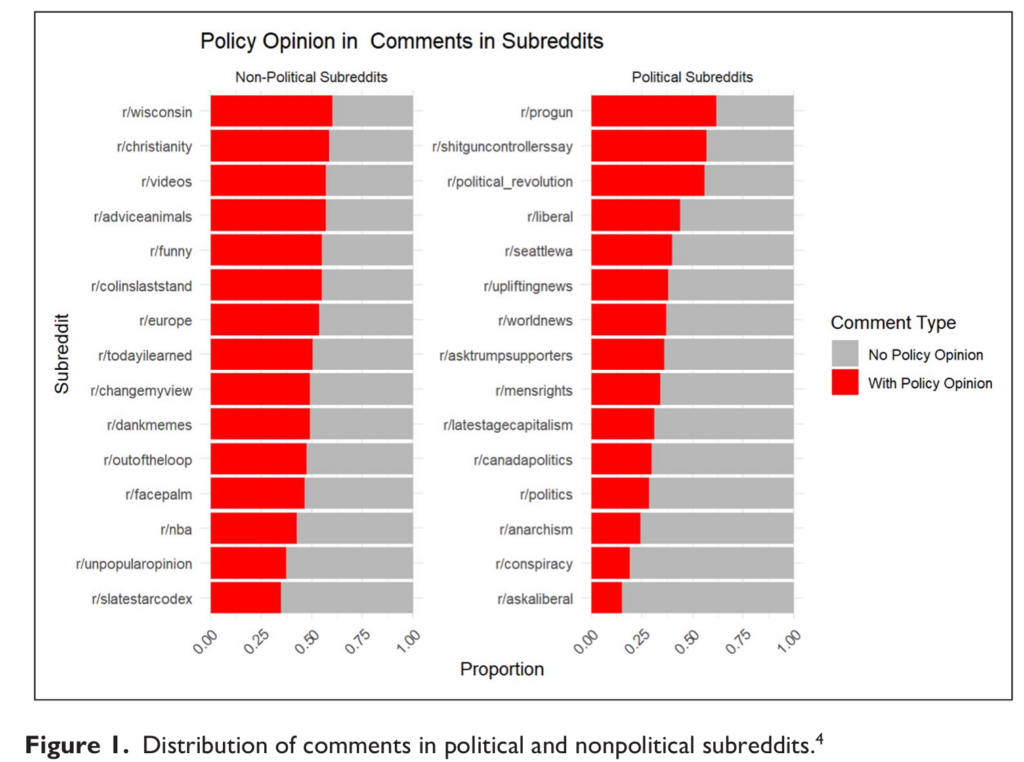
After accounting for a range of factors in our regression model, we found that comments in non-political communities were more likely to contain a clear policy opinion than comments in explicitly political communities. The model estimated that the predicted probability of expressing a clear policy position was about 34% in political communities, compared with 51% in non-political communities. This difference was statistically significant. At the same time, we found no significant difference in incivility between political and non-political communities.
This combination of findings was especially interesting and contrasts with what’s most commonly reported in the current social science literature on digital political communication.
One possible explanation is that participants in explicitly political communities are often immersed in ongoing political debate. Their comments may include detailed argumentation, interpretation, irony, criticism of political actors, or discussion of the news cycle without always stating a clear policy position. By contrast, when a major political issue enters a non-political community, participants may be more likely to be newly exposed to it and react by saying what they think should be done.
Another explanation for incivility is that Reddit’s community-based moderation matters. Many communities, political and non-political alike, rely on rules, moderators, and shared expectations that can limit openly uncivil behavior. This helps explain why we did not find a significant difference in incivility: both types of communities show a low level of uncivil comments (around 6% of the sample).
The broader lesson is that political communication does not only happen where politics is expected. It also happens in the ordinary spaces of digital life, where people gather to talk about games, cities, hobbies, entertainment, or shared interests. If we want to understand democracy online, we need to pay attention not only to where people go to talk about politics, but also to where politics shows up uninvited.
This work was published in New Media & Society: Fan, Y., Hill, B. M., & Moy, P. (2026). “Unintended politics: Opinion expression and incivility in incidental political discussion.” New Media & Society.
The work began as my master’s thesis at the University of Washington. Thanks to the committee: Benjamin Mako Hill, Patricia Moy, and Yuan Hsiao.
Discover more from Community Data Science Collective
Subscribe to get the latest posts sent to your email.