Niche Dynamics in Complex Online Community Ecosystems (ICWSM 2025)

This post is about my (Nathan TeBlunthuis) paper (pdf) just published at ICWSM 2025.

Often, several different online communities exist where similar people talk about similar things. This is really easy to observe from browsing platforms like Reddit or Facebook groups.
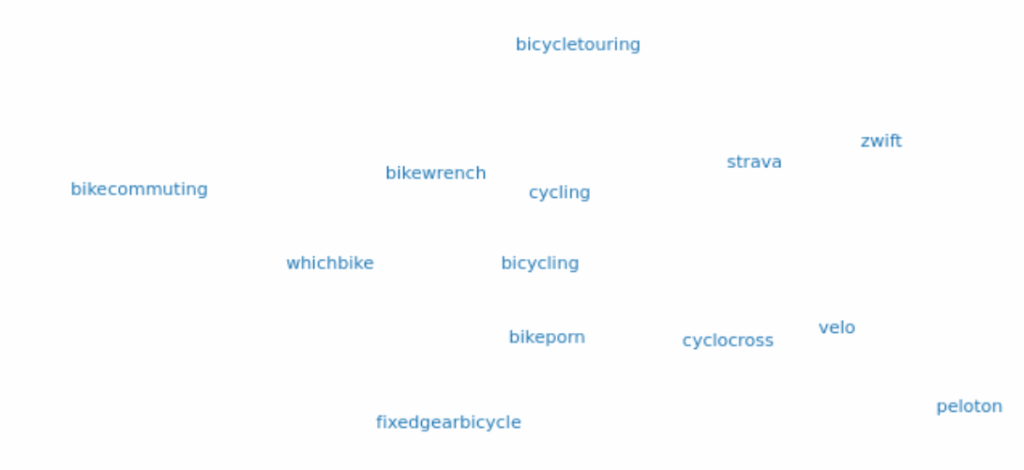
Names of bicycle-related subreddits in cluster of subreddits with many overlapping users.

For example, as we can see from this visualization of clustered subreddits with overlapping users, there are many different subreddits related to cycling. We see some communities have different emphases in complementary ways like “fixedgearbicycle” and “bicycletouring” — these are different types of cycling. But why have a community for
“cycling” and a different one for “bicycling”? A number of puzzles appear when we reflect on the existence of such related communities.

How do online communities relate to each other?

Why not have one large community that does everything?

How do people construct these systems of related online communities?

I investigated these questions in my dissertation using the theoretical lens of organizational ecology drawn from organizational sociology. This new paper explored some findings from earlier projects in more depth. The paper I published in ICWSM 2022 (pdf), takes up the question of ecological relationships among online communities. I used time series models to infer networks of competition and mutualism between overlapping online communities. This work found evidence that they tended to be mutualistic. For example, the diagram below shows a network of mental health subreddits that is dense with mutualism.
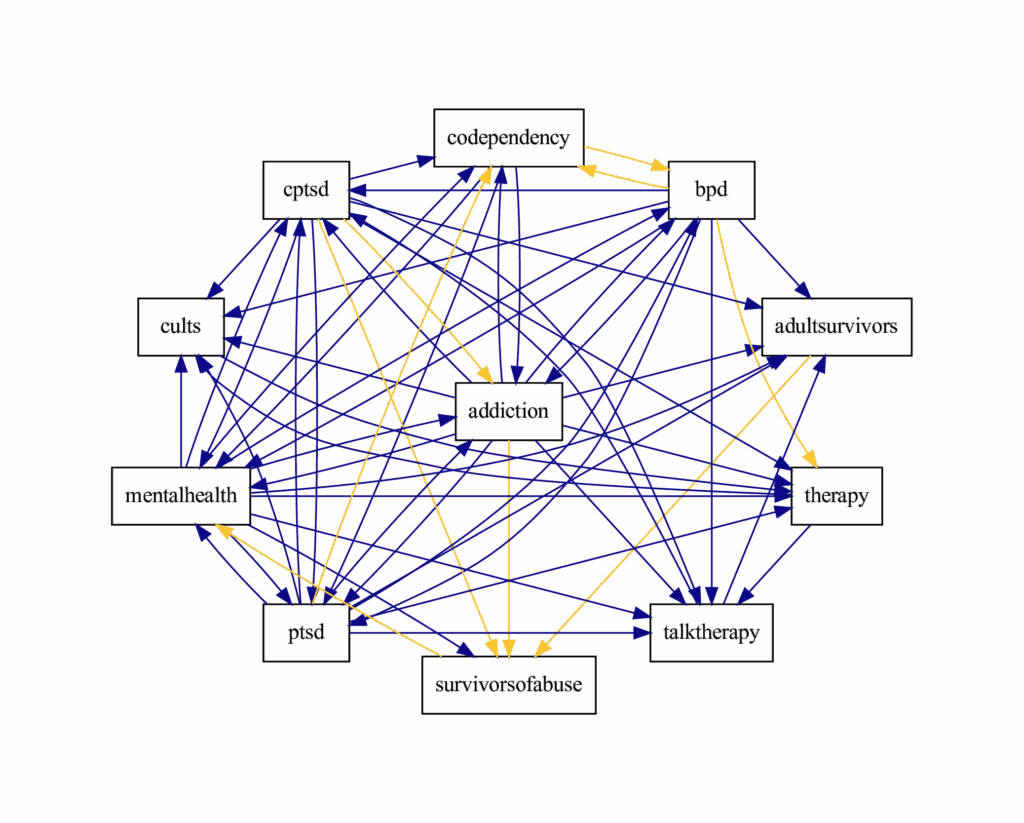
Ecological network of a cluster of mental subreddits. Blue arrows indicate mutualism and yellow arrows indicate competition according to a vector autoregression model.


However, this method, based on vector autoregression (VAR) models of activity, assumes that these relationships are static and constant over time. But dynamics of attention online are often bursty, and online communities grow, decline, and change over time in other ways. So, in this new work, I adopted nonlinear models called (regularized) S-map that can model more complex dynamics.

Since I found in the previous work that mutualism tended to happen more often than competition, I wanted to find out if that result was robust using the S-map. Since the S-map breaks these relationships down into episodes of competition or mutualism it afforded testing a more nuanced hypothesis about this tendency towards mutualism.

H1: Mutualistic interactions will be more frequent and longer lasting than competitive interactions.

In the another empirical paper previously published at CSCW 2022 (acm dl), we focused on the question of why people build overlapping online communities and found that they complementary sets of benefits to members, as illustrated below. Trade-offs between the benefits lead to specialized roles for different types of communities.
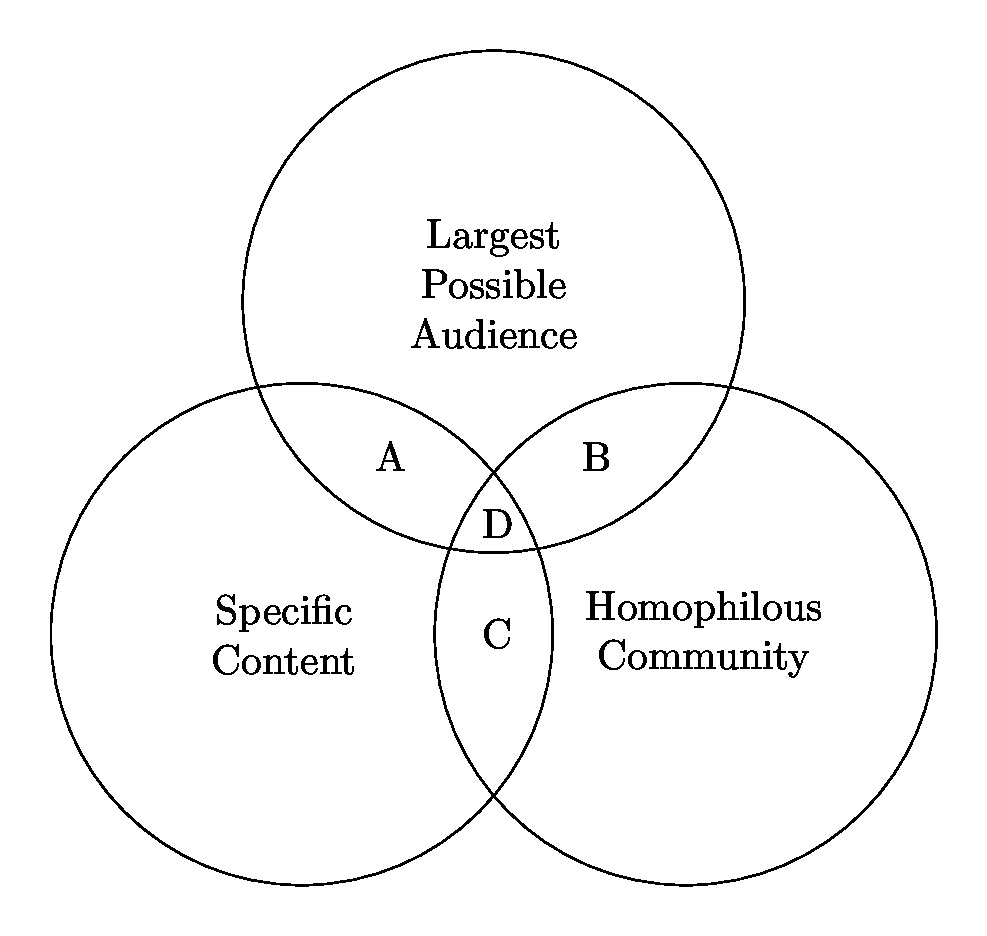
Figure from “No Community Can Do Everything: Why People Participate in Similar Online Communities” depicts three key benefits that people seek from online communities and how individual communities tend not to optimally provide all three. For example, large communities tend not to afford tight-knit homophilous community.

This reflects propositions from ecology that specialization can be a strategy to avoid competition. The new study seeks to provide more generalizable quantitative evidence about how online communities find their specialized niches. Ecology theory suggests that online communities, similar to organizations or organisms, might adapt to increase specialization and thereby promote more mutualistic relationships. To investigate whether people build specialized online communities through such an adaptive feedback process, I set out to test the following two hypotheses:

H2: Two communities having greater competition (mutualism) will subsequently have greater decreases (increases) in overlap.

H3: Two subreddits having decreasing (increasing) overlap will subsequently have greater mutualism (competition).

Methods and measures

To test these three hypotheses, I had to measure competition/mutualism, and overlap within clusters of related subreddits over time. I made topic- and user-overlap measures based on a community embedding via the LSA algorithm. To create the clusters I reused the approach from the earlier paper by using the HDBSCAN algorithm based on user overlap. As mentioned above I used the Regularized S-MAP algorithm to create a dynamic measure of ecological influence. With these longitudinal measures in hand I could test the hypotheses using two-way fixed-effects panel data estimators with dyad-robust standard errors. That’s a brief and dense summary of the methods. The chart below might help you make sense of it, but if you care to fully understand you’ll want to check out the full paper.
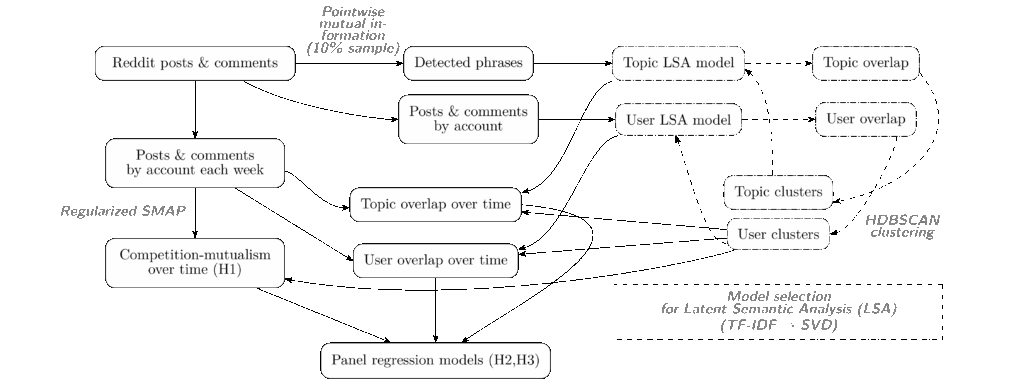
This flowchart illustrates the dataset and measures in the study.
On the left-hand side, nonline “Regularized S-Map models” are fit to time series of posts and comments in clusters of subreddits with high user-overlap to test hypothesis 1.
In the middle, competition and mutualism from the S-Map models are used with longitidunal measures of topic and user overlap based on community embeddings in panel regression models to test hypotheses 2 and 3.
Model selection is on the right-hand side.

Here are a few final notes on the data and methods. The data came from the Pushshift Reddit archive of submissions and comments from December 5th 2015 to April 13th 2020. I Started with the 19,533 subreddits that were active during at least 20% of study period weeks, excluding NSFW subreddits. HDBSCAN clustering discovered related 1,919 clusters of 8,806 subreddits having 48,484 relationships measured 17,374,116 times over 758 weeks.

Results

I found support for H1, which predicted that mutualistic interactions will be more frequent and longer lasting than competitive interactions. The plot below shows evidence in favor of the hypothesis. First, we can see clearly that the longest episodes tend to be mutualistic.
Notably, these ecological relationships are often bursty and short-lived. The average length of a mutualistic episode was 2.13 weeks and the average length of a competitive episode was just 1.83 weeks.
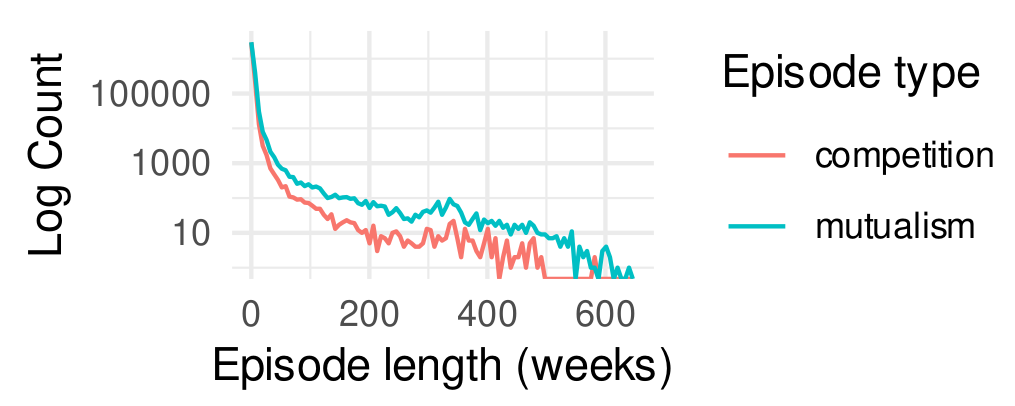
Frequency plot of the durations of competition and mutualism episodes. Mutualism tends to last longer than
competition. The y-axis is log-transformed. The axes truncated to omit outliers for visibility.

I also found support for H2, which predicted that I’d find positive coefficients for previous ecological interaction indicating that competition predicts decreases in overlap. Indeed, the panel regression models found that online communities tend to increase their specialization a bit in relatively competitive conditions, by about 0.02 standard deviations in term or user overlap for every 1-unit increase in competition.

Do increasingly specialized communities tend to decrease their competition as predicted by H3? My analysis didn’t find evidence for this. In fact, according to the panel regression models, after specialization increases, competition actually tends to increase as well.

Discussion

What to take away from all this? I still think the most important finding from this work to me is the robustness of the tendency toward mutualism among online communities. Unlike firms or other organizations that demand relatively exclusive commitments from their members, it is easy to participate in many online communities. Where classical organizations (imagine firms, churches, sports teams, nonprofit, and state organizations) seem likely to compete over employees, customers, or members online communities seem to benefit to some extant from sharing users with each other. I suspect this has to do with the ease with which nonrival content, ideas, and knowledge move between communities.

A second important takeaway from this work is that I think the evidence it finds for the adaptation explanation for the tendency toward mutualism isn’t all that convincing. Sure, communities in competition tend to become more specialized, but the effect size is pretty small and the fact that specialization doesn’t reduce competition suggests that it isn’t truly adaptive in the strongest sense. Put another way, specialized online communities might be made via an adaptive process, or they might be born out of the intentions and designs of their founders and early joiners. This work finds a bit of evidence for how specialization might be made, but the born process merits more investigation.

One clue about the significance of design for specialization comes from fellow CDSC-er Jeremy Foote‘s a nice CHI paper (acm dl) last year on how the early stages of a subreddit’s development are important to its trajectory and found that most subreddit creators didn’t set out to create a large community. Another study (arxiv.org), by Chenhao Tan on “community genealogy” shows how the growth of new subreddits often seems to depend on having high overlap with a “parent” subreddit. These papers don’t focus on specialization, but it would be cool to see future work take up these ideas.

If you enjoyed reading this summary or want to learn more, please check out the full paper. I got the chance to speculate a bit about what sorts of future technology designs might assist community leaders in crafting online communities to fill ecological roles. I also got to engage with ecological theory in a new way writing this. I hope you read and enjoy.

Finally, I wasn’t able to attend ICWSM in person this year, so I want to thank Kristen Engel for presenting on my behalf. I also want to note that CDSC-er Kaylea Champion and I were both recognized as “best reviewers” at the conference.

This work started as a chapter of my dissertation. Thanks to the committee — Professors Benjamin Mako Hill, Kirsten Foot, Aaron Shaw, David McDonald and Emma Spiro.

I also gratefully acknowledge support by NSF grants IIS-1908850 and IIS-1910202 and GRFP \#2016220885. This work was facilitated through the use of the advanced computational infrastructure provided by the Hyak supercomputer system at the University of Washington and TACC at the University of Texas.
The Introduction of Documentation in FLOSS Projects

Community decay and abandonment are persistent risks to free/libre and open source software (FLOSS) projects. As such, large institutions such as GitHub or Mozilla offer advice to FLOSS projects on how to organize their work for sustainability and community-building. Guides recommend the production of README files and CONTRIBUTING guides as useful tools in recruiting new project contributors and driving activity. Yet though the development of these documents is widely-suggested, there is little empirical study of how projects use these files and what happens when documents are introduced to projects.

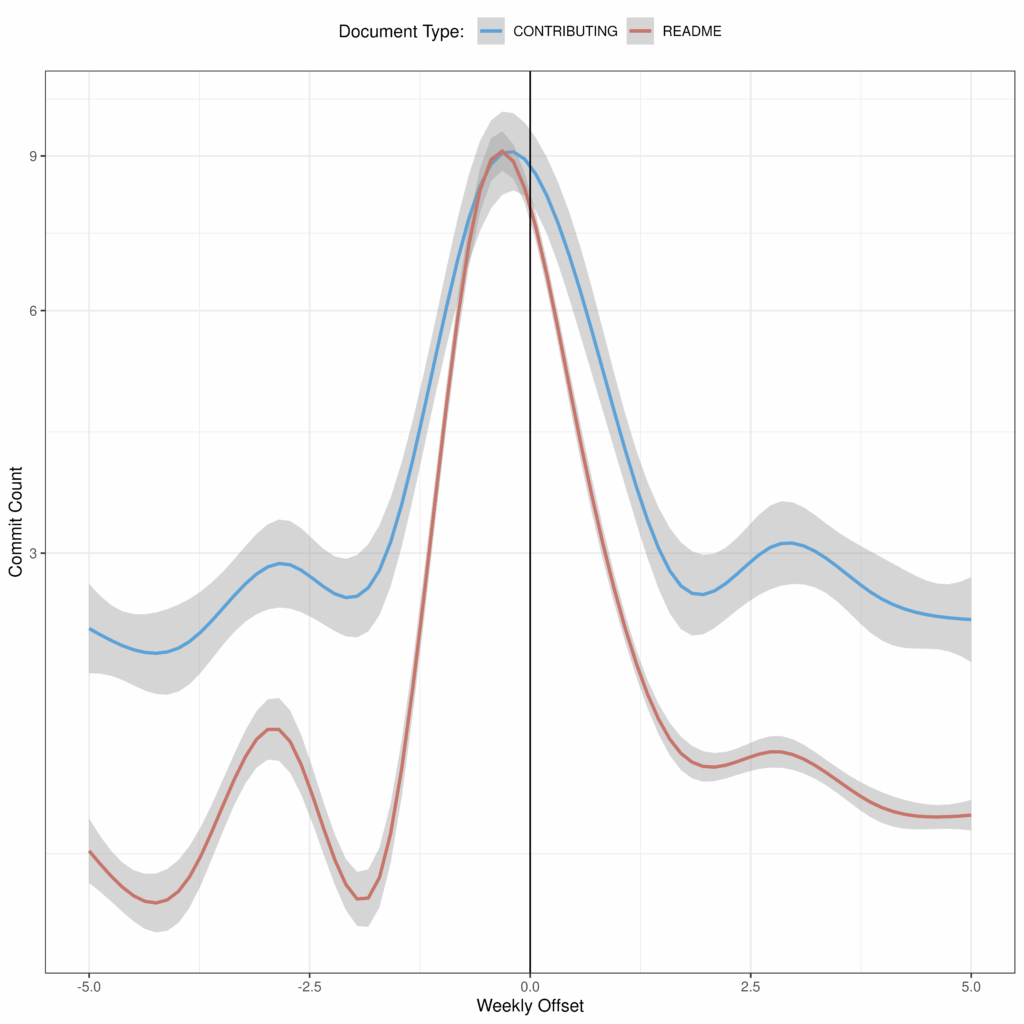
This is a plot of the moving average of weekly commit counts to the focal FLOSS project in the weeks surrounding the publication of README files or CONTRIBUTING guides. Both moving averages show a steep increase in commit activity in the weeks preceding the documents' publication, before sharp decreases in the weeks immediately following the publication. Across the 10 weeks included in the plot (5 weeks before/after document publication) projects publishing README files had fewer weekly contributions than those publishing CONTRIBUTING guides.
Plot of average (log-transformed) weekly contribution counts over time around the point of document introduction (weeks offset from document publication date) for README (red) and CONTRIBUTING (blue) files. The Y-axis has been scaled to real count values.

In one of the first empirical studies of the initial publication of documentation files, our findings suggest a disconnect between institutional recommendations and FLOSS projects’ actual use the documents. Instead of being proactively developed and community-oriented, first-version files are published following an increase of activity and focus on the functional details of using or contributing to the library.  Often, documents are published with hardly any content at all, with projects publishing empty or minimal files. We found no support for any causal claims around the nature of a document’s depth or focus and subsequent project activity. 

Our results suggest that projects may use these documents to perform a norm. The publication of empty documentation files implies that an empty file in their home directory was more important to projects than any benefits of document contents. Our results also suggest that projects may use these documents to ‘get their house in order’ after an influx of activity.

The guides and recommendations that we examined did not specify when projects should take what actions to grow sustainably. This lack of specificity limits the utility for projects trying to figure out how to sustain themselves in ever-changing environments. The work necessary to develop meticulous, community-oriented files may not be a good time investment for early-stage projects with only a handful of contributors. More research is necessary to develop useful context-situated recommendations to support FLOSS projects adaptation. 

This paper was presented a few weeks ago in Ottawa at the International Conference on Cooperative and Human Aspects of Software Engineering (CHASE) 2025. A pre-print of the paper can be found here; the data and code for the project can be found here.

This research wouldn’t be possible without the work of the volunteers producing FLOSS who have made their work available for inspection. We also gratefully acknowledge support from the Ford/Sloan Digital Infrastructure Initiative (Sloan Award 2018-113560) and the National Science Foundation (Grant IIS-2045055). This work was conducted using the Hyak supercomputer at the University of Washington as well as research computing resources at Northwestern University.

CDSC at CSCW 2024: Moderation, Bots, Taboos, and Governance Capture!

If you are attending the ACM conference on Computer-supported Cooperative Work and Social Computing (CSCW) this year CSCW in San José, Costa Rica. You are warmly invited to join CDSC members during our talks and other scheduled events. Please come say hi!

This CDSC has four papers at CSCW, which we will be presenting over the next three days:

Monday: At 11:00 am in Talamanca, Kaylea Champion will be presenting “Life Histories of Taboo Knowledge Artifacts” (full paper)

Tuesday: At 11:00 am in Central 3, Zarine Kharazian will be presenting “Governance Capture in a Self-Governing Community: A Qualitative Comparison of the Croatian, Serbian, Bosnian, and Serbo-Croatian Wikipedias” (full paper, blog post), followed by Sohyeon Hwang presenting “Adopting third-party bots for managing online communities” (full paper, blog post)

Wednesday: At 2:30 pm in Guanacaste 3, Kaylea Champion will be co-presenting “Challenges in Restructuring Community-based Moderation” (full paper, preprint)

If you’re at CSCW, feel free to get in touch in person or via Discord!

Adopting “third-party” end-user bots for managing online communities on platforms

A screenshot of the configuration panel for Moderator functions of a popular end-user bot called Dyno, adopted by millions of communities on Discord.

Bots made by end users are crucial to the success of online communities, helping community leaders moderate content as well as manage membership and engagement. But most folks don’t have the resources to develop custom bots and turn to existing bots shared by their peers. For example, on Discord, some especially popular bots are adopted by millions of communities. However, because these bots are ultimately third-party tools — made by neither the platform nor the community leader in question — they still come with several challenges. In particular, community leaders need to develop the right understandings about a bot’s nature, value, and use in order to adopt it into their community’s existing processes and culture.

In organizational research, these “understandings” are sometimes described as technological frames, a concept developed by Orlikowski & Gash (1994) as they studied why technologies became used in unexpected ways in organizational settings. When your technological frames are well-aligned with a tool’s design, you can imagine that it is easier to assess whether that tool will be useful and can be smoothly incorporated into your organization as intended. In the context of online communities, well-aligned frames can not only reduce the labor and time of bot adoption, but also help community leaders anticipate issues that might cause harm to the community. Our new paper looks to communities on Discord and asks: How do community leaders shift their technology frames of third-party bots and leverage them to address community needs?

Emergent social ecosystems around bot adoption

Our study interviewed 16 community leaders on Discord, walking through their experiences adopting third-party bots for their communities. These interviews underscore how community leaders have developed social ecosystems around bots: organic user-to-user networks of resources, aid, and knowledge about bots across communities.

Despite the decentralized arrangement of communities on Discord, users devised and took advantage of formal and informal opportunities to revise their understandings about bots, both supporting and constraining how bots became used. This was particularly important because third-party bots pose heightened uncertainties about their reliability and security, especially for bots used to protect the community from external threads (such as scammers). For example, interviewees laid out concerns about whether a bot developer could be trusted to keep their bot online, to respond to problems users had, and to manage sensitive information. The emergent social ecosystems helped users get recommendations from others, assess the reputation of bot developers, and consider whether the bot was a good fit for them along much more nuanced dimensions (in the case of one interviewee, the values of the bot developer mattered as well). They also created opportunities for people to directly get help in setting up bots and troubleshooting them, such as via engaged discussions with other users who had more experience.

Our findings underscore a couple of core reasons why we should care about these social ecosystems:

  1. Closing gaps in bot-related skills and knowledge. Across interviews, we saw patterns of people leveraging the resources and aid in social ecosystems to move towards using more powerful but complex bots. Ultimately, people with diverse technical backgrounds (including those who stated they had no technical background) were able to adopt and use bots — even bots involving code-like configurations in markdown languages that might normally pose barriers. We suggest that the diffusion of end-user tools on social platforms be matched with efforts to provide bottom-up social scaffoldings that support exploration, learning, and user discussion of those tools.
  2. Changing perceptions of the labor involved in bot adoption. The process of bot adoption as a deeply social one appeared to impact how people saw the labor they invested into it, shifting it into something fun and satisfying. Bot adoption was both collaborative, involving many individuals as a user discovered, evaluated, set up, and fine-tuned bots; and communal, with community members themselves taking part in some of these steps. We suggest that bot adoption can provide one avenue to deepen community engagement by creating new ways of participating and generating meta discussions about the community, as well as the platform.
  3. Shaping the assumptions around third-party tools. Social ecosystems enabled people to cherry-pick functions across bots, enabling creative wiggle room in curating a set of preferred functions. At the same time, people were constrained by social signals about what bots are and can do, why certain bots are worth adopting, and how the bot is used. For example, people often talked about genres of bots even though no such formal categories existed. We suggest that spaces where leaders from different communities interact with one another to discuss strategies and experiences can be impactful settings for further research, intervention, and design ideas.

Ultimately, the social nature of adopting third-party bots in our interviews offers insight into how we can better support the adoption of valuable user-facing tools across online communities. As online harms become more and more technically sophisticated (e.g., the recent rise of AI-generated disinformation), user-made bots that quickly respond to emerging issues will play an important role in managing communities — and will be even more valuable if they can be shared across communities. Further attention to the dynamics that enable tools to be used across communities with diverse norms and goals will be important as the risks that communities face, and the tools available to them, evolve.

Engage with us!

If you have thoughts, ideas, questions, we are always happy to talk – especially if you think there are community-facing resources we can develop from this work. There are a few ways to engage with us:

  • Drop a comment below this post!
  • Check out the full paper, available ✨ open access ✨ in the ACM Digital Library.
  • Come by the talks we’ll be giving:
    • at ICA2024 on Saturday, June 22, 2024 in the “Digital Networks, Platforms, and Organizing” session at 3:00-4:15PM in Coolangatta 4 (Star L3);
    • at CSCW2024 in November; schedule is still forthcoming!
  • Connect with us on social media or via email.

Founders’ influence on their new online communities

Hundreds of new subreddits are created every day, but most of them go nowhere, and never receive more than a few posts or comments. On the other hand, some become wildly popular. If we want to figure out what helps some things to get attention, then looking at new and small online communities is a great place to start. Indeed, the whole focus of my dissertation was trying to understand who started new communities, and why. So, I was super excited when Sanjay Kairam at Reddit told me that Reddit was interested in studying founders of new subreddits!

The research that Sanjay and I (but mostly Sanjay!) did was accepted at CHI 2024, a leading conference for human-computer interaction research. The goal of the research is to understand 1) founders’ motivations for starting new subreddits, 2) founders’ goals for their communities, 3) founders’ plans for making their community successful, and 4) how all of these relate to what happens to a community in the first month of its existence. To figure this out, we surveyed nearly 1,000 redditors one week after they created a new subreddit.

Lots of Motivations and Goals

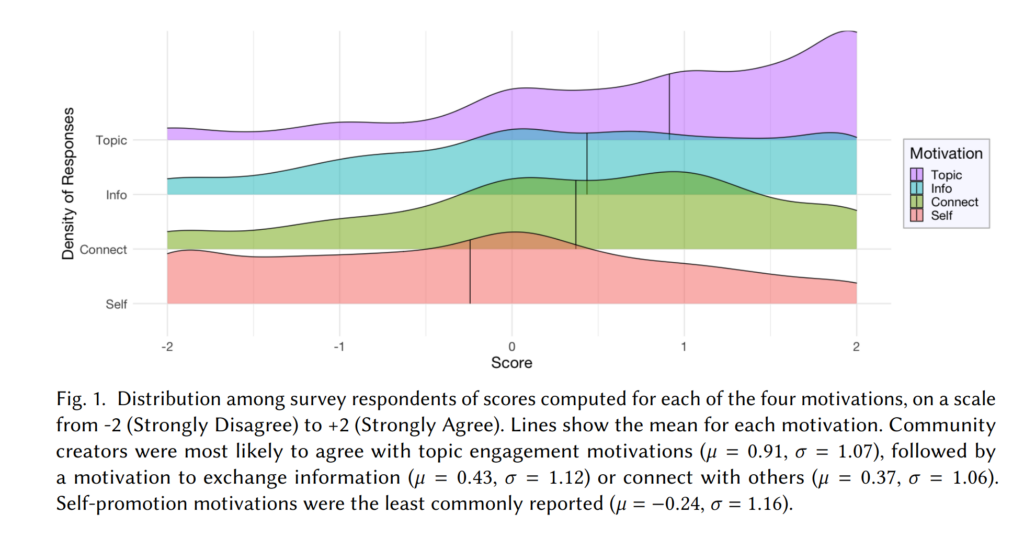
So, what did we learn? First, that founders have diverse motivations, but the most common is interest in the topic. As shown in the figure above, most founders reported being motivated by topic engagement, information exchange, and connecting with others, while self-promotion was much more rare.

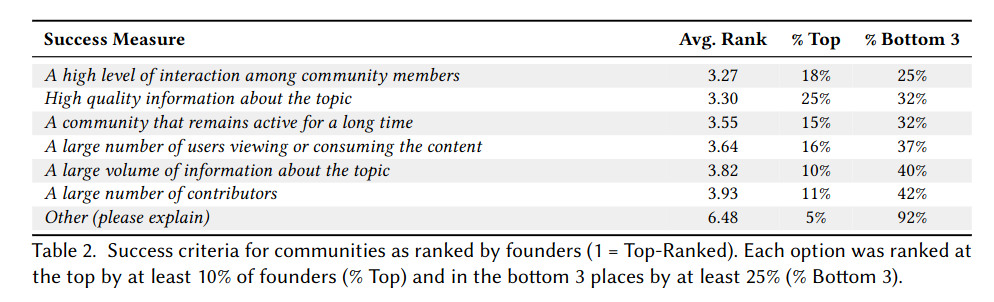
When we asked about their goals for the community, founders were split, and each of the options we gave was ranked as a top goal by a good chunk of participants. While there is some nuance between the different versions of success, we grouped them into “quantity-oriented” and “quality-oriented”, and looked at how motivations related to goals. Somewhat unsurprisingly, folks interested in self-promotion had quantity-oriented goals, while those interested in exchanging information were more focused on quality.

Diversity in plans

We then asked founders about what plans they had for building their community, based on recommendations from the online community literature, such as raising awareness, welcoming newcomers, encouraging contributions, and regulating bad behavior. Surprisingly, for each activity, about half of people said they planned to engage in doing that thing.

Early Community Outcomes

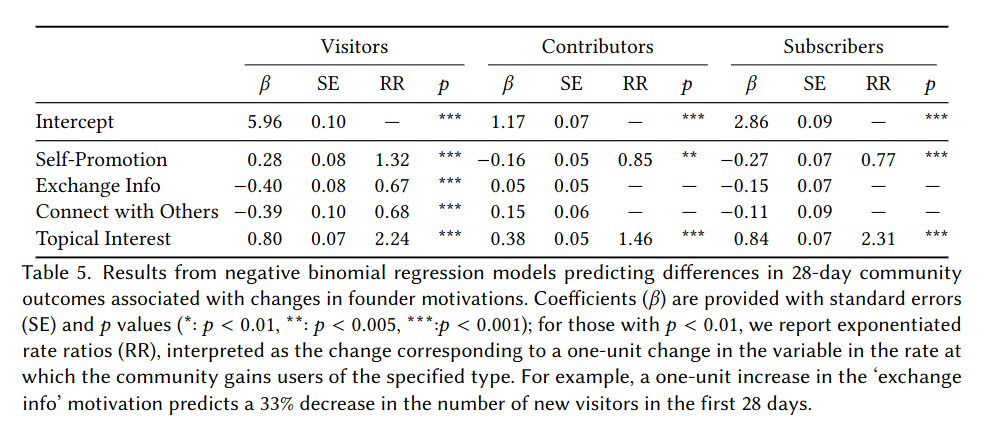
So, how do these motivations, goals, and plans relate to community outcomes? We looked at the first 28 days of each founded subreddit, and counted the number of visitors, number of contributors, and number of subscribers. We then ran regression analyses analyzing how well each aspect of motivations, goals, and plans predicted each outcome. High-level results and regression tables are shown below. For each row, when β is positive, that means that the given feature has a positive relationship with the given outcome. The exponentiated rate ratio (RR) column provides a point estimate of the effect size. For example, Self-Promotion has an RR of 1.32, meaning that if a given person’s self-promotion motivation was one unit higher the model predicts that their community would receive 32% more visitors.

A number of motivations predicted each of the outcomes we measured. The only consistently positive predictor was topical interest. Those who started a community because of interest in a topic had more visitors, more contributors, and more subscribers than others. Interestingly, those motivated by self-promotion had more visitors, but fewer contributors and subscribers.

Goals had a less pronounced relationship with outcomes. Those with quality-oriented goals had more contributors but fewer visitors than those with quantity-oriented goals. There was no significant difference in subscribers for founders with different types of goals.

Finally, raising awareness was the strategy most associated with our success metrics, predicting all three of them. Surprisingly, encouraging contributions was associated with more contributors, but fewer visitors. While we don’t know the mechanism for sure, asking for contributions seems to provide a barrier that discourages newcomers from taking interest in a community.

So what?

We think that there are some key takeaways for platform designers and those starting new communities. Sanjay outlined many of them on the Reddit engineering blog, but I’ll recap a few.

First, topical knowledge and passion is important. This isn’t a causal study, so we don’t know the mechanisms for sure, but people who are passionate about a topic may be aware of other communities in the space and are able to find the right niche; they are also probably better at writing the kinds of welcome messages, initial posts, etc. that appeal to people interested in the topic.

Second, our work is yet more evidence that communities require different things at different points in their lifecycle. Founders should probably focus on building awareness at first, and worry less about encouraging contributions or regulating behavior.

Finally, we think there are a lot of opportunities for designers to take diverse motivations and goals seriously. This could include matching people by their motivations for using a community, developing dashboards that capture different aspects of success and community health and quality, etc.

Learn More

If you want to learn more about the paper, you have options!

Sources of Underproduction in Open Source Software

Although the world relies on free/libre open source software (FLOSS) for essential digital infrastructure such as the web and cloud, the software that supports that infrastructure are not always as high quality as we might hope, given our level of reliance on them. How can we find this misalignment of quality and importance (or underproduction) before it causes major failures?

How can we find misalignment of quality and importance (underproduction) before it causes major failures?

In previous work, we found that underproduction is widespread in packages maintained by the Debian community, and when we shared this work in the Debian and FLOSS community, developers suggested that the age and language of the packages might be a factor, and tech managers suggested looking at the teams doing the maintenance work. Software engineering literature had found some support for these suspicions as well, and we embarked on a study to dig deeper into some of the factors associated with underproduction.

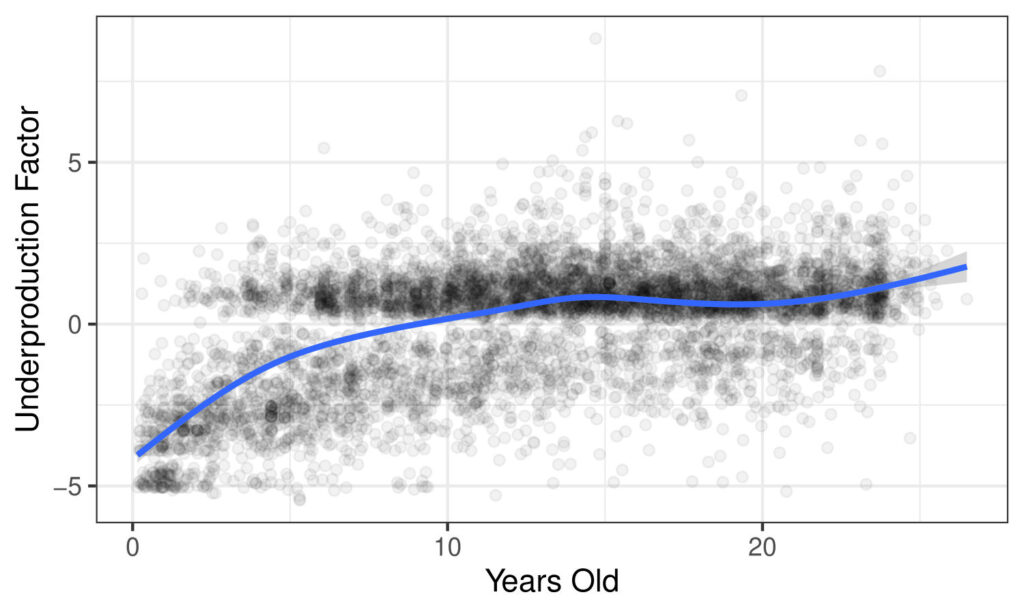
Our study was able to partially confirm this perspective using the underproduction analysis dataset from our previous study: software risk due to underproduction increases with age of both the package and its language, although many older packages and those written in older languages are and continue to be very well-maintained.

In this plot, dots represent software packages and their age, with higher underproduction factor indicating higher risk. The blue line is a smoothed average: note that we see an increase over time initially, but the trend flattens out for older packages.

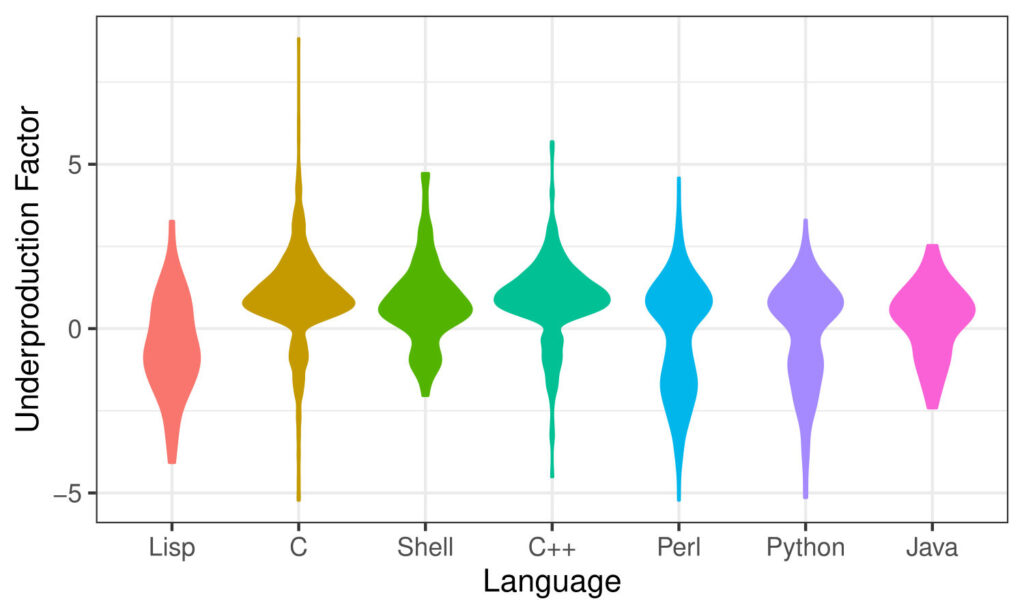
This plot shows the spread of the data across the range of underproduction factor, grouped by language, where higher values are indications of higher risk. Languages are sorted from oldest on the left (Lisp) to youngest on the right (Java). Although newer languages overall are associated with lower risk, we see a great deal of variation.

However, we found the resource question more complex: additional contributors were associated with higher risk instead of decreasing it as we hypothesized. We also found that underproduction is associated with higher eigenvector centrality in the network formed if we take packages as nodes and edges by having shared maintainers; that is, underproduced packages were likely to be maintained by the same people maintaining other parts of Debian, and not isolated efforts. This suggests that these high-risk packages are drawing from the same resource pool as those which are performing well. A lack of turnover in maintainership and being maintained by a team were not statistically significant once we included maintainer network structure and age in our model.

How should software communities respond? Underproduction appears in part to be associated with age, meaning that all communities sooner or later may need to confront it, and new projects should be thoughtful about using older languages. Distributions and upstream project developers are all part of the supply chain and have a role to play in the work of preventing and countering underproduction. Our findings about resources and organizational structure suggest that “more eyeballs” alone are not the answer: supporting key resources may be of particular value as a means to counter underproduction.

This paper will be presented as part of the International Conference on Software Analysis, Evolution and Reengineering (SANER) 2024 in Rovaniemi, Finland. Preprint available HERE; code and data released HERE.

This work would not have been possible without the generosity of the Debian community. We are indebted to these volunteers who, in addition to producing Free/Libre Open Source Software software, have also made their records available to the public. We also gratefully acknowledge support from the Sloan Foundation through the Ford/Sloan Digital Infrastructure Initiative, Sloan Award 2018-11356 as well as the National Science Foundation (Grant IIS-2045055). This work was conducted using the Hyak supercomputer at the University of Washington as well as research computing resources at Northwestern University.

FLOSS project risk and community formality

What structure and rules are best for communities producing high-quality free/libre and open source software (FLOSS)? The stakes are high: cybersecurity researchers are raising the alarm about cybersecurity risk due to undermaintained components in the global software supply chain—much of which is FLOSS. In work that’s just been accepted to the IEEE International Conference on Software Analysis, Evolution and Reengineering (‘SANER’), we studied 182 Python-language packages in the GNU/Linux Debian distribution, examining the relationship between their levels of engineering formality and software risk. We found that more formal developer organization is associated with higher levels of software risk, and more widely spread developer responsibility is associated with lower levels of software risk.

We studied software risk through the underproduction metric initially developed by Champion and Hill (2021). Underproduction is a measurement of misalignment between the usage demands of a software project and the contributions of the project’s developer community. As such, underproduction measures the risk that software will be undermaintained, possibly including a security bug.

Our work examines the relationship between risk due to underproduction and governance formality. We employed measures initially developed by Tamburri et al. (2013) and later re-implemented in Tamburri et al. (2019). These metrics use multiple measures of software project formality — such as the average contributor type, usage of GitHub milestones, and age — to evaluate how formally structured a given project is.

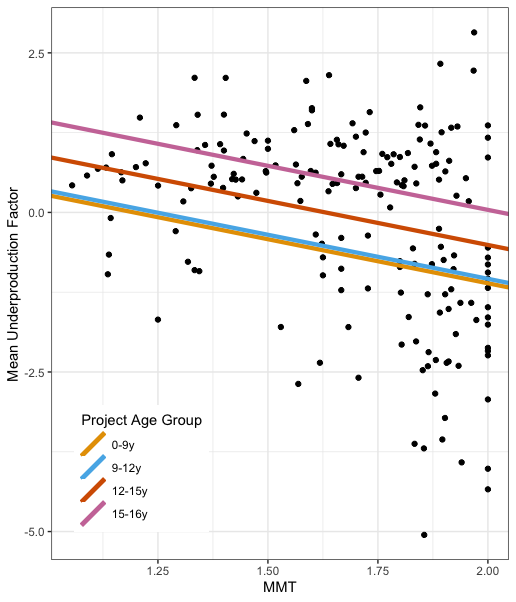
Plot of the relationship between mean underproduction factor and mean membership type (MMT), a metric encapsulating the diffusion of merge responsibility across a project’s developer community.


We used linear regression to conclude that more formal project structures are associated with higher levels of underproduction and thus, increased project risk. We also found that the share of community-members who have merged code into the main development branch is also related to underproduction, with lower levels of underproduction correlated with larger shares of community mergers.

Evaluated together, these two conclusions suggest that operating less formally and sharing power more equally is associated with lower underproduction risk. The development of FLOSS project engineering is a process laden with tradeoffs, we hope that our conclusions can help better inform community decision making and organization.

For more details, visualizations, statistics, and more, we hope you’ll take a look at our paper. If you are attending SANER in March 2024, we hope you’ll talk to us in Rovaniemi, Finland!

—————

The full citation for the paper is:

Gaughan, Matthew, Champion, Kaylea, and & Hwang, Sohyeon. (2024) “Engineering Formality and Software Risk in Debian Python Packages.” In 31st IEEE International Conference on Software Analysis, Evolution and Reengineering (SANER2024) (Short Paper and Posters Track). Rovaniemi, Finland.

We have also released replication materials for the paper, including all the data and code used to conduct the analyses.

This blog post and the paper it describes are collaborative work by Matt Gaughan, Kaylea Champion, and Sohyeon Hwang.

A new paper on the risk of nationalist governance capture in self-governed Wikipedia projects

Wikipedia is one of the most visited websites in the world and the largest online repository of human knowledge. It is also both a target of and a defense against misinformation, disinformation, and other forms of online information manipulation. Importantly, its 300 language editions are self-governed—i.e., they set most of their rules and policies. Our new paper asks: What types of governance arrangements make some self-governed online groups more vulnerable to disinformation campaigns? We answer this question by comparing two Wikipedia language editions—Croatian and Serbian Wikipedia. Despite relying on common software and being situated in a common sociolinguistic environment, these communities differed in how successfully they responded to disinformation-related threats.

For nearly a decade, the Croatian language version of Wikipedia was run by a cabal of far-right nationalists who edited articles in ways that promoted fringe political ideas and involved cases of historical revisionism related to the Ustaše regime, a fascist movement that ruled the Nazi puppet state called the Independent State of Croatia during World War II. This cabal seized complete control of the governance of the encyclopedia, banned and blocked those who disagreed with them, and operated a network of fake accounts to give the appearance of grassroots support for their policies.

Thankfully, Croatian Wikipedia appears to be an outlier. Though both the Croatian and Serbian language editions have been documented to contain nationalist bias and historical revisionism, Croatian Wikipedia alone seems to have succumbed to governance capture: a takeover of the project’s mechanisms and institutions of governance by a small group of users.

The situation in Croatian Wikipedia was well-documented and is now largely fixed, but still know very little about why Croatian Wikipedia was taken over, while other language editions seem to have rebuffed similar capture attempts. In a new paper that is accepted for publication in the Proceedings of the ACM: Human-Computer Interaction (CSCW), we present an interview-based study that tries to explain why Croatian was captured while several other editions facing similar contexts and threats fared better.

Short video presentation of the work given at Wikimania in August 2023.

We interviewed 15 participants from both the Croatian and Serbian Wikipedia projects, as well as the broader Wikimedia movement. Based on insights from these interviews, we arrived at three propositions that, together, help explain why Croatian Wikipedia succumbed to capture while Serbian Wikipedia did not: 

  1. Perceived Value as a Target. Is the project worth expending the effort to capture?
  2. Bureaucratic Openness. How easy is it for contributors outside the core founding team to ascend to local governance positions?
  3. Institutional Formalization. To what degree does the project prefer personalistic, informal forms of organization over formal ones?
The conceptual model from our paper, visualizing possible institutional configurations among Wikipedia projects that affect the risk of governance capture. 

We found that both Croatian Wikipedia and Serbian Wikipedia were attractive targets for far-right nationalist capture due to their sizable readership and resonance with a national identity. However, we also found that the two projects diverged early on in their trajectories in terms of how open they remained to new contributors ascending to local governance positions and the degree to which they privileged informal relationships over formal rules and processes as organizing principles of the project. Ultimately, Croatian’s relative lack of bureaucratic openness and rules constraining administrator behavior created a window of opportunity for a motivated contingent of editors to seize control of the governance mechanisms of the project. 

Though our empirical setting was Wikipedia, our theoretical model may offer insight into the challenges faced by self-governed online communities more broadly. As interest in decentralized alternatives to Facebook and X (formerly Twitter) grows, communities on these sites will likely face similar threats from motivated actors. Understanding the vulnerabilities inherent in these self-governing systems is crucial to building resilient defenses against threats like disinformation. 

For more details on our findings, take a look at the preprint of our paper.


Preprint on arxiv.org: https://arxiv.org/abs/2311.03616. The paper has been accepted for publication in Proceedings of the ACM on Human-Computer Interaction (CSCW) and will be presented at CSCW in 2024. This blog post and the paper it describes are collaborative work by Zarine Kharazian, Benjamin Mako Hill, and Kate Starbird.

Let’s talk about taboo! A new paper on how taboo shapes activity on Wikipedia

Taboo subjects—such as sexuality and mental health—are as important to discuss as they are difficult to raise in conversation. Although many people turn to online resources for information on taboo subjects, censorship and low quality information are common in search results. In work that has just been published at CSCW this week, we present a series of analyses that describe how taboo shapes the process of collaborative knowledge building on English Wikipedia. Our work shows that articles on taboo subjects are much more popular and the subject of more vandalism than articles on non-taboo topics. In surprising news, we also found that they were edited more often and were of higher quality! We also found that contributors to taboo articles did less to hide their identity than we expected.

Short video of a our presentation of the work given at Wikimania in August 2023.

The first challenge we faced in conducting our study was building a list of Wikipedia articles on taboo topics. This was challenging because while taboo is deeply cultural and can seem natural, our individual perspectives of what is and isn’t taboo is privileged and limited. In building our list, we wanted to avoid relying on our own intuition about what qualifies as taboo. Our approach was to make use of an insight from linguistics: people develop euphemisms as ways to talk about taboos. Think about all the euphemisms we’ve devised for death, or sex, or menstruation, or mental health. Using figurative languages lets us distance ourselves from the pollution of a taboo.

We used this insight to build a new machine learning classifier based on dictionary definitions in English Wiktionary. If a ‘sense’ of a word was tagged as a euphemism, we treated the words in the definition as indicators of taboo. The end result of this analysis is a series of words and phrases that most powerfully differentiate taboo from non-taboo. We then did a simple match between those words and phrases and Wikipedia article titles. We built a comparison sample of articles whose titles are words that, like our taboo articles, appear in Wiktionary definitions.

We used this new dataset to test a series of hypotheses about how taboo shapes collaborative production in Wikipedia. Our initial hypotheses were based on the idea that taboo information is often in high demand but that Wikipedians might be reluctant to associate their names (or usernames) with taboo topics. The result, we argued, would be articles that were in high demand but of low quality. What we found was that taboo articles are thriving on Wikipedia! In summary, we found in comparison to non-taboo articles:

  • Taboo articles are more popular (as expected).
  • Taboo articles receive more contributions (contrary to expectations).
  • Taboo articles receive more low-quality contributions (as expected).
  • Taboo articles are higher quality (contrary to expectations).
  • Taboo article contributors are more likely to contribute without an account (as expected), and have less experience (as expected), but that accountholders are more likely to make themselves more identifiable by having a user page, disclosing their gender, and making themselves emailable (all three of these are contrary to expectation!).

For more details, visualizations, statistics, and more, we hope you’ll take a look at our paper. If you are attending CSCW in October 2023, we also hope and come to our CSCW presentation in Minneapolis!


The full citation for the paper is: Champion, Kaylea, and Benjamin Mako Hill. 2023. “Taboo and Collaborative Knowledge Production: Evidence from Wikipedia.” Proceedings of the ACM on Human-Computer Interaction 7 (CSCW2): 299:1-299:25. https://doi.org/10.1145/3610090.

We have also released replication materials for the paper, including all the data and code used to conduct the analyses.

This blog post and the paper it describes are collaborative work by Kaylea Champion and Benjamin Mako Hill.

The social structure of new wiki communities

A new paper that our that our group has published seeks to test whether the kind of communication patterns associated with successful offline teams also predict success in online collaborative settings. Surprisingly, we find that it does not. In the rest of this blog post, we summarize that research and unpack that result.

Many of us have been part of a work team where everyone clicked. Everyone liked and respected each other, maybe you even hung out together outside of work. In a team like that, when someone asks you to cover a shift, or asks you to stay late to help them finish a project, you do it.

This anecdotal experience that many of us have is borne out by research. When members of work groups in corporate settings feel integrated into a group, and particularly when their identity is connected to their group membership, they are more willing to contribute to the group’s goals. Integrative groups (where there isn’t a strong hierarchy and where very few people are on the periphery) are also able to communicate and coordinate their work better.

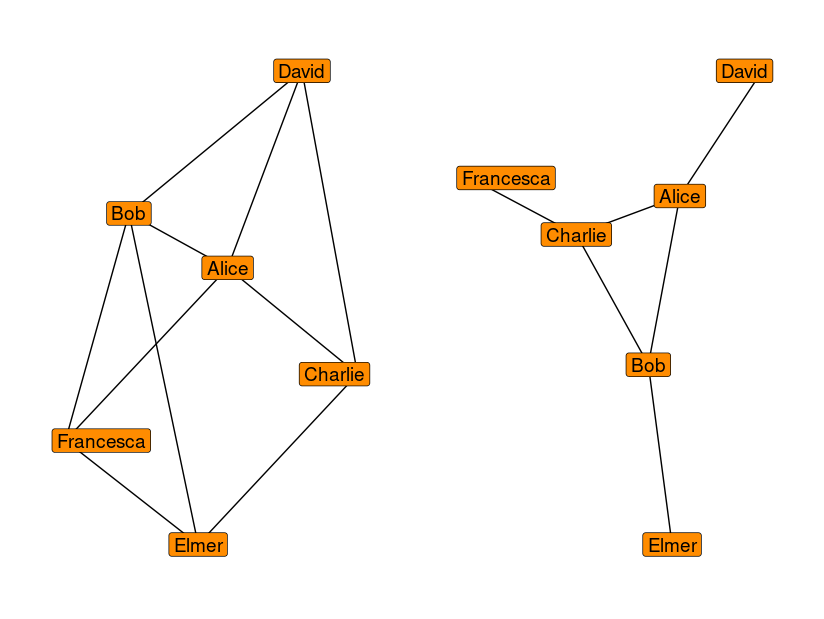
One way to measure whether a group is “integrative” is to look at the group’s conversation networks, as shown in the figure below. Groups where few people are on the periphery (like on the left) usually perform better along a number of dimensions, such as creativity and productivity.

Examples of two possible configurations of a work group. The work group on the left is much more “integrative,” and we would expect it to be more creative and productive.

In our new paper, we set out to look for evidence that early online wiki communities at Fandom.com work the same way as work groups. When communities are getting started, there are lots of reasons to think that they would also benefit from integrative networks. Their members typically don’t know each other and communicate mostly via text—conditions that should make building a shared identity tough. In addition, they are volunteers who can easily leave at any time. The research on work groups made us think that integrative social structures would be especially important in making new wikis successful.

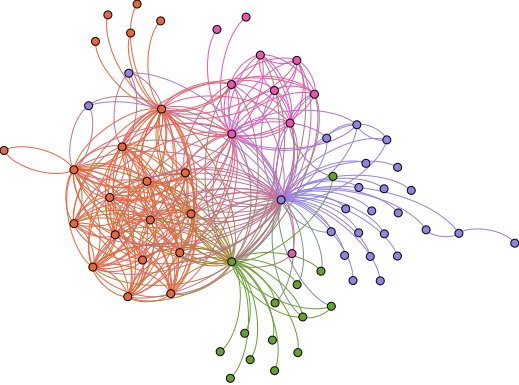
Communication network of the Spongebob wiki after 700 edits

In order to measure the social structure of these communities, we created communication networks for almost 1,000 wikis for the talk that happened during their firs 700 main page edits. Connections between people were based on who talked to whom on Talk pages. These are wiki pages connected to each page and each registered user on a wiki. We connected users who talked to each other at least a few times on the same talk pages, and looked at whether how integrative a communication network was predicted 1) how much people contributed and 2) how long a wiki remained active.

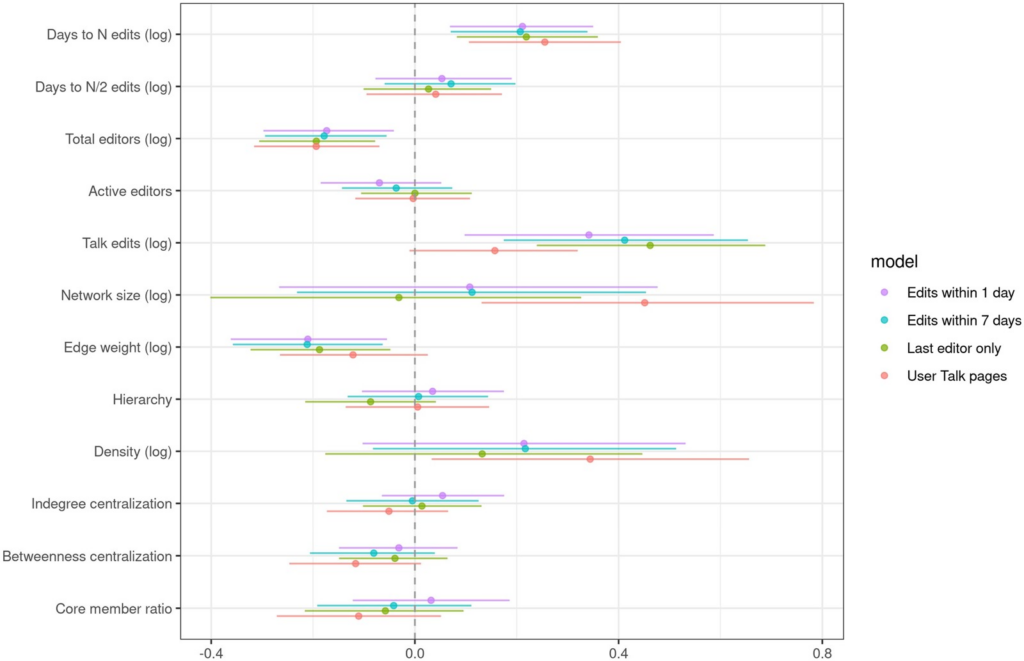
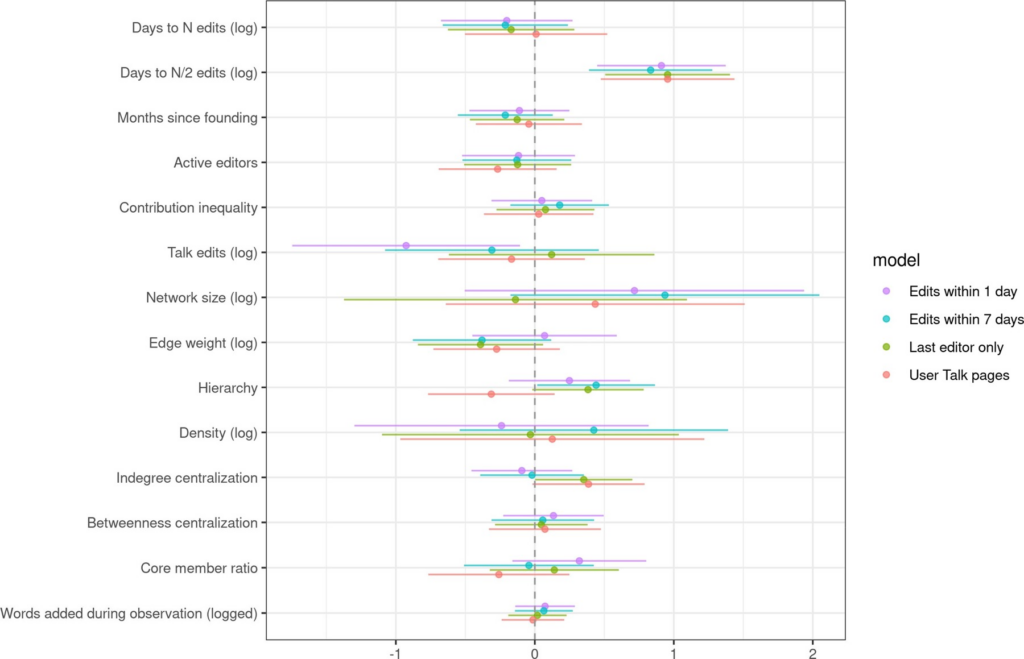
Surprisingly, we found that no matter how we measured communication networks, and no matter how we measured success, integrative network measures were not good at predicting that a wiki would survive or be productive. While a few of our control variables helped to predict productivity and survival, none of the network measures (nor all of them taken together) helped much to predict either of our success measures, as shown in Figures 5 and 6 from the paper.

Figure 5. Estimated coefficients predicting the productivity of a wiki.
Figure 6. Estimated coefficients predicting how quickly a wiki will become inactive.

So, what is going on here?

We have a few possible explanations for why communication network structures don’t seem to matter. One is that group identity for wiki members may not be influenced much by network structure. In a work group, it can be painfully obvious if you are on the periphery and not included in conversations or activities. Even though wiki conversations are technically all public and visible, in practice it’s very easy for group members to be unaware of conversations happening in other parts of the site. This idea is supported by research led by Sohyeon Hwang, which showed that people can build identity in an online community even without personal relationships.

Another complementary explanation for how groups coordinate work without integrative communication networks is that wiki software helps to organize what needs to be done without explicit communication. Much of this happens just because the central artifact of the community—the wiki—is continuously updated, so it is (relatively) clear what has been done and what needs to be done. In addition, there are opportunities for stigmergy. Stigmergy occurs when actors modifying the environment as a way of communicating. Then, others make decisions based on observing the environment. The canonical example is ants who leave pheremone trails for other ants to find and follow.

In wikis, this can be accomplished in a few ways. For example, contributors can create a link to a page that doesn’t yet exist. By default, these show up as red links, suggesting to others that a page needs to be created.

A final possible explanation for our results is based on how easy it is to join and leave online communities. It may be that integrative structures are so important because they help groups to overcome and navigate conflicts; in online communities contributors may be more likely to simply disengage instead of trying to resolve a conflict.

As we conclude in the paper:

Why do communication networks—important predictors of group performance outcomes across diverse domains—not predict productivity or survival in peer production? Our findings suggest that the relationship of communication structure to effective collaboration and organization is not universal but contingent. While all groups require coordination and undergo social influence, groups composed of different types of people or working in different technological contexts may have different communicative needs. Wikis provide a context where coordination via stigmergy may suffice and where the role of cheap exit as well as the difficulty of group-level conversation may lead to consensus-by-attrition.

We hope that others will help us to study some of these mechanisms more directly, and look forward to talking more with researchers and others interested in how and why online groups succeed.


The full citation for the paper is: Foote, Jeremy, Aaron Shaw, and Benjamin Mako Hill. 2023. “Communication Networks Do Not Predict Success in Attempts at Peer Production.” Journal of Computer-Mediated Communication 28 (3): zmad002. https://doi.org/10.1093/jcmc/zmad002.

We have also released replication materials for the paper, including all the data and code used to conduct the analyses.