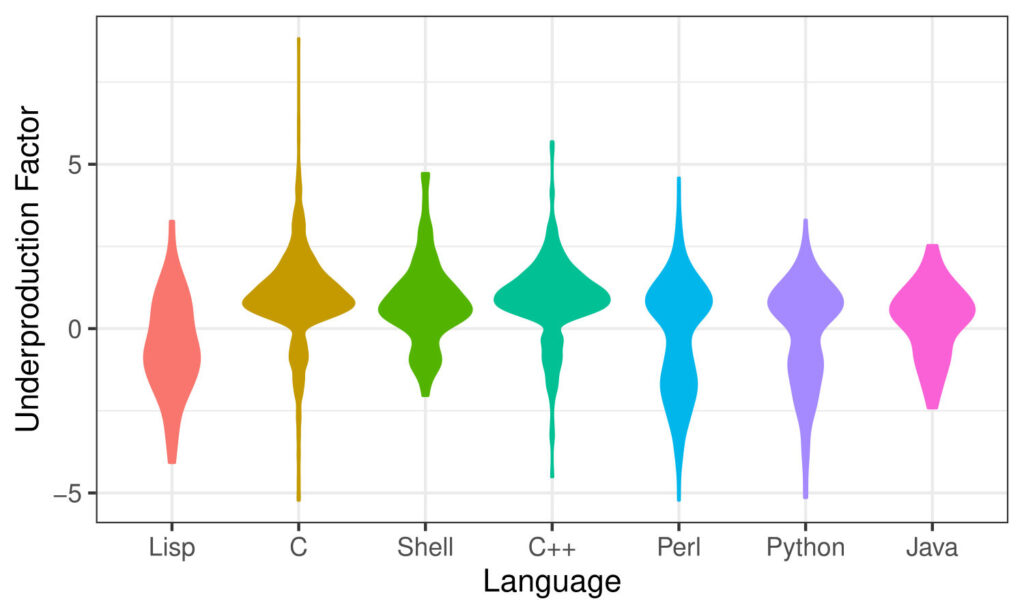
What structure and rules are best for communities producing high-quality free/libre and open source software (FLOSS)? The stakes are high: cybersecurity researchers are raising the alarm about cybersecurity risk due to undermaintained components in the global software supply chain—much of which is FLOSS. In work that’s just been accepted to the IEEE International Conference on Software Analysis, Evolution and Reengineering (‘SANER’), we studied 182 Python-language packages in the GNU/Linux Debian distribution, examining the relationship between their levels of engineering formality and software risk. We found that more formal developer organization is associated with higher levels of software risk, and more widely spread developer responsibility is associated with lower levels of software risk.
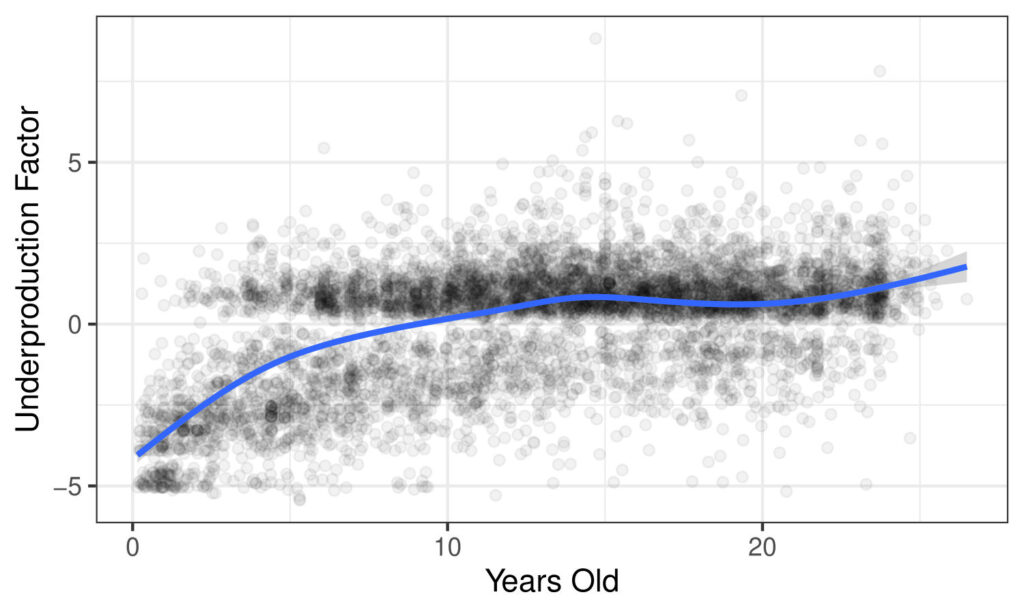
We studied software risk through the underproduction metric initially developed by Champion and Hill (2021). Underproduction is a measurement of misalignment between the usage demands of a software project and the contributions of the project’s developer community. As such, underproduction measures the risk that software will be undermaintained, possibly including a security bug.
Our work examines the relationship between risk due to underproduction and governance formality. We employed measures initially developed by Tamburri et al. (2013) and later re-implemented in Tamburri et al. (2019). These metrics use multiple measures of software project formality — such as the average contributor type, usage of GitHub milestones, and age — to evaluate how formally structured a given project is.
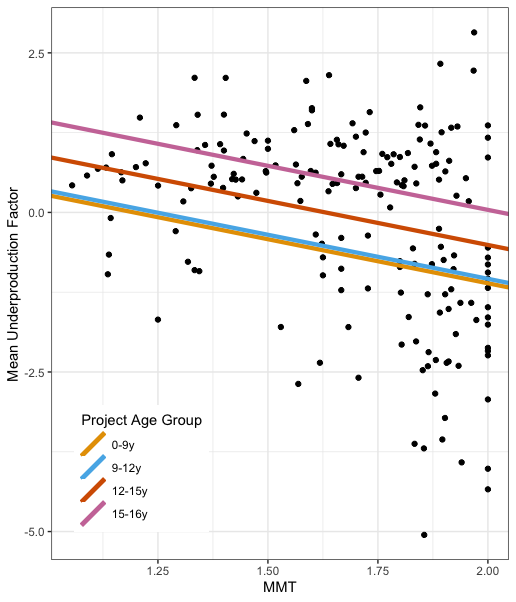
Plot of the relationship between mean underproduction factor and mean membership type (MMT), a metric encapsulating the diffusion of merge responsibility across a project’s developer community.
We used linear regression to conclude that more formal project structures are associated with higher levels of underproduction and thus, increased project risk. We also found that the share of community-members who have merged code into the main development branch is also related to underproduction, with lower levels of underproduction correlated with larger shares of community mergers.
Evaluated together, these two conclusions suggest that operating less formally and sharing power more equally is associated with lower underproduction risk. The development of FLOSS project engineering is a process laden with tradeoffs, we hope that our conclusions can help better inform community decision making and organization.
For more details, visualizations, statistics, and more, we hope you’ll take a look at our paper. If you are attending SANER in March 2024, we hope you’ll talk to us in Rovaniemi, Finland!
—————
The full citation for the paper is:
Gaughan, Matthew, Champion, Kaylea, and & Hwang, Sohyeon. (2024) “Engineering Formality and Software Risk in Debian Python Packages.” In 31st IEEE International Conference on Software Analysis, Evolution and Reengineering (SANER2024) (Short Paper and Posters Track). Rovaniemi, Finland.
We have also released replication materials for the paper, including all the data and code used to conduct the analyses.
Wikipedia is one of the most visited websites in the world and the largest online repository of human knowledge. It is also both a target of and a defense against misinformation, disinformation, and other forms of online information manipulation. Importantly, its 300 language editions are self-governed—i.e., they set most of their rules and policies. Our new paper asks: What types of governance arrangements make some self-governed online groups more vulnerable to disinformation campaigns? We answer this question by comparing two Wikipedia language editions—Croatian and Serbian Wikipedia. Despite relying on common software and being situated in a common sociolinguistic environment, these communities differed in how successfully they responded to disinformation-related threats.
For nearly a decade, the Croatian language version of Wikipedia was run by a cabal of far-right nationalists who edited articles in ways that promoted fringe political ideas and involved cases of historical revisionism related to the Ustaše regime, a fascist movement that ruled the Nazi puppet state called the Independent State of Croatia during World War II. This cabal seized complete control of the governance of the encyclopedia, banned and blocked those who disagreed with them, and operated a network of fake accounts to give the appearance of grassroots support for their policies.
Thankfully, Croatian Wikipedia appears to be an outlier. Though both the Croatian and Serbian language editions have been documented to contain nationalist bias and historical revisionism, Croatian Wikipedia alone seems to have succumbed to governance capture: a takeover of the project’s mechanisms and institutions of governance by a small group of users.
The situation in Croatian Wikipedia was well-documented and is now largely fixed, but still know very little about why Croatian Wikipedia was taken over, while other language editions seem to have rebuffed similar capture attempts. In a new paper that is accepted for publication in the Proceedings of the ACM: Human-Computer Interaction (CSCW), we present an interview-based study that tries to explain why Croatian was captured while several other editions facing similar contexts and threats fared better.
Short video presentation of the work given at Wikimania in August 2023.
We interviewed 15 participants from both the Croatian and Serbian Wikipedia projects, as well as the broader Wikimedia movement. Based on insights from these interviews, we arrived at three propositions that, together, help explain why Croatian Wikipedia succumbed to capture while Serbian Wikipedia did not:
Perceived Value as a Target. Is the project worth expending the effort to capture?
Bureaucratic Openness. How easy is it for contributors outside the core founding team to ascend to local governance positions?
Institutional Formalization. To what degree does the project prefer personalistic, informal forms of organization over formal ones?
The conceptual model from our paper, visualizing possible institutional configurations among Wikipedia projects that affect the risk of governance capture.
We found that both Croatian Wikipedia and Serbian Wikipedia were attractive targets for far-right nationalist capture due to their sizable readership and resonance with a national identity. However, we also found that the two projects diverged early on in their trajectories in terms of how open they remained to new contributors ascending to local governance positions and the degree to which they privileged informal relationships over formal rules and processes as organizing principles of the project. Ultimately, Croatian’s relative lack of bureaucratic openness and rules constraining administrator behavior created a window of opportunity for a motivated contingent of editors to seize control of the governance mechanisms of the project.
Though our empirical setting was Wikipedia, our theoretical model may offer insight into the challenges faced by self-governed online communities more broadly. As interest in decentralized alternatives to Facebook and X (formerly Twitter) grows, communities on these sites will likely face similar threats from motivated actors. Understanding the vulnerabilities inherent in these self-governing systems is crucial to building resilient defenses against threats like disinformation.
For more details on our findings, take a look at the preprint of our paper.
Preprint on arxiv.org: https://arxiv.org/abs/2311.03616. The paper has been accepted for publication in Proceedings of the ACM on Human-Computer Interaction (CSCW) and will be presented at CSCW in 2024. This blog post and the paper it describes are collaborative work by Zarine Kharazian, Benjamin Mako Hill, and Kate Starbird.
Taboo subjects—such as sexuality and mental health—are as important to discuss as they are difficult to raise in conversation. Although many people turn to online resources for information on taboo subjects, censorship and low quality information are common in search results. In work that has just been published at CSCW this week, we present a series of analyses that describe how taboo shapes the process of collaborative knowledge building on English Wikipedia. Our work shows that articles on taboo subjects are much more popular and the subject of more vandalism than articles on non-taboo topics. In surprising news, we also found that they were edited more often and were of higher quality! We also found that contributors to taboo articles did less to hide their identity than we expected.
Short video of a our presentation of the work given at Wikimania in August 2023.
The first challenge we faced in conducting our study was building a list of Wikipedia articles on taboo topics. This was challenging because while taboo is deeply cultural and can seem natural, our individual perspectives of what is and isn’t taboo is privileged and limited. In building our list, we wanted to avoid relying on our own intuition about what qualifies as taboo. Our approach was to make use of an insight from linguistics: people develop euphemisms as ways to talk about taboos. Think about all the euphemisms we’ve devised for death, or sex, or menstruation, or mental health. Using figurative languages lets us distance ourselves from the pollution of a taboo.
We used this insight to build a new machine learning classifier based on dictionary definitions in English Wiktionary. If a ‘sense’ of a word was tagged as a euphemism, we treated the words in the definition as indicators of taboo. The end result of this analysis is a series of words and phrases that most powerfully differentiate taboo from non-taboo. We then did a simple match between those words and phrases and Wikipedia article titles. We built a comparison sample of articles whose titles are words that, like our taboo articles, appear in Wiktionary definitions.
We used this new dataset to test a series of hypotheses about how taboo shapes collaborative production in Wikipedia. Our initial hypotheses were based on the idea that taboo information is often in high demand but that Wikipedians might be reluctant to associate their names (or usernames) with taboo topics. The result, we argued, would be articles that were in high demand but of low quality. What we found was that taboo articles are thriving on Wikipedia! In summary, we found in comparison to non-taboo articles:
Taboo articles are more popular (as expected).
Taboo articles receive more contributions (contrary to expectations).
Taboo articles receive more low-quality contributions (as expected).
Taboo articles are higher quality (contrary to expectations).
Taboo article contributors are more likely to contribute without an account (as expected), and have less experience (as expected), but that accountholders are more likely to make themselves more identifiable by having a user page, disclosing their gender, and making themselves emailable (all three of these are contrary to expectation!).
For more details, visualizations, statistics, and more, we hope you’ll take a look at our paper. If you are attending CSCW in October 2023, we also hope and come to our CSCW presentation in Minneapolis!
The full citation for the paper is: Champion, Kaylea, and Benjamin Mako Hill. 2023. “Taboo and Collaborative Knowledge Production: Evidence from Wikipedia.” Proceedings of the ACM on Human-Computer Interaction 7 (CSCW2): 299:1-299:25. https://doi.org/10.1145/3610090.
A new paper that our that our group has published seeks to test whether the kind of communication patterns associated with successful offline teams also predict success in online collaborative settings. Surprisingly, we find that it does not. In the rest of this blog post, we summarize that research and unpack that result.
Many of us have been part of a work team where everyone clicked. Everyone liked and respected each other, maybe you even hung out together outside of work. In a team like that, when someone asks you to cover a shift, or asks you to stay late to help them finish a project, you do it.
This anecdotal experience that many of us have is borne out by research. When members of work groups in corporate settings feel integrated into a group, and particularly when their identity is connected to their group membership, they are more willing to contribute to the group’s goals. Integrative groups (where there isn’t a strong hierarchy and where very few people are on the periphery) are also able to communicate and coordinate their work better.
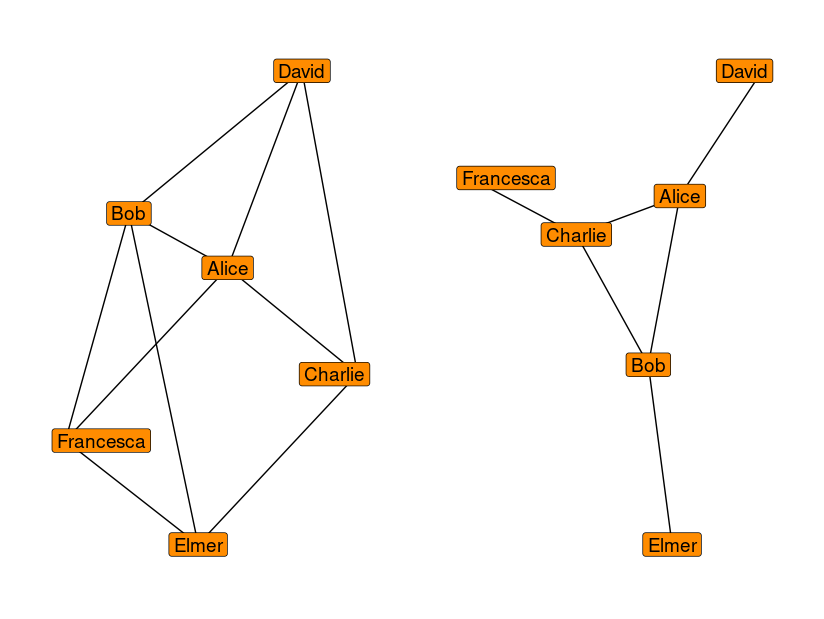
One way to measure whether a group is “integrative” is to look at the group’s conversation networks, as shown in the figure below. Groups where few people are on the periphery (like on the left) usually perform better along a number of dimensions, such as creativity and productivity.
Examples of two possible configurations of a work group. The work group on the left is much more “integrative,” and we would expect it to be more creative and productive.
In our new paper, we set out to look for evidence that early online wiki communities at Fandom.com work the same way as work groups. When communities are getting started, there are lots of reasons to think that they would also benefit from integrative networks. Their members typically don’t know each other and communicate mostly via text—conditions that should make building a shared identity tough. In addition, they are volunteers who can easily leave at any time. The research on work groups made us think that integrative social structures would be especially important in making new wikis successful.
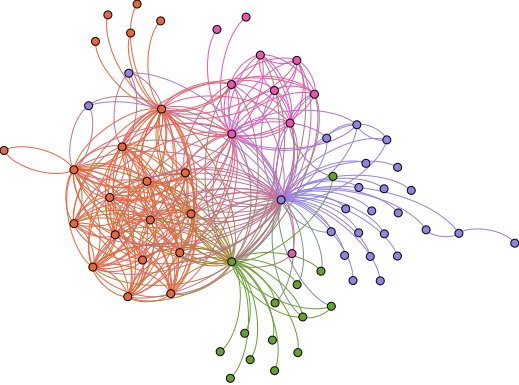
Communication network of the Spongebob wiki after 700 edits
In order to measure the social structure of these communities, we created communication networks for almost 1,000 wikis for the talk that happened during their firs 700 main page edits. Connections between people were based on who talked to whom on Talk pages. These are wiki pages connected to each page and each registered user on a wiki. We connected users who talked to each other at least a few times on the same talk pages, and looked at whether how integrative a communication network was predicted 1) how much people contributed and 2) how long a wiki remained active.
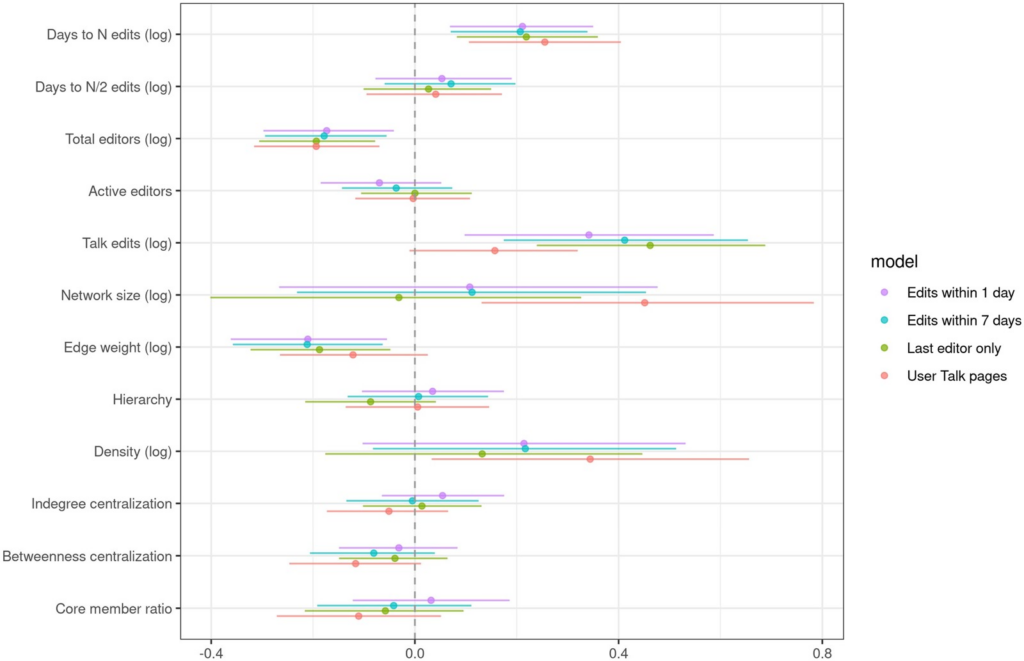
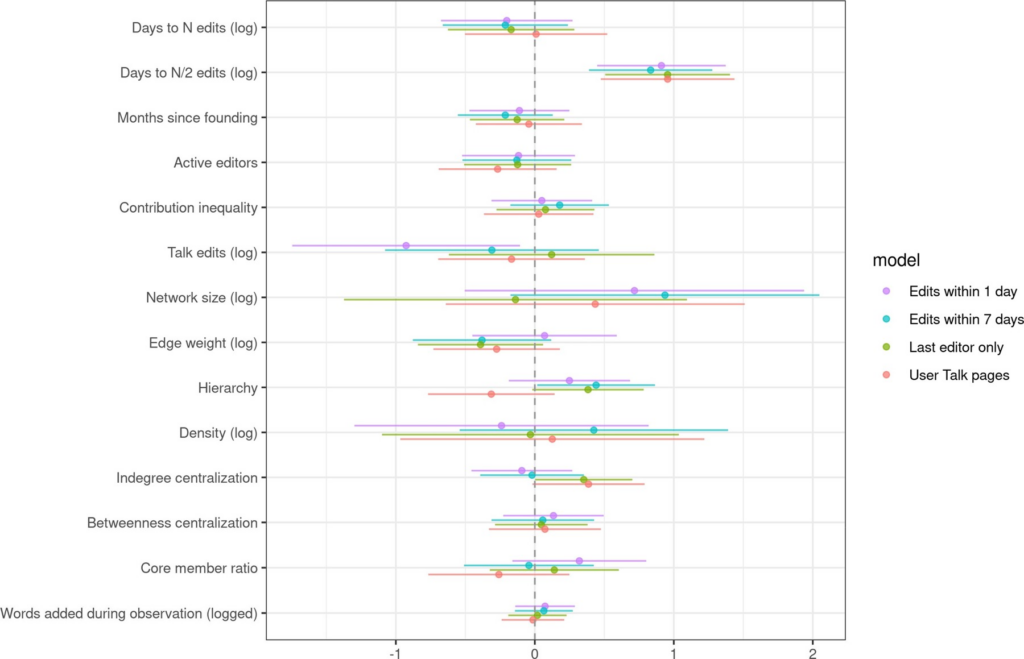
Surprisingly, we found that no matter how we measured communication networks, and no matter how we measured success, integrative network measures were not good at predicting that a wiki would survive or be productive. While a few of our control variables helped to predict productivity and survival, none of the network measures (nor all of them taken together) helped much to predict either of our success measures, as shown in Figures 5 and 6 from the paper.
Figure 5. Estimated coefficients predicting the productivity of a wiki.Figure 6. Estimated coefficients predicting how quickly a wiki will become inactive.
So, what is going on here?
We have a few possible explanations for why communication network structures don’t seem to matter. One is that group identity for wiki members may not be influenced much by network structure. In a work group, it can be painfully obvious if you are on the periphery and not included in conversations or activities. Even though wiki conversations are technically all public and visible, in practice it’s very easy for group members to be unaware of conversations happening in other parts of the site. This idea is supported by research led by Sohyeon Hwang, which showed that people can build identity in an online community even without personal relationships.
Another complementary explanation for how groups coordinate work without integrative communication networks is that wiki software helps to organize what needs to be done without explicit communication. Much of this happens just because the central artifact of the community—the wiki—is continuously updated, so it is (relatively) clear what has been done and what needs to be done. In addition, there are opportunities for stigmergy. Stigmergy occurs when actors modifying the environment as a way of communicating. Then, others make decisions based on observing the environment. The canonical example is ants who leave pheremone trails for other ants to find and follow.
In wikis, this can be accomplished in a few ways. For example, contributors can create a link to a page that doesn’t yet exist. By default, these show up as red links, suggesting to others that a page needs to be created.
A final possible explanation for our results is based on how easy it is to join and leave online communities. It may be that integrative structures are so important because they help groups to overcome and navigate conflicts; in online communities contributors may be more likely to simply disengage instead of trying to resolve a conflict.
As we conclude in the paper:
Why do communication networks—important predictors of group performance outcomes across diverse domains—not predict productivity or survival in peer production? Our findings suggest that the relationship of communication structure to effective collaboration and organization is not universal but contingent. While all groups require coordination and undergo social influence, groups composed of different types of people or working in different technological contexts may have different communicative needs. Wikis provide a context where coordination via stigmergy may suffice and where the role of cheap exit as well as the difficulty of group-level conversation may lead to consensus-by-attrition.
We hope that others will help us to study some of these mechanisms more directly, and look forward to talking more with researchers and others interested in how and why online groups succeed.
The full citation for the paper is: Foote, Jeremy, Aaron Shaw, and Benjamin Mako Hill. 2023. “Communication Networks Do Not Predict Success in Attempts at Peer Production.” Journal of Computer-Mediated Communication 28 (3): zmad002. https://doi.org/10.1093/jcmc/zmad002.
Many online platforms are adopting machine learning as a tool to maintain order and high quality information in the face of massive influxes of of user generated content. Of course, machine learning algorithms can be inaccurate, biased or unfair. How do signals from machine learning predictions shape the fairness of online content moderation? How can we measure an algorithmic flagging system’s effects?
In our paper published at CSCW 2021, I (Nate TeBlunthuis) together with Benjamin Mako Hill and Aaron Halfaker analyzed the RCFilters system: an add-on to Wikipedia that highlights and filters edits that a machine learning algorithm called ORES identifies as likely to be damaging to Wikipedia. This system has been deployed on large Wikipedia language editions and is similar to other algorithmic flagging systems that are becoming increasingly widespread. Our work measures the causal effect of being flagged in the RCFilters user interface.
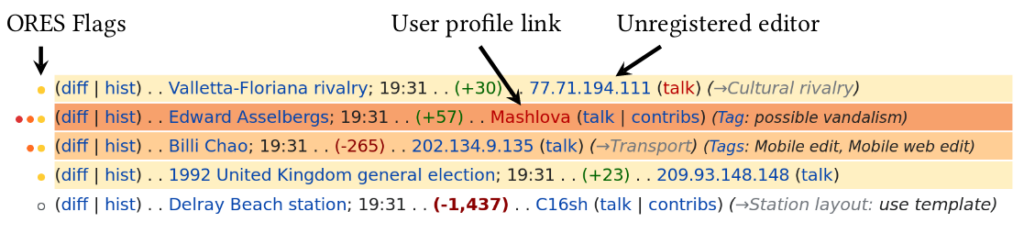
Screenshot of Wikipedia edit metadata on Special:RecentChanges with RCFilters enabled. Highlighted edits with a colored circle to the left side of other metadata are flagged by ORES. Different circle and highlight colors (white, yellow, orange, and red in the figure) correspond to different levels of confidence that the edit is damaging. RCFilters does not specifically flag edits by new accounts or unregistered editors, but does support filtering changes by editor types.
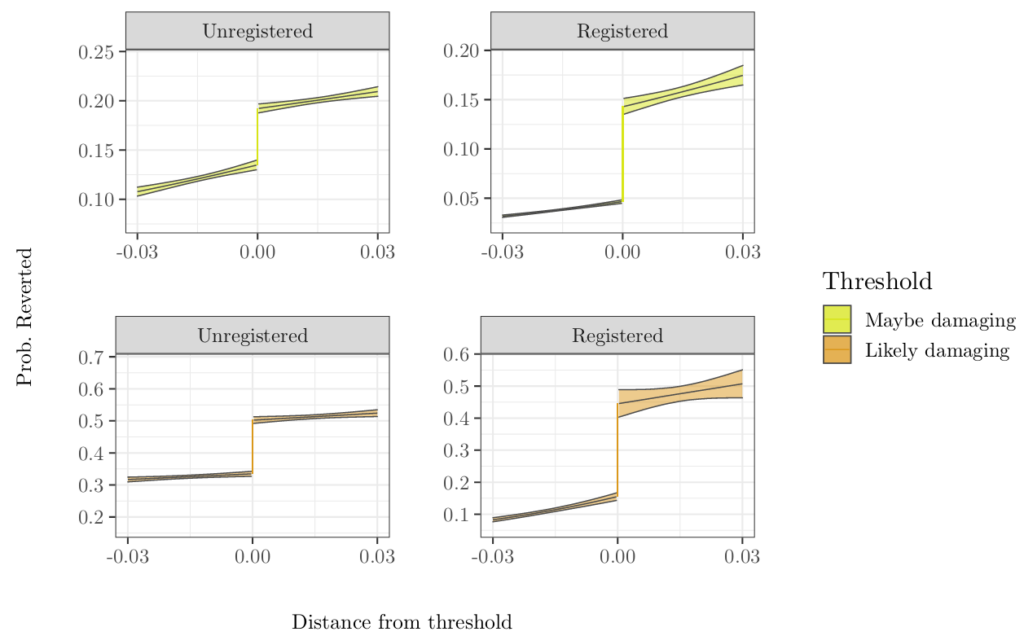
Our work takes advantage of the fact that RCFilters, like many algorithmic flagging systems, create discontinuities in the relationship between the probability that a moderator should take action and whether a moderator actually does. This happens because the output of machine learning systems like ORES is typically a continuous score (in RCFilters, an estimated probability that a Wikipedia edit is damaging), while the flags (in RCFilters, the yellow, orange, or red highlights) are either on or off and are triggered when the score crosses some arbitrary threshold. As a result, edits slightly above the threshold are both more visible to moderators and appear more likely to be damaging than edits slightly below. Even though edits on either side of the threshold have virtually the same likelihood of truly being damaging, the flagged edits are substantially more likely to be reverted. This fact lets us use a method called regression discontinuity to make causal estimates of the effect of being flagged in RCFilters.
Charts showing the probability that an edit will be reverted as function of ORES scores in the neighborhood of the discontinuous threshold that triggers the RCfilters flag. The jump in the increase in reversion chances is larger for registered editors compared to unregistered editors at both thresholds.
To understand how this system may effect the fairness of Wikipedia moderation, we estimate the effects of flagging on edits on different groups of editors. Comparing the magnitude of these estimates lets us measure how flagging is associated with several different definitions of fairness. Surprisingly, we found evidence that these flags improved fairness for categories of editors that have been widely perceived as troublesome—particularly unregistered (anonymous) editors. This occurred because flagging has a much stronger effect on edits by the registered than on edits by the unregistered.
We believe that our results are driven by the fact algorithmic flags are especially helpful for finding damage that can’t be easily detected otherwise. Wikipedia moderators can see the editor’s registration status in the recent changes, watchlists, and edit history. Because unregistered editors are often troublesome, Wikipedia moderators’ attention is often focused on their contributions, with or without algorithmic flags. Algorithmic flags make damage by registered editors (in addition to unregistered editors) much more detectable to moderators and so help moderators focus on damage overall, not just damage by suspicious editors. As a result, the algorithmic flagging system decreases the bias that moderators have against unregistered editors.
This finding is particularly surprising because the ORES algorithm we analyzed was itself demonstrably biased againstunregistered editors (i.e., the algorithm tended to greatly overestimate the probability that edits by these editors were damaging). Despite the fact that the algorithms were biased, their introduction could still lead to less biased outcomes overall.
Our work shows that although it is important to design predictive algorithms to not have such biases, it is equally important to study fairness at the level of the broader sociotechnical system. Since we first published a preprint of our paper, a followup piece by Leijie Wang and Haiyi Zhu replicated much of our work and showed that differences between different Wikipedia communities may be another important factor driving the effect of the system. Overall, this work suggests that social signals and social context can interact with algorithmic signals and together these can influence behavior in important and unexpected ways.
The full citation for the paper is: TeBlunthuis, Nathan, Benjamin Mako Hill, and Aaron Halfaker. 2021. “Effects of Algorithmic Flagging on Fairness: Quasi-Experimental Evidence from Wikipedia.” Proceedings of the ACM on Human-Computer Interaction 5 (CSCW): 56:1-56:27. https://doi.org/10.1145/3449130.
We have also released replication materials for the paper, including all the data and code used to conduct the analysis and compile the paper itself.
Inequality and discrimination in the labor market is a persistent and sometimes devastating problem for job seekers. Increasingly, labor is moving to online platforms, but labor inequality and discrimination research often overlooks work that happens on such platforms. Do research findings from traditional labor contexts generalize to the online realm? We have reason to think perhaps not, since entering the online labor market requires specific technical infrastructure and skills (as we showed in this paper). Besides, hiring processes for online platforms look significantly different: these systems use computational structures to organize labor at a scale that exceeds any hiring operation in the traditional labor market.
To understand what research on patterns of inequality and discrimination in the gig economy is out there and to identify remaining puzzles, I (Floor) systematically gathered, analyzed, and synthesized studies on this topic. The result is a paper recently published in New Media & Society.
I took a systematic approach in order to capture all the different strands of inquiry across various academic fields. These different strands might use different methods and even different language but, crucially, still describe similar phenomena. For this review, Siying Luo (research assistant on this project) and I gathered literature from five academic databases covering multiple disciplines. By sifting through many journal articles and conference proceedings, we identified 39 studies of participation and success in the online labor market.
Most research focuses on individual-level resources and biases as a source of unequal participation, rather than the role of the platform.
Three approaches
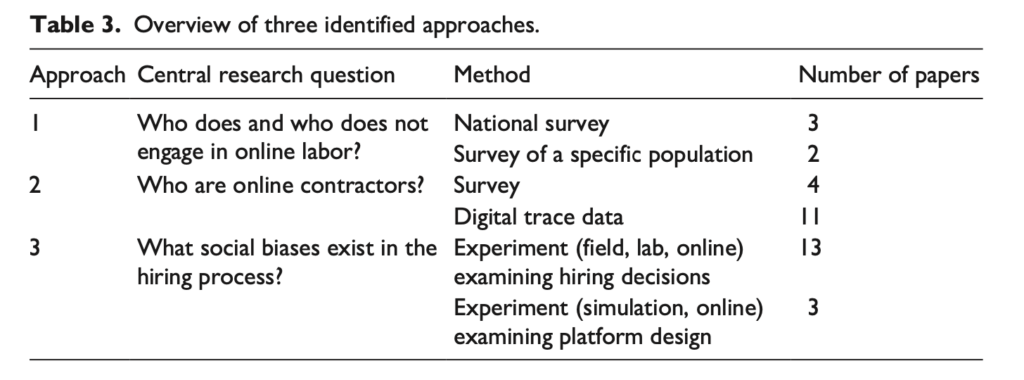
I found three approaches to the study of inequality and discrimination in the gig economy. All address distinct research questions drawing on different methods and framing (see the table below for an overview).
Approach 1 asks who does and who does not engage in online labor. This strand of research takes into account the voices of both those who have pursued such labor and those who have not. Five studies take this approach, of which three draw on national survey data and two others examine participation among a specific population (such as older adults).
Approach 2 asks who online contractors are. Some of this research describes the sociodemographic composition of contractors by surveying them or by analyzing digital trace data. Other studies focus on labor outcomes, identifying who among those that pursue online labor actually land jobs and generate an income. You might imagine a study asking whether male contractors make more money on an online platform than female contractors do.
Approach 3 asks what social biases exist in the hiring process, both on the side of individual users making hiring decisions and the algorithms powering the online labor platforms. Studies taking this approach tend to rely on experiments that test the impact of some manipulation in the contractor’s sociodemographic background on an outcome, such as whether they get featured by the platform or whether they get hired.
Extended pipeline of online participation inequalities
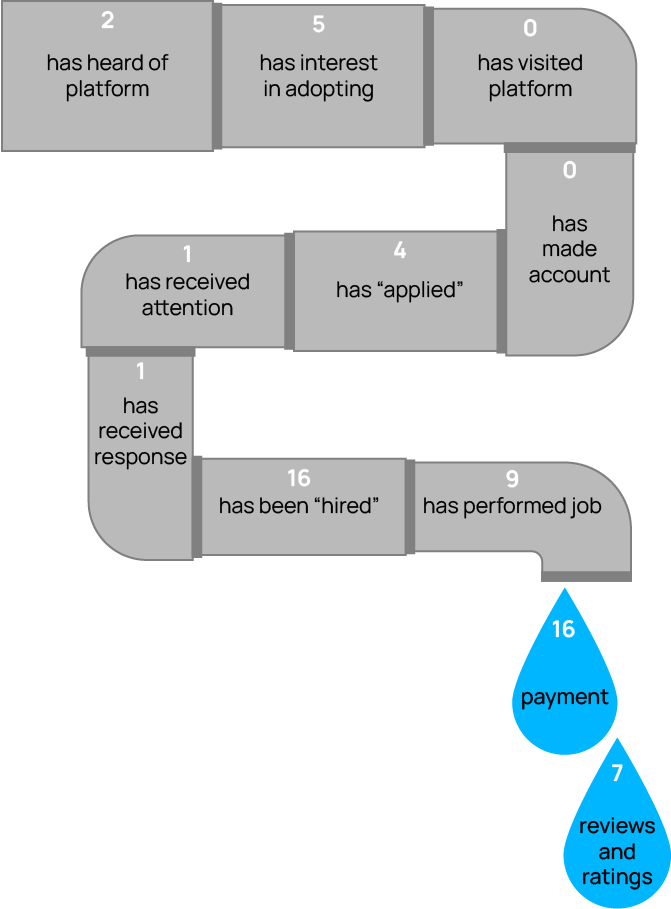
In addition to identifying these three approaches, I map the outcomes variables of all studies across an extended version of the so-called pipeline of participation inequalities (as coined and tested in this paper). This model breaks down the steps one needs to take before being able to contribute online, presenting them in the form of a pipeline. Studying online participation as stages of the pipeline allows for the identification of barriers since it reveals the spots where people face obstacles and drop out before fully participating. Mapping the literature on inequality and discrimination in the gig economy across stages of a pipeline proved helpful in understanding and visualizing what parts of the process of becoming an online contractor have been studied and what parts require more attention.
I extended the pipeline of participation inequalities to fit the process of participating in the gig economy. This form of online participation does not only require having the appropriate access and skills to participate, but also requires garnering attention and getting hired. The extended pipeline model has eleven stages: from having heard of a platform to receiving payment as well as reviews and ratings for having performed a job. The figure below shows a visualization of the pipeline with the number of studies that study an outcome variable associated with each stage.
The extended pipeline of participation inequalities, specific to the process of becoming an online contractor, with the number of studies that examined each stage
When mapping the studies across the pipeline, we find that two stages have been studied much more than others. Prior literature primarily examines whether individuals who pursue work online are getting hired and receiving a payment. In contrast, the literature in this scoping review hardly examined earlier stages of the pipeline.
So, what should we take away?
After systematically gathering and analyzing the literature on inequality and discrimination in the online labor market, I want to highlight three takeaways.
One: Most of the research focuses on individual-level resources and biases as a source of unequal participation. This scoping review points to a need for future research to examine the specific role of the platform in facilitating inequality and discrimination.
Two: The literature thus far has primarily focused on behaviors at the end of the pipeline of participation inequalities (i.e., having been hired and received payment). Studying earlier stages is important as it might explain patterns of success in later stages. In addition, such studies are also worthwhile inquiries in their own right. Insights into who meets these conditions of participation and desired labor outcomes are valuable, for example, in designing policy interventions.
Three: Hardly any research looks at participation across multiple stages of the pipeline. Considering multiple stages in one study is important to identify the moments that individuals face obstacles and how sociodemographic factors relate to making it from one stage to the next.
Floor Fiers is PhD candidate at Northwestern University in the Media, Technology, and Society program. They received support and advice from other members of the collective. Most notably, Siying Luo contributed greatly to this project as a research assistant.
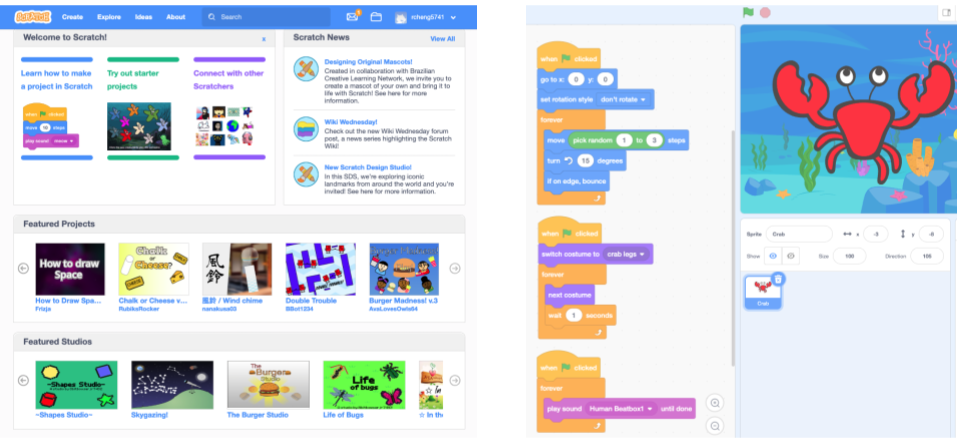
Thousands of widely used online communities are designed to promote learning. Although some rely on formal educational approaches like lesson plans, curriculum, and tests, many of the most successful learning communities online are structured as what scholars call a community of practice (CoP). In CoPs, members mentor and apprentice with each other (both formally and informally) while working toward a common interest or goal. For example, the Scratch online community is a CoP where millions of young people share and collaborate on programming projects.
Despite an enormous amount of attention paid to online CoPs, there is still a lot of disagreement about the best ways to promote learning in them. One source of disagreement stems from the fact that participants in CoPs are learning a number of different kinds of things and designers are often trying to support many types of learning at once. In a new paper that I’ve published—and that I will be presenting at CSCW this week—I conduct quantitative analyses on data from Scratch to show that there is a complex set of learning pathways at play in CoPs like Scratch. Types of participation that are associated with some important kinds of learning are often unrelated to, or even negatively associated with, other important types of learning outcomes.
The Scratch online community (left) and an example of a programming project in Scratch (right).
So what exactly are people learning in CoPs? We dug into the CoP literature and identified three major types of learning outcomes:
Learning about the domain, which refers to learning knowledge and skills for the core tasks necessary for achieving the explicit goal in the community. In Scratch, this is learning to code.
Learning about the community, which means the development of identity as a community member, forming relationships, affinities, and a sense of belonging. In Scratch, this involves learning to interact with others users and developing an identity as a community member.
Learning about the practice, which means adopting community specific values, such as the style of contribution that will be accepted and appreciated by its members. In Scratch, this means becoming a valued and respected contributor to the community.
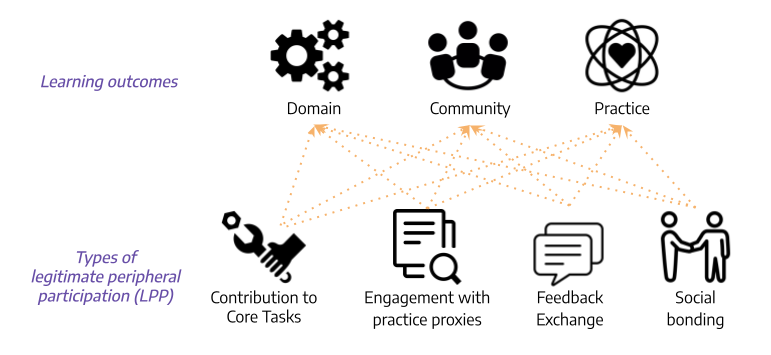
So what types of participation might contribute to learning in a CoP? We identified several different types of newcomers’ participation that may support learning:
Contribution to core tasks which involves direct work towards the community’s explicit goal. In Scratch, this often involves making original programming projects.
Engagement with practice proxies which involves observing and participating in others’ work practices. In Scratch, this might mean remixing others’ projects by making changes and building on existing code.
Feedback exchange with community members about their contributions. In Scratch, this often involves writing comments on others’ projects.
Social bonding with community members. In Scratch, this can involve “friending” others, which allows a user to follow others’ projects and updates.
A visual representation of our study design.
We conducted a quantitative analysis on how the different types of newcomer participation contribute to the different learning outcomes. In other words, we tested for the presence/absence and the direction of the relationships (shown as the orange arrows) between each of the learning outcomes on the top of the figure and each of the types of newcomer participation on the bottom. To conduct these tests, we used data from Scratch to construct a user level dataset with proxy measures for each type of learning and type of newcomer participation as well as a series of important control variables. All the technical details about the measures and models are in the paper.
Overall, what we found was a series of complex trade-offs that suggest the kinds of things that support one type of learning frequently do not support others. For example, we found that contribution to core tasks as a newcomer is positively associated with learning about the domain in the long term, but negatively associated with learning about the community and its practices. We found that engagement with practice proxies as a newcomer is negatively associated with long-term learning about the domain and the community. Engaging in feedback exchange and social bonding as a newcomer, on the other hand, are positively associated with learning about the community and its practice.
Our findings indicate that there are no easy solutions: different types of newcomer participation provide varying support for different learning outcomes. What is productive for some types of learning outcomes can be unhelpful for others, and vice versa. For example, although social features like feedback mechanisms and systems for creating social bonds may not be a primary focus of many learning systems, they could be implemented to help users develop a sense of belonging in the community and learn about community specific values. At the same time, while contributing to core tasks may help with domain learning, direct contribution may often be too difficult and might discourage newcomers from staying in the community and learn about its values.
The paper and this blog post are collaborative work between Ruijia “Regina” Cheng and Benjamin Mako Hill. The paper is being published this month(open access) in the Proceedings of the ACM on Human-Computer Interaction The full citation for this paper is: Ruijia Cheng and Benjamin Mako Hill. 2022. Many Destinations, Many Pathways: A Quantitative Analysis of Legitimate Peripheral Participation in Scratch. Proc. ACM Hum.-Comput. Interact. 6, CSCW2, Article 381 (November 2022), 26 pages https://doi.org/10.1145/3555106
The paper is also available as an arXiv preprint and in the ACM Digital Library. The paper is being presented several times at the Virtual CSCW conference taking place in November 2022. Both Regina and Mako are happy to answer questions over email, in the comments on this blog post, or at the one remaining presentation slot at the CSCW conference on November 16th at 8-9pm Pacific Time.
More than a billion people visit Wikipedia each month and millions have contributed as volunteers. Although Wikipedia exists in 300+ language editions, more than 90% of Wikipedia language editions have fewer than one hundred thousand articles. Many small editions are in languages spoken by small numbers of people, but the relationship between the size of a Wikipedia language edition and that language’s number of speakers—or even the number of viewers of the Wikipedia language editions—varies enormously. Why do some Wikipedias engage more potential contributors than others? We attempted to answer this question in a study of three Indian language Wikipedias that will be published and presented at the ACM Conference on Human Factors in Computing (CHI 2022).
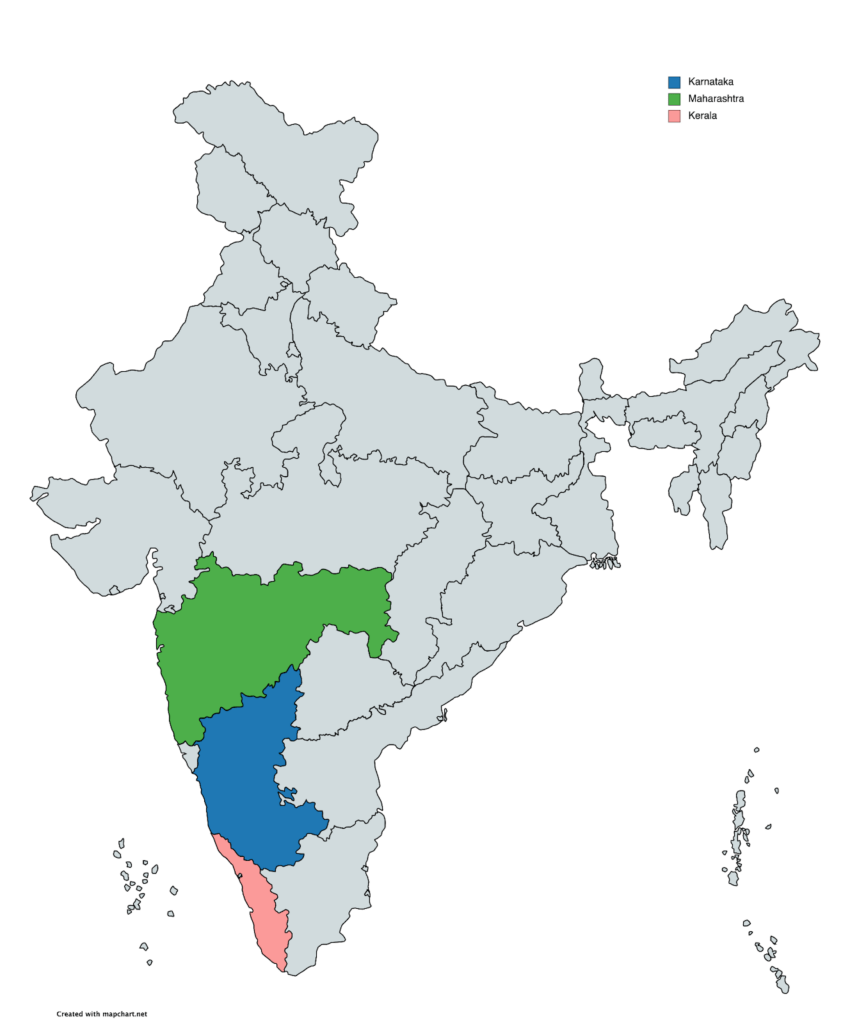
To conduct our study, we selected 3 Wikipedia language communities that correspond to the official languages of 3 neighboring states of India: Marathi (MR) from the state of Maharashtra, Kannada (KN) from the state of Karnataka, and Malayalam (ML) from the state of Kerala (see the map in right panel of the figure above). While the three projects share goals, technological infrastructure, and a similar set of challenges, Malayalam Wikipedia’s community engaged its language speakers in contributing to Wikipedia at a much higher rate than the others. The graph above (left panel) shows that although MR Wikipedia has twice as many viewers as ML Wikipedia, ML has more than double the number of articles on MR.
Our study focused on identifying differentiating factors between the three Wikipedias that could explain these differences. Through a grounded theory analysis of interviews with 18 community participants from the three projects, we identified two broad explanations of a “positive participation cycle” in Malayalam Wikipedia and a “negative participation cycle” in Marathi and Kannada Wikipedias.
As the first step of our study, we conducted semistructured interviews with active participants of all three projects to understand their personal experiences and motivation; their perceptions of dynamics, challenges, and goals within their primary language community; and their perceptions of other language Wikipedia.
We found that MR and KN contributors experience more day-to-day barriers to participation than ML, and that these barriers hinder contributors’ day-to-day activity and impede engagement. For example, both MR and KN members reported a large number of content disputes that they felt reduced their desire to contribute.
But why do some Wikipedias like MR or KN have more day-to-day barriers to contribution like content disputes and low social support than others? Our interviews pointed to a series of higher-level explanations. For example, our interviewees reported important differences in the norms and rules used within each community as well as higher levels of territoriality and concentrated power structures in MR and KN.
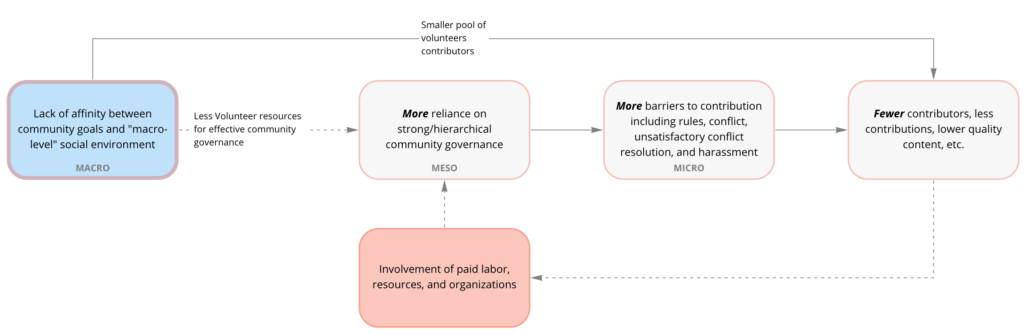
Once again, though: why do the MR and KN Wikipedias have these issues with territoriality and centralized authority structures? Here we identify a third, even higher-level set of differences in the social and cultural contexts of the three language-speaking communities. For example, MR and KN community members attributed low engagement to broad cultural attitudes toward volunteerism and differences in their language community’s engagement with free software and free culture.
The two flow charts above visualize the explanatory mapping of divergent feedback loops we describe. The top part of the figure illustrates how the relatively supportive macro-level social environment in Kerala led to a larger group of potential contributors to ML as well as a chain reaction of processes that led to a Wikipedia better able to engage potential contributors. The process is an example of a positive feedback cycle. The second, bottom part of the figure shows the parallel, negative feedback cycle that emerged in MR and KN Wikipedias. In these settings, features of the macro-level social environment led to a reliance on a relatively small group of people for community leadership and governance. This led, in turn, to barriers to entry that reduced contributions.
One final difference between the three Wikipedias was the role that paid labor from NGOs played. Because the MR and KN Wikipedias struggled to recruit and engage volunteers, NGOs and foundations deployed financial resources to support the development of content in Marathi and Kannada, but not in ML to the same degree. Our work suggested this tended to further concentrate power among a small group of paid editors in ways that aggravated the meso-level community struggles. This is shown in the red box in the second (bottom) row of the figure.
The results from our study provide a conceptual framework for understanding how the embeddedness of social computing systems within particular social and cultural contexts shape various aspects of the systems. We found that experience with participatory governance and free/open-source software in the Malayalam community supported high engagement of contributors. Counterintuitively, we found that financial resources intended to increase participation in the Marathi and Kannada communities hindered the growth of these communities. Our findings underscore the importance of social and cultural context in the trajectories of peer production communities. These contextual factors help explain patterns of knowledge inequity and engagement on the internet.
Please refer to the preprint of the paper for more details on the study and our design suggestions for localized peer production projects. We’re excited that this paper has been accepted to CHI 2022 and received the Best Paper Honorable Mention Award! It will be published in the Proceedings of the ACM on Human-Computer Interaction and presented at the conference in May. The full citation for this paper is:
Sejal Khatri, Aaron Shaw, Sayamindu Dasgupta, and Benjamin Mako Hill. 2022. The social embeddedness of peer production: A comparative qualitative analysis of three Indian language Wikipedia editions. In CHI Conference on Human Factors in Computing Systems (CHI ’22), April 29-May 5, 2022, New Orleans, LA, USA. ACM, New York, NY, USA, 18 pages. https://doi.org/10.1145/3491102.3501832
Attending the conference in New Orleans? Come attend our live presentation on May 3 at 3 pm at the CHI program venue, where you can discuss the paper with all the authors.
Online communities are frequently described as promising sites for computing education. Advocates of online communities as contexts for learning argue that they can help novices learn concrete programming skills through self-directed and interest-driven work. Of course, it is not always clear how well this plays out in practice—especially when it comes to learning challenging programming concepts. We sought to understand this process through a mixed-method case study of the Scratch online community that will be published and presented at the ACM Conference on Human Factors in Computing (CHI 2022) in several weeks.
Scratch is the largest online interest-driven programming community for novices. In Scratch, users can create programming projects using the visual-block based Scratch programming language. Scratch users can choose to share their projects—and many do—so that they can be seen, interacted with, and remixed by other Scratch community members. Our study focused on understanding how Scratch users learn to program with data structures (i.e., variables and lists)—a challenging programming concept for novices—by using community-produced learning resources such as discussion threads and curated project examples. Through a qualitative analysis on Scratch forum discussion threads, we identified a social feedback loop where participation in the community raises the visibility of some particular ways of using variables and lists in ways that shaped the nature and diversity of community-produced learning resources. In a follow-up quantitative analysis on a large collection of Scratch projects, we find statistical support for this social process.
A Scratch project code of a score counter in a game.
As the first step of our study, we collected and qualitatively analyzed 400 discussion threads about variables and lists in the Scratch Q&A forums. Our key finding was that Scratch users use specific, concrete examples to teach each other about variables and lists. These examples are commonly framed in terms of elements in the projects that they are making, often specific to games.
For instance, we observed users teach each other how to make a score counter in a game using variables. In another example, we saw users sharing tips on creating an item inventory in a game using lists. As a result of this focus on specific game elements, user-generated examples and tutorials are often framed in the specifics of these game-making scenarios. For example, a lot of sample Scratch code on variables and lists were from games with popular elements like scores and inventories. While these community-produced learning resources offers valuable concrete examples, not everybody is interested in making games. We some some evidence that users who are not interested in making games involving scores and inventories were less likely to get effective support when they sought to learn about variables. We argue that repeated over time, this dynamic can lead to a social feedback loop where reliance on community-generated resources can place innovative forms of creative coding at a disadvantage compared to historically common forms.
Our proposed hypothetical social feedback loop of how community-generated resources may constrain innovative computational participation.
The graph here is a visualization of the social feedback loop theory that we proposed. Stage 1 suggests that, in an online interest-driven learning community, some specific applications of a concept (“Use Case A”) will be more popular than others. This might be due to random chance or any number of reasons. When seeking community support, learners will tend to ask questions framed specifically around Use Case A and use community resources framed in terms of the same use case. Stage 2 shows the results of this process. As learners receive support, they produce new artifacts with Use Case A that can serve as learning resources for others. Then, learners in the future can use these learning resources, becoming even more likely to create the same specific application. The outcome of the feedback loop is that, as certain applications of a concept become more popular over time, the community’s learning resources are increasingly focused on the same applications.
We tested our social feedback loop theory using 5 years of Scratch data including 241,634 projects created by 75,911 users. We tested both the mechanism and the outcome of the loop from multiple angles in terms of three hypotheses that we believe will be true if our the feedback loop we describe is shaping behavior:
More projects involving variables and lists will be games over time.
The type of project elements that users make with variables and lists (we defined it as the names that they gave to variables and lists) will be more homogenous.
Users who have been exposed to popular variable and list names will be more likely to use those names in their own projects. We found at least some support for all of our hypotheses.
Our results provide broad (if imperfect) support for our social feedback loop theory. For example, the graph below illustrates one of our findings: users who have been exposed to popular list names (solid line) will be more likely to use (in other words, less likely to never use) popular names in their projects, compared to users who have never downloaded projects with popular list names (dashed line).
Plots from our cox proportional survival analysis on the difference between users who have previously downloaded projects with popular list names versus those who have never done so.
The results from our study describe an important trade-off that designers of online communities in computational learning need to be aware of. On the one hand, learners can learn advanced computational concepts by building their own explanation and understanding on specific use cases that are popular in the community. On the other, such learning can be superficial and not conceptual or generalizable: learners’ preference for peer-generated learning resources around specific interests can restrict the exploration of broader and more innovative uses, which can potentially limit sources of inspiration, pose barriers to broadening participation, and confine learners’ understanding of general concepts. We conclude our paper suggesting several design strategies that might be effective in countering this effect.
Please refer to the preprint of the paper for more details on the study and our design suggestions for future online interest-driven learning communities. We’re excited that this paper has been accepted to CHI 2022 and received the Best Paper Honorable Mention Award! It will be published in the Proceedings of the ACM on Human-Computer Interaction and presented at the conference in May. The full citation for this paper is:
Ruijia Cheng, Sayamindu Dasgupta, and Benjamin Mako Hill. 2022. How Interest-Driven Content Creation Shapes Opportunities for Informal Learning in Scratch: A Case Study on Novices’ Use of Data Structures. In CHI Conference on Human Factors in Computing Systems (CHI ’22), April 29-May 5, 2022, New Orleans, LA, USA. ACM, New York, NY, USA, 16 pages. https://doi.org/10.1145/3491102.3502124
The OG Mechanical Turk (public domain via Wikimedia Commons). It probably was not useful for unbiased survey research sampling either.
When it comes to research about participation in social media, sampling and bias are topics that often get ignored or politely buried in the “limitations” sections of papers. This is even true in survey research using samples recruited through idiosyncratic sites like Amazon’s Mechanical Turk. Together with Eszter Hargittai, I (Aaron) have a new paper (pdf) out in the International Journal of Communication (IJOC) that illustrates why ignoring sampling and bias in online survey research about online participation can be a particularly bad idea.
Surveys remain a workhorse method of social science, policy, and market research. But high-quality survey research that produces generalizable insights into big (e.g., national) populations is expensive, time-consuming, and difficult. Online surveys conducted through sites like Amazon Mechanical Turk (AMT), Qualtrics, and others offer a popular alternative for researchers looking to reduce the costs and increase the speed of their work. Some people even go so far as to claim that AMT has “ushered in a golden age in survey research” (and focus their critical energies on other important issues with AMT, like research ethics!).
Despite the hype, the quality of the online samples recruited through AMT and other sites often remains poorly or incompletely documented. Sampling bias online is especially important for research that studies online behaviors, such as social media use. Even with complex survey weighting schemes and sophisticated techniques like multilevel regression with post-stratification (MRP), surveys gathered online may incorporate subtle sources of bias because the people who complete the surveys online are also more likely to engage in other kinds of activities online.
Surprisingly little research has investigated these concerns directly. Eszter and I do so by using a survey instrument administered concurrently on AMT and a national sample of U.S. adults recruited through NORC at the University of Chicago (note that we published another paper in Socius using parts of the same dataset last year). The results suggest that AMT survey respondents are significantly more likely to use numerous social media, from Twitter to Pinterest and Reddit, as well as have significantly more experiences contributing their own online content, from posting videos to participating in various online forums and signing online petitions.
Such findings may not be shocking, but prevalent research practices often overlook the implications: you cannot rely on a sample recruited from an online platform like AMT to map directly to a general population when it comes to online behaviors. Whether AMT has created a survey research “golden age” or not, analysis conducted on a biased sample produces results that are less valuable than they seem.