The Hidden Costs of Requiring Accounts

Should online communities require people to create accounts before participating?

This question has been a source of disagreement among people who start or manage online communities for decades. Requiring accounts makes some sense since users contributing without accounts are a common source of vandalism, harassment, and low quality content. In theory, creating an account can deter these kinds of attacks while still making it pretty quick and easy for newcomers to join. Also, an account requirement seems unlikely to affect contributors who already have accounts and are typically the source of most valuable contributions. Creating accounts might even help community members build deeper relationships and commitments to the group in ways that lead them to stick around longer and contribute more.

In a new paper published in Communication Research, Benjamin Mako Hill and Aaron Shaw provide an answer. We analyze data from “natural experiments” that occurred when 136 wikis on Fandom.com started requiring user accounts. Although we find strong evidence that the account requirements deterred low quality contributions, this came at a substantial (and usually hidden) cost: a much larger decrease in high quality contributions. Surprisingly, the cost includes “lost” contributions from community members who had accounts already, but whose activity appears to have been catalyzed by the (often low quality) contributions from those without accounts.


The full citation for the paper is: Hill, Benjamin Mako, and Aaron Shaw. 2020. “The Hidden Costs of Requiring Accounts: Quasi-Experimental Evidence from Peer Production.” Communication Research, 48 (6): 771–95. https://doi.org/10.1177/0093650220910345.

If you do not have access to the paywalled journal, please check out this pre-print or get in touch with us. We have also released replication materials for the paper, including all the data and code used to conduct the analysis and compile the paper itself.

Measuring Wikipedia Article Quality in One Continuous Dimension

Accurately estimating the quality of Wikipedia articles is important task for both researchers and Wikipedia community members. In a forthcoming paper in the Proceedings of the OpenSym 2021, I describe a new method for estimating article quality in Wikipedia in one dimension that builds on the widely used ORES quality model and that improves on the techniques researches have used to incorporate measures of quality into their studies of Wikipedia in the past. I will presenting virtually this week at the OpenSym 2021 conference. OpenSym is free and open to the public this year but requires registration.

Numerous efforts have gone into measuring the quality of Wikipedia articles and the Wikimedia Foundation maintains a machine learning model for measuring article quality on English Wikipedia called the ORES quality model. This model is trained on quality assessments conducted by members of WikiProjects that label articles into hierarchy of quality levels (i.e., stub, start-class, C-class, B-class, Good, Featured) and use boosted decision trees to predict the quality of versions of articles. This model is useful because it can predict the quality of versions of articles that haven’t been assessed. My OpenSym paper (teaser video, full presentation) builds on the ORES quality models to improve measuring Wikipedia article quality in one continuous dimension using ordinal regression models. A 1-D real-valued measure of quality is more granular and easier to use in downstream research. My method also increases the accuracy of quality prediction for units of analysis that are most important for research like articles or revisions and also estimates spacing between different levels of article quality.

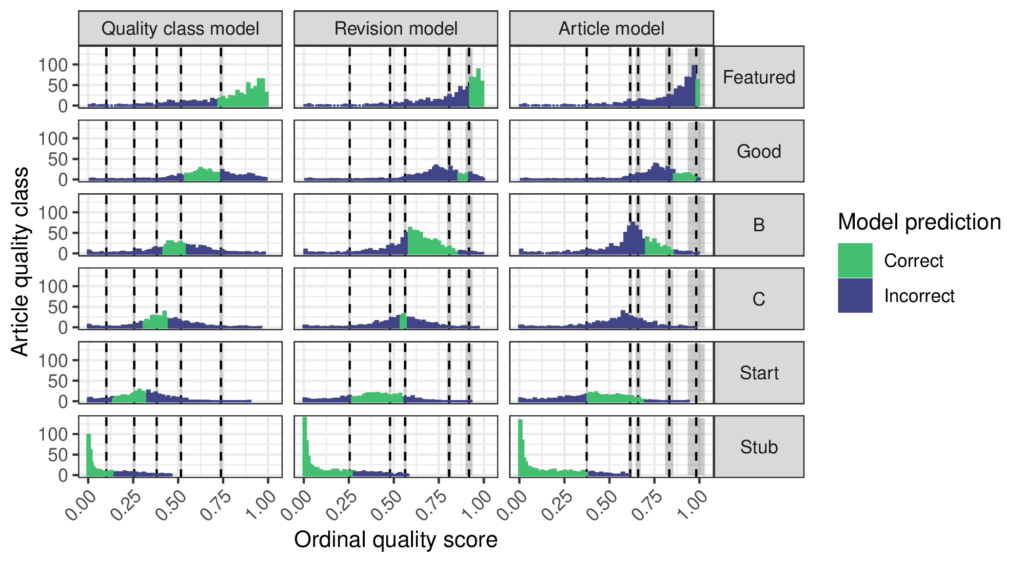
Quality scores and predictions of the ordinal regression models. Columns in the grid of charts correspond to the ordinal quality model calibrated to the indicated unit of analysis and rows correspond to sampled articles having the indicated level of quality as assessed by Wikipedians. Each chart shows the histogram of scores, thresholds inferred by the ordinal model with 95% credible intervals colored in gray, and colors indicating when the model makes correct or incorrect predictions. The thresholds are not evenly spaced, especially in revision model and article model that have more weight on lower quality classes. These two models infer that the gaps between Stub and Start and between Start and C-class articles are considerably wider than the gap between C-class and B-class articles.

An important limitation of the ORES quality models is that they do not output a single real-valued quality score. Instead, they output a multinomial distribution of the probability of an article’s quality class. This means that instead of saying “article X has quality 0.3” the model tells you “the probability of article X’s quality class is 0.1 for stub, 0.2 for start-class, 0.5 for C-class, 0.15 for B-class, 0.05 for Good and 0 for featured and the most probable quality class (MPQC) is C.” Using this kind of output in a downstream statistical analysis is kind of messy. For example, it might seem reasonable to use the MPQC as an integer-valued measure of quality, but this throws away information. Suppose ORES says that “the probability of article Y’s quality class is 0.00 for stub, 0.15 for start-class, 0.5 for C-class, 0.2 for B-class, 0.1 for Good, and 0.05 for Featured” According to the ORES quality model, Y probably has greater quality than X. Even though both have a MPQC of C-class, there’s a much greater change for article Y to be B-class or better than for article X. Is there a way to use the ORES probabilities to build a more granular measure of quality that accounts for this difference?

Aaron Halfaker, one of the creators of the ORES system, combined the probabilities into a 1-D score for one of his research projects by taking a weighed sum of the probabilities and assuming that Wikipedia article quality levels are “evenly spaced.” This creates a score out of the quality class probabilities by multiplying each probability by a weight so that probabilities for higher quality levels get more weight. He chose the weights [0,1,2,3,4,5] so an article gets 0 quality points for being a probable stub, 1 for the probability of being start-class, 2 for C-class, and so on with 5 points for Featured. This results in a nice continuous measure of quality that simplifies downstream statistical analysis. A number of others have followed his lead.

But how reasonable is the “evenly spaced” assumption that supports using the weights [0,1,2,3,4,5]? Could there be a way to pick weights to combine the ORES probabilities without using this assumption? My paper explains why ordinal regression is the right tool for the job and proposes a procedure for fitting an ordinal regression model to a sample representative of a unit of analysis like articles or revisions or quality classes that have been labeled by a WikiProject and scored by the ORES quality model. The ordinal regression predicts the quality labels as a function of the ORES scores and in this way finds a good way to combine the ORES scores into a single value. It also infers threshold parameters that define different regions of the quality score corresponding to quality classes and this allows the “evenly spaced” assumption to be tested. The figure above shows that the article quality levels are not evenly spaced! Interestingly, the way that they are unevenly spaced depends on how quality is measured. If the quality scale is designed to be accurate across all quality classes, then the quality levels are relatively even. However, if it is designed to be accurate for revisions or articles then more of the scale goes to lower levels of quality. Overall, the models agree that the difference between C-class and Start articles is smaller than that between the other levels.

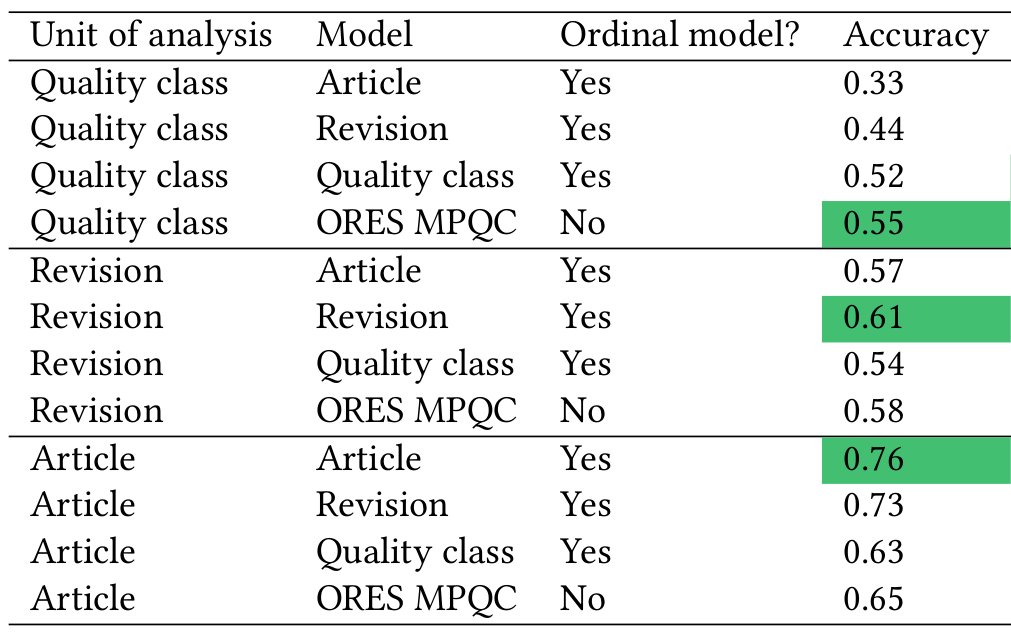
Using the quality scores based on ordinal regression also improves accuracy. This mostly comes from calibrating the ordinal model to the appropriate unit of analysis. The ORES quality model is fit on a “balanced” dataset where each quality class is equally represented. This means that the ORES quality model has learned that each quality class is equally likely to occur in the data. Of course, in reality lower quality articles are far more common than high quality articles. There are over 3,000,000 Stubs on English Wikipedia but less than 8,000 Featured articles. As the table below shows, fitting ordinal models that know the true proportion of each quality class in a sample can improve accuracy compared to the ORES quality model.

Accuracy of quality prediction models depends on the unit of analysis. The greatest accuracy scores are highlighted. Models are more accurate when calibrated on the same unit of analysis on which they are evaluated. Compared to the MPQC, the ordinal quality models have better accuracy when revisions or articles are the unit of analysis. When the quality class is the unit of analysis, the ordinal quality model has slightly worse accuracy.

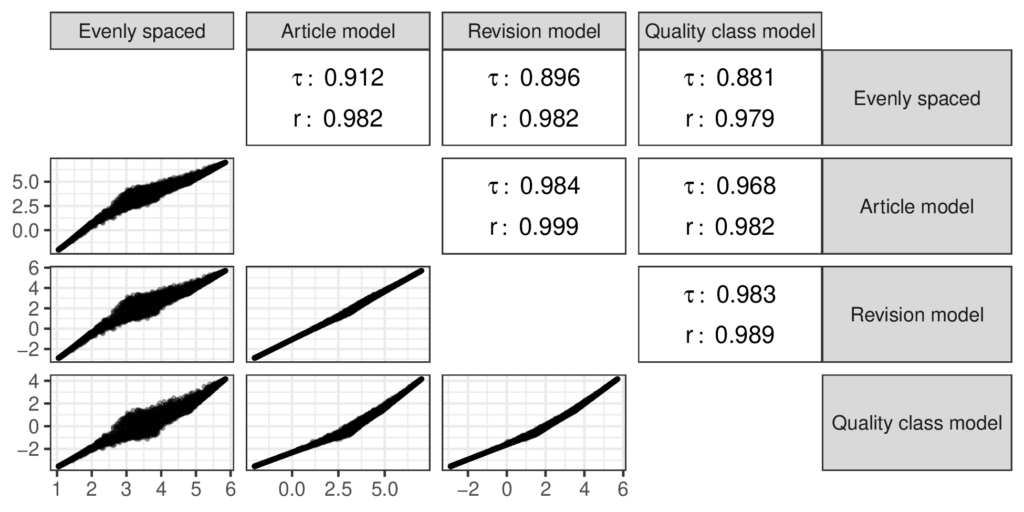
Even though my study has found evidence against the “evenly spaced” assumption, I also found that the quality scores based on it are strongly correlated with the scores from the ordinal model as shown in the figure below. The ‘𝜏’ symbols in the figure stand for the Kendall rank correlation coefficient while the ‘r’ symbols stand for the Pearson correlation coefficient. I used the Kendall correlation because it can capture nonlinear divergences between the measures and the Pearson coefficient is the familiar linear correlation. The “evenly spaced” scores aren’t totally in agreement with the scores from the ordinal models, but they are close enough that I doubt that prior research that used the “evenly spaced” scores to measure quality was mislead by this choice.

Correlations between quality measures show that the different approaches to measuring quality are quite similar. “Evenly spaced” uses the weighted sum of the ORES scores with handpicked coefficients [0,1,2,3,4,5]. Lower values of Kendall’s 𝜏, a nonparametric rank correlation statistic, compared to Pearson’s 𝑟 suggest nonlinear differences between the weighted sum and the other measures.

Conclusions

Measuring article quality in one continuous dimension is a valuable tool for studying the peer production of information goods because it provides granularity and is amenable to statistical analysis. Prior approaches extended ORES article quality prediction into a continuous measure under the “evenly spaced” assumption. I used ordinal regression models to transform the ORES predictions into a continuous measure of quality that is interpretable as a probability distribution over article quality levels, provides an account of its own uncertainty and does not assume that quality levels are “evenly spaced.” Calibrating the models to the chosen unit of analysis improves accuracy for research applications. I recommend that future work adopt this approach when article quality is an independent variable in a statistical analysis.

My paper also has a number of other tidbits about the uncertainty of different quality measures, the importance of feedback between measurement and knowledge in the scientific process and demonstrates model calibration.


A preprint of the paper is available here. The paper has been accepted to OpenSym 2021 and will be presented at the virtual conference on September 17th. A video of the presentation is available here. A dataverse repository containing code and data from the project is available here.

Why do people participate in small online communities?

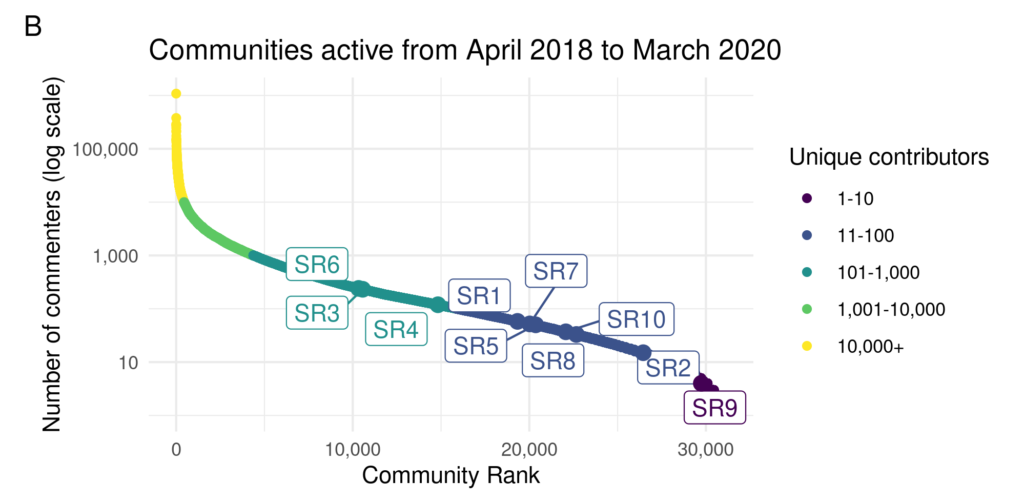
The number of unique commenters who commented on subreddits in March 2020, for subreddits that had at least 1 comment in the each of the previous 23 months. The “SR” communities are those we drew our interview sample from.

When it comes to online communities, we often assume that bigger is better. Large communities can create robust interactions, have access to broad and extensive body of experiences, and provide many opportunities for connections. As a result, small communities are often thought as failed attempts to build big ones. In reality, most online communities are very small and most small communities remain small throughout their lives.  If growth and a large number of members are so advantageous, why do small communities not only exist but persist in their smallness?

In a recent research study, we investigated why individuals participate in these persistently small online communities by interviewing twenty participants of small subreddits  on Reddit. We asked people about their motivations and explicitly tried to get them to compare their experiences in small subreddits with their experience in larger subreddits. Below we present three of the main things that we discovered through analyzing our conversations.

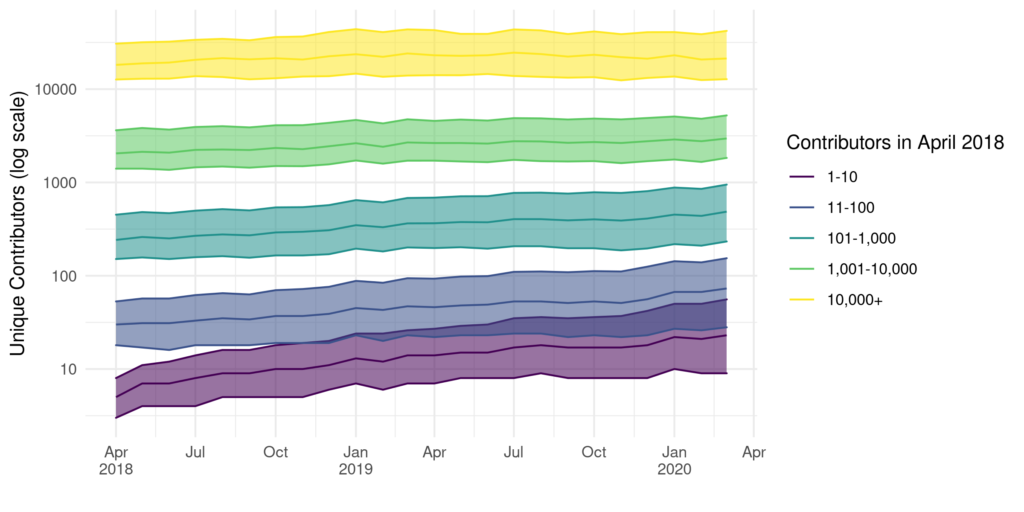
Size of consistently active subreddits over time (i.e., those with at least one comment per month from April 2018 to March 2020). Subreddits are grouped by their size in April 2018. Lines represent the median size each month, and ribbons show the first and third quartiles.

Informational niches

First, we found that participants saw their small communities as unique spaces for information and interaction. Frequently, small communities are narrower versions or direct offshoots of larger communities. For example, the r/python community is about the programming language Python while the r/learnpython community is a smaller community explicitly for newcomers to the language. 

By being in a smaller, more specific community, our participants described being able to better anticipate the content, audience, and norms: a specific type of content, people who cared about the narrow topic just like them, and expectations of how to behave online. For example, one participant said:

[…] I can probably make a safe assumption that people there more often than not know what they’re talking about. I’ll definitely be much more specific and not try to water questions down with like, my broader scheme of things—I can get as technical as possible, right? If I were to ask like the same question over at [the larger parent community], I might want to give a little bit background on what I’m trying to do, why I’m trying to do it, you know, other things that I’m using, but [in small community], I can just be like, hey, look, I’m trying to use this algorithm for this one thing. Why should I? Or should I not do it for this?

Curating online experiences

More broadly, participants explained their participation in these small communities as part of an ongoing strategy of curating their online experience. Participants described a complex ecosystem of interrelated communities that the small communities sat within, and how the small communities gave them the ability to select very specific topics, decide who to interact with, and manage content consumption.

In this sense, small communities give individuals a semblance of control on the internet. Given the scale of the internet—and a widespread sense of malaise with online hate, toxicity, and harassment—it is possible that controlling the online experience is more important to users than ever. Because of their small size, these small communities were largely free of the vandals and trolls that plague large online communities, and  several participants described their online communities as special spaces to get away from the negativity on the rest of the internet. 

Relationships

Finally, one surprise from our research was what we didn’t find. Previous research led us to predict that people would participate in small communities because they would make it easier to develop friendships with other people. Our participants described being interested in the personal experiences of other group members, but not in building individual relationships with them.

Conclusions

Our research shows that small online communities play an important and underappreciated role. At the individual level, online communities help people to have control over their experiences, curating a set of content and users that is predictable and navigable. At the platform level, small communities seem to have a symbiotic relationship with large communities. By breaking up broader topical niches, small communities likely help to keep a larger set of users engaged.

We hope that this paper will encourage others to take seriously the role of small online communities. They are qualitatively different from large communities, and more empirical and theoretical research is needed in order to understand how communities of different sizes operate and interact in community ecosystems.


A preprint of the paper is available here. We’re excited that this paper has been accepted to CSCW2021 and will be published in the Proceedings of the ACM on Human-Computer Interaction and presented at the conference in November. If you have any questions about this research, please feel free to reach out to one of the authors: Sohyeon Hwang or Jeremy Foote.

Do generous attitudes underlie contributions to user-generated content?

User-generated content on the Internet provides the basis for some of the most popular websites, such as Wikipedia, crowdsourced question-and-answer sites like Stack Overflow, video-sharing sites like YouTube, and social media platforms like Reddit. Much (or in some cases all) of the content on these sites is created by unpaid volunteers, who invest substantial time and effort to produce high quality information resources. So are these volunteers and content contributors more generous in general than people who don’t contribute their time, knowledge, or information online?

We (Floor Fiers, Aaron Shaw, and Eszter Hargittai) consider this question in a recent paper published in The Journal of Quantitative Description: Digital Media (JQD:DM). The publication of this particularly is exciting because it pursues a new angle on these questions, and also because it’s part of the inaugural issue of JQD:DM, a new open-access venue for research that seeks to advance descriptive (as opposed to analytic or causal) knowledge about digital media.

The study uses data from a national survey of U.S. adult internet users that includes questions about many kinds of online contribution activities, various demographic and background attributes, as well as a dictator game to measure generosity. In the dictator game, each participant has an opportunity to make an anonymous donation of some unanticipated funds to another participant in the study. Prior experimental research across the social sciences has used dictator games, but no studies we know of had compared dictator game donations with online content contributions.

Sharing content. GotCredit via flickr.

Overall, we find that people who contribute some kind of content online exhibit more generosity in the dictator game. More specifically, we find that people producing any type of user-generated content tend to donate more in the dictator game than those who do not produce any such content. We also disaggregate the analysis by type of content contribution and find that donating in the dictator game only correlates with content contribution for those who write reviews, upload public videos, pose or answer questions, and contribute to encyclopedic knowledge collections.

So, generous attitudes and behaviors may help explain contributions to some types of user-generated content, but not others. This implies that user-generated content is not a homogeneous activity, since variations exist between different types of content contribution.

The (open access!) paper has many more details, so we hope you’ll download, read, and cite it. Please feel free to leave a comment below too.

Paper Citation: Fiers, Floor, Aaron Shaw, and Eszter Hargittai. 2021. “Generous Attitudes and Online Participation”. Journal of Quantitative Description: Digital Media 1 (April). https://doi.org/10.51685/jqd.2021.008.

Detecting At-Risk Software Infrastructure

A span of cracked concrete with exposed rebar.
Crumbling infrastructure. J.C. Burns (jcburns) via flickr, CC BY-NC-ND 2.0

Critical software we all rely on can silently crumble away beneath us. Unfortunately, we often don’t find out software infrastructure is in poor condition until it is too late. Over the last year or so, I have been leading a project I announced earlier to measure software underproduction—a term I use to describe software that is low in quality but high in importance.

Underproduction reflects an important type of risk in widely used free/libre open source software (FLOSS) because participants often choose their own projects and tasks. Because FLOSS contributors work as volunteers and choose what they work on, important projects aren’t always the ones to which FLOSS developers devote the most attention. Even when developers want to work on important projects, relative neglect among important projects is often difficult for FLOSS contributors to see.

Given all this, what can we do to detect problems in FLOSS infrastructure before major failures occur? I recently published and presented a paper laying out our new method for measuring underproduction at the IEEE International Conference on Software Analysis, Evolution and Reengineering (SANER) 2021 that I believe provides one important answer to this question.

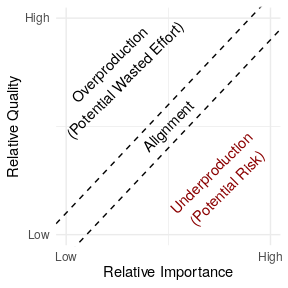
A conceptual diagram of underproduction. The x-axis shows relative importance, the y-axis relative quality. The top left area of the graph described by these axes is 'overproduction' -- high quality, low importance. The diagonal is Alignment: quality and importance are approximately the same. The lower right depicts underproduction -- high importance, low quality -- the area of potential risk.
Conceptual diagram showing how our conception of underproduction relates to quality and importance of software.

In the paper—coauthored with Benjamin Mako Hill—we describe a general approach for detecting “underproduced” software infrastructure that consists of five steps: (1) identifying a body of digital infrastructure (like a code repository); (2) identifying a measure of quality (like the time to takes to fix bugs); (3) identifying a measure of importance (like install base); (4) specifying a hypothesized relationship linking quality and importance if quality and importance are in perfect alignment; and (5) quantifying deviation from this theoretical baseline to find relative underproduction.

To show how our method works in practice, we applied the technique to an important collection of FLOSS infrastructure: 21,902 packages in the Debian GNU/Linux distribution. Although there are many ways to measure quality, we used a measure of how quickly Debian maintainers have historically dealt with 461,656 bugs that have been filed over the last three decades. To measure importance, we used data from Debian’s Popularity Contest opt-in survey. After some statistical machinations that are documented in our paper, the result was an estimate of relative underproduction for the 21,902 packages in Debian we looked at.


One of our key findings is that underproduction is very common in Debian. By our estimates, at least 4,327 packages in Debian are underproduced. As you can see in the list of the “most underproduced” packages—again, as estimated using just one more measure—many of the most at risk packages are associated with the desktop and windowing environments where there are many users but also many extremely tricky integration-related bugs.

This table shows the 30 packages with the most severe underproduction problem in Debian, shown as a series of boxplots.
These 30 packages have the highest level of underproduction in Debian according to our analysis.

We hope these results are useful to folks at Debian and the Debian QA team. We also hope that the basic method we’ve laid out is something that others will build off in other contexts and apply to other software repositories.

In addition to the paper itself and the video of the conference presentation on Youtube, we’ve put a repository with all our code and data in an archival repository Harvard Dataverse and we’d love to work with others interested in applying our approach in other software ecosytems.


For more details, check out the full paper which is available as a freely accessible preprint.

This project was supported by the Ford/Sloan Digital Infrastructure Initiative. Wm Salt Hale of the Community Data Science Collective and Debian Developers Paul Wise and Don Armstrong provided valuable assistance in accessing and interpreting Debian bug data. René Just generously provided insight and feedback on the manuscript.

Paper Citation: Kaylea Champion and Benjamin Mako Hill. 2021. “Underproduction: An Approach for Measuring Risk in Open Source Software.” In Proceedings of the IEEE International Conference on Software Analysis, Evolution and Reengineering (SANER 2021). IEEE.

Contact Kaylea Champion (kaylea@uw.edu) with any questions or if you are interested in following up.

Are Vandals Rational?

Although Wikipedia is the encyclopedia that anybody can edit, not all edits are welcome. Wikipedia is subject to a constant deluge of vandalism. Random people on the Internet are constantly “blanking” Wikipedia articles by deleting their content, replacing the text of articles with random characters, inserting outlandish claims or insults, and so on. Although volunteer editors and bots do an excellent job of quickly reverting the damage, the cost in terms of volunteer time is real.

Why do people spend their time and energy vandalizing web pages? For readers of Wikipedia that encounter a page that has been marred or replaced with nonsense or a slur—and especially for all the Wikipedia contributors who spend their time fighting back the tide of vandalism by checking and reverting bad edits and maintaining the bots and systems that keep order—it’s easy to dismiss vandals as incomprehensible sociopaths.

In a paper I just published in the ACM International Conference on Social Media and Society, I systematically analyzed a dataset of Wikipedia vandalism in an effort to identify different types of Wikipedia vandalism and to explain how each can been seen as “rational” from the point of view of the vandal.

You can see Kaylea present this work via a 5-minute YouTube talk.

Leveraging a dataset we created in some of our other work, the study used a random sample of contributions drawn from four groups that vary in the degree to the editors in question can be identified by others in Wikipedia: established users with accounts, users with accounts making their first edits, users without accounts, and users of the Tor privacy tool. Tor users were of particular interest to me because the use of Tor offers concrete evidence that a contributor is deliberately seeking privacy. I compared the frequency of vandalism in each group, developed an ontology to categorize it, and tested the relationship between group membership and different types of vandalism.

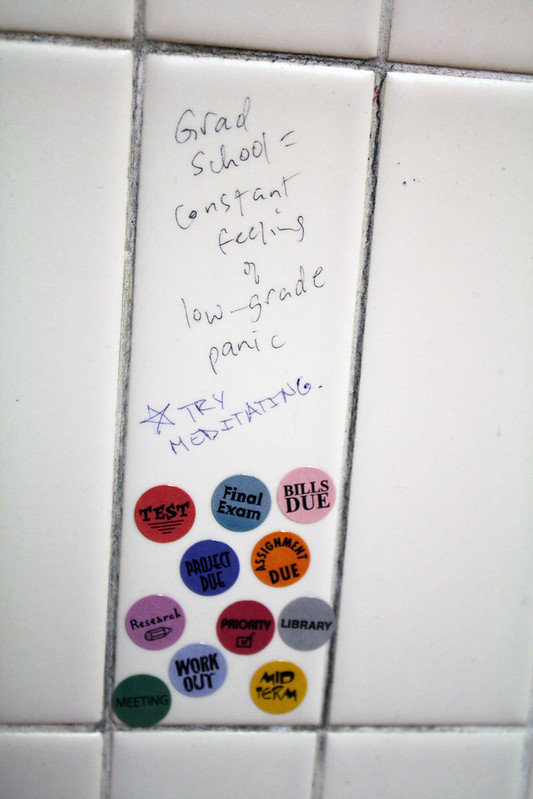
Vandalism in an University bathroom. [“Whiteboard Revisited.” Quinn Dombrowski. via flickr, CC BY-SA 2.0]

I found that the group that had engaged in the least effort in order to edit—users without accounts—were the most likely to vandalize. Although privacy-seeking Tor contributors were not the most likely to vandalize, vandalism from Tor-based contributors was less likely to be sociable, was more likely to be large scale (i.e. large blocks of text, such as by pasting in the same lines over and over), and more likely to express frustration with the Wikipedia community.

Thinking systematically about why different groups of users might engage in vandalism can help counter vandalism. Potential interventions might change not just the amount, but also the type, of vandalism a community will receive. Tools to detect vandalism may find that the patterns in each category allow for more accurate targeting. Ultimately, viewing vandals as more than irrational sociopaths opens potential avenues for dialogue.


For more details, check out the full paper which is available as a freely accessible preprint. The project would not have been possible without Chau Tran’s work to develop a dataset of contributions from Tor users. This work was supported by the National Science Foundation (Awards CNS-1703736 and CNS-1703049).

Paper Citation: Kaylea Champion. 2020. “Characterizing Online Vandalism: A Rational Choice Perspective.” In International Conference on Social Media and Society (SMSociety’20). Association for Computing Machinery, New York, NY, USA, 47–57. https://doi.org/10.1145/3400806.3400813

Tor users: An untapped resource for Wikipedia?

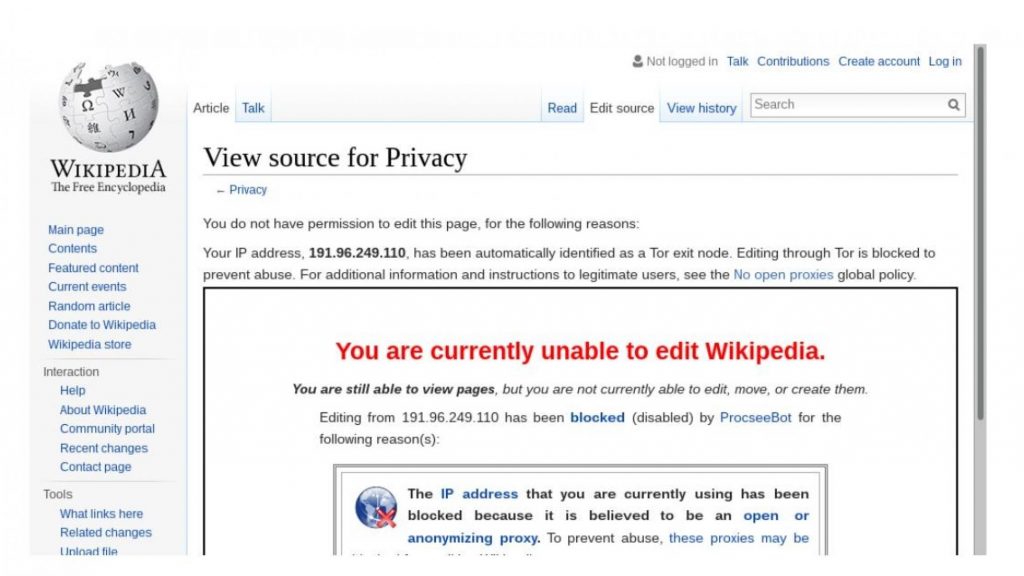
screenshot of Wikipedia banning tor users
An image displaying the message that Tor users typically receive when trying to make edits on Wikipedia, stating that the user’s IP address has been identified as a Tor exit node, and that “editing through Tor is blocked to prevent abuse.”

Like everyone else, Internet users who protect their privacy by using the anonymous browsing software Tor are welcome to read Wikipedia. However, when Tor users try to contribute to the self-described “encyclopedia that anybody can edit,” they typically come face-to-face with a notice explaining that their participation is not welcome.

Our new paper—led by Chau Tran at NYU and authored by a group of researchers from the University of Washington, the Community Data Science Collective, Drexel, and New York University—was published and presented this week at the IEEE Symposium on Security & Privacy and provides insight into what Wikipedia might be missing out on by blocking Tor. By comparing contributions from Tor that slip past Wikipedia’s ban to edits made by other types of contributors, we find that Tor users make contributions to Wikipedia that are just as valuable as those made by new and unregistered Wikipedia editors. We also found that Tor users are more likely to engage with certain controversial topics.

One-minute “Trailer” for our paper and talk at the IEEE Symposium on Security & Privacy. Video was produced by Tommy Ferguson at the UW Department of Communication.

To conduct our study, we first identified more than 11,000 Wikipedia edits made by Tor users who were able to bypass Wikipedia’s ban on contributions from Tor between 2007 and 2018. We then used a series of quantitative techniques to evaluate the quality of these contributions. We found that Tor users made contributions that were similar in quality to, and in some senses even better than, contributions made by other users without accounts and newcomers making their first edits.

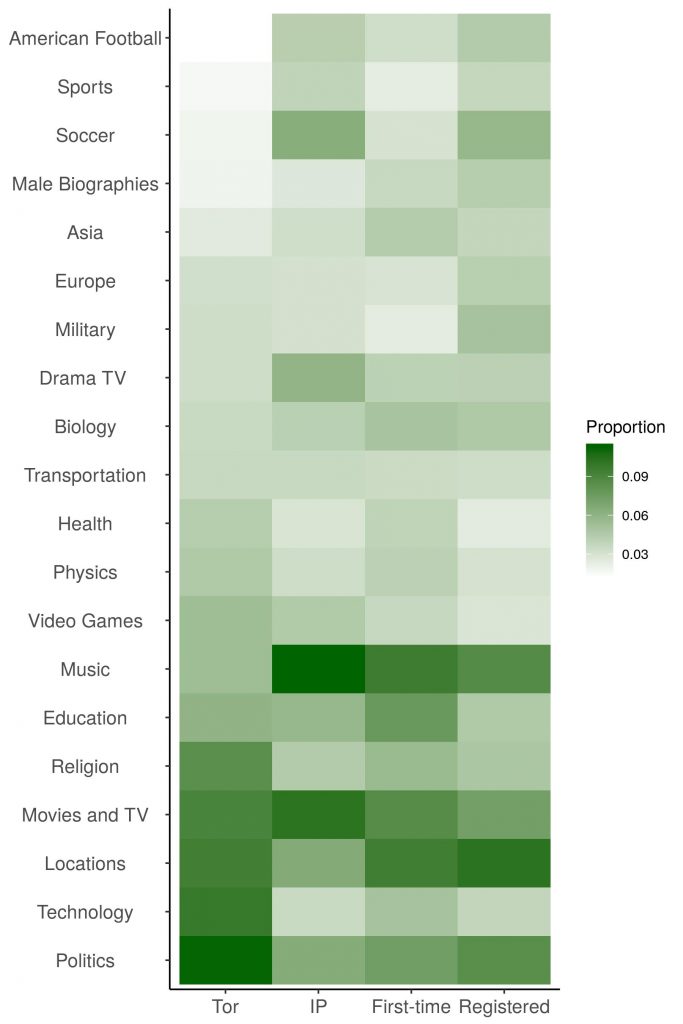
An image from the study showing the differences in topics edited by Tor users and other Wikipedia users. The image suggests that Tor users are more likely to edit pages discussing topics such as politics, religion, and technology. Other types of users, including IP, First-time, and Registered editors, are more likely to edit pages discussing topics such as music and sports.

We used a range of analytical techniques including direct parsing of article histories, manual inspections of article changes, and a machine learning platform called ORES to analyze contributions. We also used a machine learning technique called topic modeling to analyze Tor users’ areas of interest by checking their edits against clusters of keywords. We found that Tor-based editors are more likely than other users to focus on topics that may be considered controversial, such as politics, technology, and religion.

In a closely connected study led by Kaylea Champion and published several months ago in the Proceedings of the ACM on Human Computer Interaction (CSCW), we conducted a forensic qualitative analysis of contributions of the same dataset. Our results in that study are described in a separate blog post about that project and paint a complementary picture of Tor users engaged—in large part—in uncontroversial and quotidian types of editing behavior.

Across the two papers, our results are similar to other work that suggests that Tor users are very similar to other internet users. For example, one previous study has shown that Tor users frequently visit websites in the Alexa top one million.

Much of the discourse about anonymity online tends toward extreme claims backed up by very little in the way of empirical evidence or systematic study. Our work is a step toward remedying this gap and has implications for many websites that limit participation by users of anonymous browsing software like Tor. In the future, we hope to conduct similar systematic studies in contexts beyond Wikipedia.

Video of the conference presentation at the IEEE Symposium on Security & Privacy 2020 by Chau Tran.

In terms of Wikipedia’s own policy decisions about anonymous participation, we believe that our paper suggests that the benefits of a “pathway to legitimacy” for Tor contributors to Wikipedia might exceed the potential harm due to the value of their contributions. We are particularly excited about exploring ways to allow contributors from anonymity-seeking users under certain conditions: for example, requiring review prior to changes going live. Of course, these are questions for the Wikipedia community to decide but it’s a conversation that we hope our research can inform and that we look forward to participating in.


Authors of the paper, “Are anonymity-seekers just like everybody else? An analysis of contributions to Wikipedia from Tor,” include Chau Tran (NYU), Kaylea Champion (UW & CDSC), Andrea Forte (Drexel), Benjamin Mako Hill (UW & CDSC), and Rachel Greenstadt (NYU). The paper was published at the 2020 IEEE Symposium on Security & Privacy between May 18 and 20. Originally to be held in San Francisco, the event was held digitally due to the COVID-19 pandemic. This blog post borrows with permission from this news release by Andrew Laurent at NYU.

Paper Citation: Tran, Chau, Kaylea Champion, Andrea Forte, Benjamin Mako Hill, and Rachel Greenstadt. “Are Anonymity-Seekers Just like Everybody Else? An Analysis of Contributions to Wikipedia from Tor.” In 2020 IEEE Symposium on Security and Privacy (SP), 1:974–90. San Francisco, California: IEEE Computer Society, 2020. https://doi.org/10.1109/SP40000.2020.00053.

The research was funded by the National Science Foundation.

What do people do when they edit Wikipedia through Tor?

A paper recently published at CSCW describes the results of a forensic qualitative analysis of contributions made to Wikipedia through the anonymous browsing system Tor. The project was conducted collaboratively with researchers from Drexel, NYU, and the University of Washington and complements a quantitative analysis of the same data we also published to provide a rich qualitative picture of what anonymity-seekers are trying to do when they contribute to Wikipedia. The work also shows how the ability to stay anonymous can play a important role in facilitating certain types of contributions to online knowledge bases like Wikipedia.

Many individuals use Tor to reduce their visibility to widespread internet surveillance.

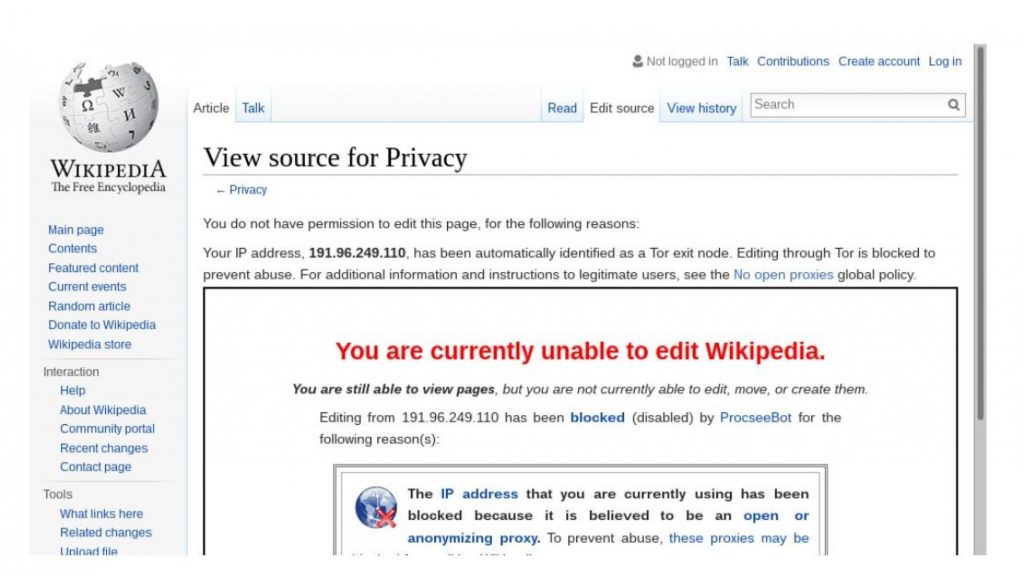
Media reports often describe how online platforms are tracking us. That said, trying to live our lives online without leaving a trail of our personal information can be difficult because many services can’t be used without an account and systems that protect privacy are often blocked. One popular approach to protecting our privacy online involves using the Tor network. Tor protects users from being identified by their IP address which can be tied to a physical location. However, if you’d like to contribute to Wikipedia using Tor, you’ll run into a problem. Although most IP addresses can edit without an account, Tor users are blocked from editing.

Tor users attempting to contributing to Wikipedia are shown a screen that informs them that they are not allowed to edit Wikipedia.

Other research by my team has shown that Wikipedia’s attempt to block Tor is imperfect and that some people have been able to edit despite the ban. This work also built a dataset of more than 11,000 contributions made to Wikipedia via Tor and used quantitative analysis to show that the contributions of people using Tor were about the same quality as contributions from other new editors and other contributors without accounts. Of course, given the unusual circumstances Tor-based contributors faced, we wondered if a deeper look into the content of their edits might tell us more about their motives and the kinds of contributions they seek to make. I led a qualitative investigation that sought to explore these questions.

Given the challenges of studying anonymity seekers, we designed a novel “forensic” qualitative approach that was inspired by the techniques common in the practice of computer security as well as criminal investigation. We applied to this new technique to a sample of 500 different editing sessions and sorted each session into a category based on what the editor seemed to be intending to do.

Most of the contributions we found fell into one of the two following categories:

  • Many contributions were quotidian attempts to add to the encyclopedia. Tor-based editors added facts, they fixed typos, and they updated train schedules. There’s no way to know if these individuals knew that they were just getting lucky in their ability to edit or if they were patiently reloading to evade the ban.
  • Second, we found harassing comments and vandalism. Unwelcome conduct is common in online environments, and sometimes more common when the likelihood of being identified is decreased. Some of the harassing comments we observed were direct responses to being banned as a Tor user.

Although these were most of what we observed, we also found evidence of several types of contributor intent:

  • We observed activism, as when a contributor tried to bring attention to journalistic accounts of environmental and human rights abuses being committed by a mining company, only to have editors traceable to the mining company repeatedly remove their edits. Another example included an editor trying to diminish the influence of alternative medicine proponents.
  • We also observed quality maintenance activities when editors used Wikipedia’s rules about appropriate sourcing to remove personal websites being cited in conspiracy theories.
  • We saw edit wars with Tor editors participating in a back-and-forth removal and replacement of content as part of a dispute, in some cases countering the work of an experienced Wikipedia editor who even other experienced editors had gauged to be biased.
  • Finally, we saw Tor-based editors participating in non-article discussions such as investigations of administrator misconduct, and protesting the mistrust of Tor editors by the Wikipedia platform.
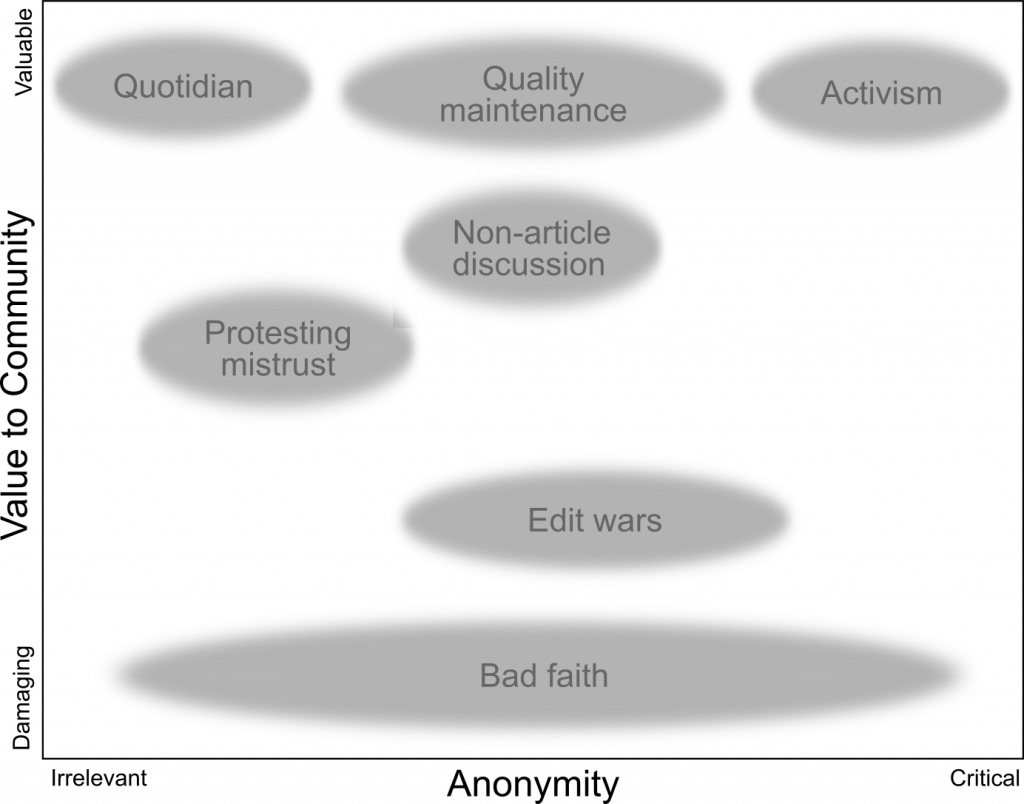
An exploratory mapping of our themes in terms of the value a type of contribution represents to the Wikipedia community and the importance of anonymity in facilitating it. Anonymity protecting tools play a critical role in facilitating contributions on the right side of the figure while edits on the left are more likely to occur even when anonymity is impossible. Contributions toward the top reflect valuable forms of participation in Wikipedia while edits on the bottom reflect damage.

In all, these themes led us to reflect on how the risks that individuals face when contributing to online communities are sometimes out of alignment with the risks the communities face by accepting their work. Expressing minoritized perspectives, maintaining community standards even when you may be targeted by the rulebreaker, highlighting injustice or acting as a whistleblower can be very risky for an individual, and may not be possible without privacy protections. Of course, in platforms seeking to support the public good, such knowledge and accountability may be crucial.


This project was conducted by Kaylea Champion, Nora McDonald, Stephanie Bankes, Joseph Zhang, Rachel Greenstadt, Andrea Forte, and Benjamin Mako Hill. This work was supported by the National Science Foundation (awards CNS-1703736 and CNS-1703049) and included the work of two undergraduates supported through an NSF REU supplement.
Paper Citation: Kaylea Champion, Nora McDonald, Stephanie Bankes, Joseph Zhang, Rachel Greenstadt, Andrea Forte, and Benjamin Mako Hill. 2019. A Forensic Qualitative Analysis of Contributions to Wikipedia from Anonymity Seeking Users. Proceedings of the ACM on Human-Computer Interactaction. 3, CSCW, Article 53 (November 2019), 26 pages. https://doi.org/10.1145/3359155
Modeling the ecological dynamics of online organizations

Do online communities compete with each other over resources or niches? Do they co-evolve in symbiotic or even parasitic relationships? What insights can we gain by applying ecological models of collective behavior to the study of collaborative online groups?

A colorful pisaster ochraceus (a.k.a., pisaster), a sea star species whose presence or absence can radically alter the ecology of an intertidal community. Our research will adapt theories created to explain the population dymamics of organisms like the pisaster in the context of online communities and human organizations (photo: Multi-Agency Rocky Intertidal Network).

We  are delighted to announce that a Community Data Science Collective (CDSC) team led by Nate TeBlunthuis and Jeremy Foote has just started work on a three-year grant from the U.S. National Science Foundation to study the ecological dynamics of online communities! Aaron Shaw and Benjamin Mako Hill are principal investigators for the grant.

The projects supported by the award will extend the study of peer production and online communities by analyzing how aspects of communities’ environments impact their growth, patterns of participation, and survival. The work draws on recent research on various biological systems, organizational ecology, and human computer interaction (HCI). In general, we adapt these approaches to inform quantitative and computational analysis of populations of peer production communities and other online organizations.

As a major goal, we want to explain the conditions under which certain ecological dynamics emerge versus when they do not. For example, prior work has suggested that communities interact in ways that are both competitive and mutalistic. But what leads two communities to become competitors and others to benefit each other?  We aim to understand when these patterns to arise. We are also interested in how community leaders might pursue effective strategies for survival given circumstances in the surrounding environment.

The grant promises to support a number of projects within the CDSC. Nate and Jeremy led the proposal writing as well as two key pilot studies that informed the development of the proposal. Other group members are now involved in planning and developing multiple studies under the grant.

The grant was awarded by the NSF Cyber-Human Systems (CHS) program within the Directorate for Information and Intellligent Systems (IIS) and the award is shared by Northwestern and the University of Washington (award numbers IIS-1910202 and IIS-1908850). 

We’ve published the description of the proposal that we submitted to the NSF, although some details will shift as we carry out the project. The best place to stay up-to-date about the work will be to follow [the CDSC Twitter account (@ComDataSci)or the CDSC blog.

How Online Communities Adapt to New Platforms with Public APIs

Introducing new technology into a work place is often disruptive, but what if your work was also completely mediated by technology? This is exactly the case for the teams of volunteer moderators who work to regulate content and protect online communities from harm. What happens when the social media platforms these communities rely on change completely? How do moderation teams overcome the challenges caused by new technological environments? How do they do so while managing a “brand new” community with tens of thousands of users?

For a new study that will be published in CSCW in November, we interviewed 14 moderators of 8 “subreddit” communities from the social media aggregation and discussion platform Reddit to answer these questions. We chose these communities because each community had recently adopted the real-time chat platform Discord to support real-time chat in their community. This expansion into Discord introduced a range of challenges—especially for the moderation teams of large communities.

We found that moderation teams of large communities improvised their own creative solutions to challenges they faced by building bots on top of Discord’s API. This was not too shocking given that APIs and bots are frequently cited as tools that allow innovation and experimentation when scaling up digital work. What did surprise us, however, was how important moderators’ past experiences were in guiding the way they used bots. In the largest communities that faced the biggest challenges, moderators relied on bots to reproduce the tools they had used on Reddit. The moderators would often go so far as to give their bots the names of moderator tools available on Reddit. Our findings suggest that support for user-driven innovation is important not only in that it allows users to explore new technological possibilities but also in that it allows users to mine their past experiences to introduce old systems into new environments.

What Challenges Emerged in Discord?

Left: A screenshot of the subreddit /r/aww. Right: A screenshot of a Discord server named “Social Computing”.

Discord’s text channels allow for more natural, in the moment conversations compared to Reddit. In Discord, this social aspect also made moderation work much more difficult. One moderator explained:

“It’s kind of rough because if you miss it, it’s really hard to go back to something that happened eight hours ago and the conversation moved on and be like ‘hey, don’t do that.’ ”

Moderators we spoke to found that the work of managing their communities was made even more difficult by their community’s size:

On the day to day of running 65,000 people, it’s literally like running a small city…We have people that are actively online and chatting that are larger than a city…So it’s like, that’s a lot to actually keep track of and run and manage.”

The moderators of large communities repeatedly told us that the tools provided to moderators on Discord were insufficient. For example, they pointed out tools like Discord’s Audit Log was inadequate for keeping track of the tens of thousands of members of their communities. Discord also lacks automated moderation tools like the Reddit’s Automoderator and Modmail leaving moderators on Discord with few tools to scale their work and manage communications with community members. 

How Did Moderation Teams Overcome These Challenges?

The moderation teams we talked with adapted to these challenges through innovative uses of Discord’s API toolkit. Like many social media platforms, Discord offers a public API where users can develop apps that interact with the platform through a Discord “bot.” We found that these bots play a critical role in helping moderation teams manage Discord communities with large populations.

Guided by their experience with using tools like Automoderator on Reddit, moderators working on Discord built bots with similar functionality to solve the problems associated with scaled content and Discord’s fast-paced chat affordances. This bots would search for regular expressions and URLs that go against the community’s rules:

“It makes it so that rather than having to watch every single channel all of the time for this sort of thing or rely on users to tell us when someone is basically running amuck, posting derogatory terms and terrible things that Discord wouldn’t catch itself…so it makes it that we don’t have to watch every channel.”

Bots were also used to replace Discord’s Audit Log feature with what moderators referred to often as “Mod logs”—another term borrowed from Reddit. Moderators will send commands to a bot like “!warn username” to store information such as when a member of their community has been warned for breaking a rule and automatically store this information in a private text channel in Discord. This information helps organize information about community members, and it can be instantly recalled with another command to the bot to help inform future moderation actions against other community members.

Finally, moderators also used Discord’s API to develop bots that functioned virtually identically to Reddit’s Modmail tool. Moderators are limited in their availability to answer questions from members of their community, but tools like the “Modmail” helps moderation teams manage this problem by mediating communication to community members with a bot:

“So instead of having somebody DM a moderator specifically and then having to talk…indirectly with the team, a [text] channel is made for that specific question and everybody can see that and comment on that. And then whoever’s online responds to the community member through the bot, but everybody else is able to see what is being responded.”

The tools created with Discord’s API — customizable automated content moderation, Mod logs, and a Modmail system — all resembled moderation tools on Reddit. They even bear their names! Over and over, we found that moderation teams essentially created and used bots to transform aspects of Discord, like text channels into Mod logs and Mod Mail, to resemble the same tools they were using to moderate their communities on Reddit. 

What Does This Mean for Online Communities?

We think that the experience of moderators we interviewed points to a potentially important underlooked source of value for groups navigating technological change: the potent combination of users’ past experience combined with their ability to redesign and reconfigure their technological environments. Our work suggests the value of innovation platforms like APIs and bots is not only that they allow the discovery of “new” things. Our work suggests that these systems value also flows from the fact that they allow the re-creation of the the things that communities already know can solve their problems and that they already know how to use.

Our work has several more specific takeaways as well. For moderators and community leaders:

  • Leaders of online communities planning to add an additional platform to host more discussion and social interactions for their community members should consider platforms with public APIs like Discord. You may run into challenges that the platform’s default tools are ineffective at solving, but public APIs allow for users to write software to solve their own problems.

For designers of online communities:

  • Designers of social media applications and platforms that host online communities should consider the effects of community growth and large population sizes on the work of moderation teams, who are often unpaid volunteers with limited time and resources to manage their communities.
  • Designers should also support a robust, public API for these applications and platforms. As our findings show, not every feature may be imagined in the creation of these platforms, but with a public API, users can drive the creation of custom solutions to unforeseen design problems. Our work suggests that these may be drawn from users unique knowledge of their problems as well as from their knowledge of existing solutions.

Both this blog post and the paper it describes are collaborative work by Charles Kiene, Jialun “Aaron” Jiang, and Benjamin Mako Hill. For more details, check out the full 23 page paper. The work will be presented in Austin, Texas at the ACM Conference on Computer-supported Cooperative Work and Social Computing (CSCW’19) in November 2019. The work was supported by the National Science Foundation (awards IIS-1617129 and IIS-1617468). If you have questions or comments about this study, email Charles Kiene at ckiene [at] uw [dot] edu.

Paper Citation: Kiene, Charles, Jialun “Aaron” Jiang, and Benjamin Mako Hill. 2019. “Technological Frames and User Innovation: Exploring Technological Change in Community Moderation Teams.” Proceedings of the ACM: Human-Computer Interaction 3 (CSCW): 44:1-44:23.