The Northwestern University branch of the Community Data Science Collective (CDSC) is hiring research assistants. CDSC is an interdisciplinary research group made of up of faculty and students at multiple institutions, including Northwestern University, Purdue University, and the University of Washington. We’re social and computer scientists studying online communities such as Wikipedia, Reddit, Scratch, and more.
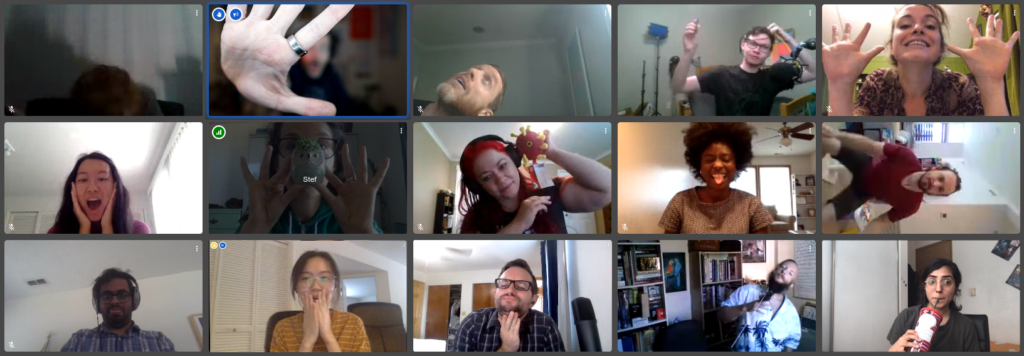
A screenshot from a recent remote meeting of the CDSC…
Recent work by the group includes studies of participation inequalities in online communities and the gig economy, comparisons of different online community rules and norms, and evaluations of design changes deployed across thousands of sites. More examples and information can be found on our list of publications and our research blog (you’re probably reading our blog right now).
This posting is specifically to work on some projects through the Northwestern University part of the CDSC. Northwestern Research Assistants will contribute to data collection, analysis, documentation, and administration on one (or more) of the group’s ongoing projects. Some research projects you might help with include:
A study of rules across the five largest language editions of Wikipedia.
A systematic literature review on the gig economy.
Interviews with contributors to small, niche subreddit communities.
A large-scale analysis of the relationships between communities.
Successful applicants will have an interest in online communities, social science or social computing research, and the ability to balance collaborative and independent work. No specialized skills are required and we will adapt work assignments and training to the skills and interests of the person(s) hired. Relevant skills might include: coursework, research, and/or familiarity with digital media, online communities, human computer interaction, social science research methods such as interviewing, applied statistics, and/or data science. Relevant software experience might include: R, Python, Git, Zotero, or LaTeX. Again, no prior experience or specialized skills are required.
Expected minimum time commitment is 10 hours per week through the remainder of the Winter quarter (late March) with the possibility of working additional hours and/or continuing into the Spring quarter (April-June). All work will be performed remotely.
Interested applicants should submit a resume (or CV) along with a short cover letter explaining your interest in the position and any relevant experience or skills. Applicants should indicate whether you would prefer to pursue this through Federal work-study, for course credit (most likely available only to current students at one of the institutions where CDSC affiliates work), or as a paid position (not Federal work-study). For paid positions, compensation will be $15 per hour. Some funding may be restricted to current undergraduate students (at any institution), which may impact hiring decisions.
Questions and/or applications should be sent to Professor Aaron Shaw. Work-study eligible Northwestern University students should indicate this in their cover letter. Applications will be reviewed by Professor Shaw and current CDSC-NU team members on a rolling basis and finalists will be contacted for an interview.
The CDSC strives to be an inclusive and accessible research community. We particularly welcome applications from members of groups historically underrepresented in computing and/or data sciences. Some of these positions funded through a U.S. National Science Foundation Research Experience for Undergraduates (REU) supplement to awards numbers: IIS-1910202 and IIS-1617468.
It’s Ph.D. application season and the Community Data Science Collective is recruiting! As always, we are looking for talented people to join our research group. Applying to one of the Ph.D. programs that the CDSC faculty members are affiliated with is a great way to do that.
This post provides a very brief run-down on the CDSC, the different universities and Ph.D. programs we’re affiliated with, and what we’re looking for when we review Ph.D. applications. It’s close to the deadline for some of our programs, but we hope this post will still be useful to prospective applicants now and in the future.
CDSC members at the CDSC group retreat in August 2020 (pandemic virtual edition). Left to right by row, starting at top: Charlie, Mako, Aaron, Carl, Floor, Gabrielle, Stef, Kaylea, Tiwalade, Nate, Sayamindu, Regina, Jeremy, Salt, and Sejal.
What are these different Ph.D. programs? Why would I choose one over the other?
Although we have people at other places, this year the group includes four faculty principal investigators (PIs) who are actively recruiting PhD students: Aaron Shaw (Northwestern University), Benjamin Mako Hill (University of Washington in Seattle), Sayamindu Dasgupta (University of North Carolina at Chapel Hill), and Jeremy Foote (Purdue University). Each of these PIs advise Ph.D. students in Ph.D. programs at their respective universities. Our programs are each described below.
Although we often work together on research and serve as co-advisors to students in each others’ projects, each faculty person has specific areas of expertise and interests. The reasons you might choose to apply to one Ph.D. program or to work with a specific faculty member could include factors like your previous training, career goals, and the alignment of your specific research interests with our respective skills.
At the same time, a great thing about the CDSC is that we all collaborate and regularly co-advise students across our respective campuses, so the choice to apply to or attend one program does not prevent you from accessing the expertise of our whole group. But please keep in mind that our different Ph.D. programs have different application deadlines, requirements, and procedures!
Who is actively recruiting this year?
Given the disruptions and uncertainties associated with the COVID19 pandemic, the faculty PIs are more constrained in terms of whether and how they can accept new students this year. If you are interested in applying to any of the programs, we strongly encourage you to reach out the specific faculty in that program before submitting an application.
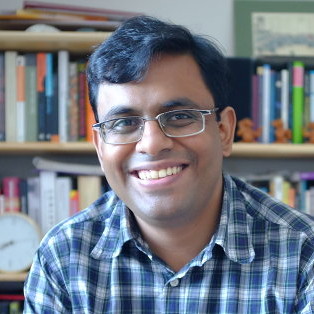
Benjamin Mako Hill is an Assistant Professor of Communication at the University of Washington. He is also an Adjunct Assistant Professor at UW’s Department of Human-Centered Design and Engineering (HCDE) and Computer Science and Engineering (CSE). Although many of Mako’s students are in the Department of Communication, he also advises students in the Department of Computer Science and Engineering, HCDE, and the Information School—although he typically has limited ability to admit students into those programs. Mako’s research focuses on population-level studies of peer production projects, computational social science, efforts to democratize data science, and informal learning.
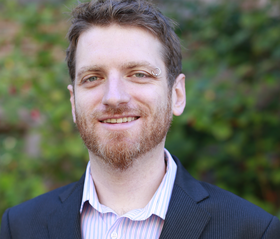
Aaron Shaw is an Associate Professor in the Department of Communication Studies at Northwestern. In terms of Ph.D. programs, Aaron’s primary affiliations are with the Media, Technology and Society (MTS) and the Technology and Social Behavior (TSB) Ph.D. programs. Aaron also has a courtesy appointment in the Sociology Department at Northwestern, but he has not directly supervised any Ph.D. advisees in that department (yet). Aaron’s current research projects focus on comparative analysis of the organization of peer production communities and social computing projects, participation inequalities in online communities, and empirical research methods.
Jeremy Foote
Jeremy Foote is an Assistant Professor at the Brian Lamb School of Communication at Purdue University. He is affiliated with the Organizational Communication and Media, Technology, and Society programs. Jeremy’s current research focuses on how individuals decide when and in what ways to contribute to online communities, and how understanding those decision-making processes can help us to understand which things become popular and influential. Most of his research is done using data science methods and agent-based simulations.
What do you look for in Ph.D. applicants?
There’s no easy or singular answer to this. In general, we look for curious, intelligent people driven to develop original research projects that advance scientific and practical understanding of topics that intersect with any of our collective research interests.
To get an idea of the interests and experiences present in the group, read our respective bios and CVs (follow the links above to our personal websites). Specific skills that we and our students tend to use on a regular basis include experience consuming and producing social science and/or social computing (human-computer interaction) research; applied statistics and statistical computing, various empirical research methods, social theory and cultural studies, and more.
Formal qualifications that speak to similar skills and show up in your resume, transcripts, or work history are great, but we are much more interested in your capacity to learn, think, write, analyze, and/or code effectively than in your credentials, test scores, grades, or previous affiliations. It’s graduate school and we do not expect you to show up knowing how to do all the things already.
Intellectual creativity, persistence, and a willingness to acquire new skills and problem-solve matter a lot. We think doctoral education is less about executing a task that someone else hands you and more about learning how to identify a new, important problem; develop an appropriate approach to solving it; and explain all of the above and why it matters so that other people can learn from you in the future. Evidence that you can or at least want to do these things is critical. Indications that you can also play well with others and would make a generous, friendly colleague are really important too.
All of this is to say, we do not have any one trait or skill set we look for in prospective students. We strive to be inclusive along every possible dimension. Each person who has joined our group has contributed unique skills and experiences as well as their own personal interests. We want our future students and colleagues to do the same.
Now what?
Still not sure whether or how your interests might fit with the group? Still have questions? Still reading and just don’t want to stop? Follow the links above for more information. Feel free to send at least one of us an email. We are happy to try to answer your questions and always eager to chat.
It’s Ph.D. application season and the Community Data Science Collective is recruiting! As always, we are looking for talented people to join our research group. Applying to one of the Ph.D. programs that Aaron, Mako, Sayamindu, and Jeremy are affiliated with is a great way to do that.
This post provides a very brief run-down on the CDSC, the different universities and Ph.D. programs we’re affiliated with, and what we’re looking for when we review Ph.D. applications. It’s close to the deadline for some of our programs, but we hope this post will still be useful to prospective applicants now and in the future.
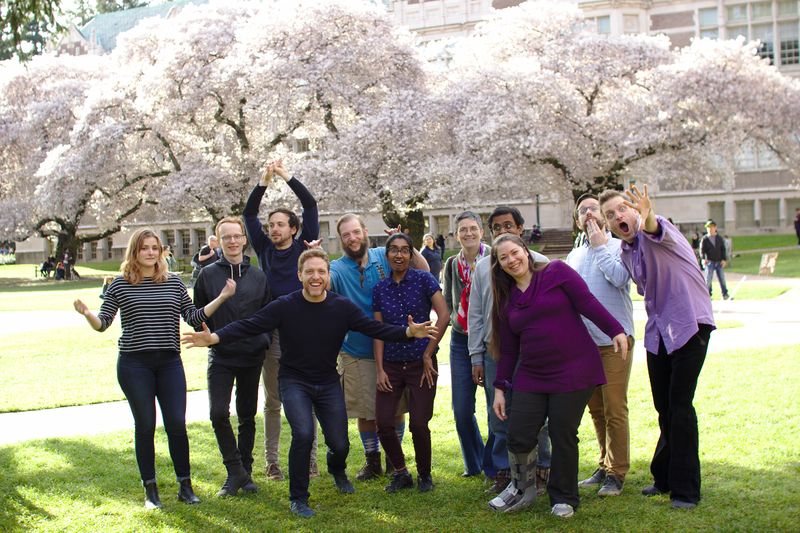
Members of the CDSC at a group retreat in Evanston, Illinois in September 2019. Clockwise from far right is: Salt, Jackie, Floor, Sejal, Nick, Kaylea, Sohyeon, Aaron, Nate, Jeremy, Mako, Jim, Charlie, and Regina. Sayamindu and Sneha are will us in spirit!
What are these different Ph.D. programs? Why would I choose one over the other?
The group currently includes four faculty principal investigators (PIs): Aaron Shaw (Northwestern University), Benjamin Mako Hill (University of Washington in Seattle), Sayamindu Dasgupta (University of North Carolina at Chapel Hill), and Jeremy Foote (Purdue University). The PIs advise Ph.D. students in Ph.D. programs at their respective universities. Our programs are each described below.
Although we often work together on research and serve as co-advisors to students in each others’ projects, each faculty person has specific areas of expertise and unique interests. The reasons you might choose to apply to one Ph.D. program or to work with a specific faculty member include factors like your previous training, career goals, and the alignment of your specific research interests with our respective skills.
At the same time, a great thing about the CDSC is that we all collaborate and regularly co-advise students across our respective campuses, so the choice to apply to or attend one program does not prevent you from accessing the expertise of our whole group. But please keep in mind that our different Ph.D. programs have different application deadlines, requirements, and procedures!
Benjamin Mako Hill is an Assistant Professor of Communication at the University of Washington. He is also an Adjunct Assistant Professor at UW’s Department of Human-Centered Design and Engineering (HCDE) and Computer Science and Engineering (CSE). Although most of Mako’s students are in the Department of Communication, he also advises students in the Department of Computer Science and Engineering and HCDE—although he typically has limited ability to admit students into those programs. Mako’s research focuses on population-level studies of peer production projects, computational social science, efforts to democratize data science, and informal learning.
Aaron Shaw is an Associate Professor in the Department of Communication Studies at Northwestern. In terms of Ph.D. programs, Aaron’s primary affiliations are with the Media, Technology and Society (MTS) and the Technology and Social Behavior (TSB) Ph.D. programs. Aaron also has a courtesy appointment in the Sociology Department at Northwestern, but he has not directly supervised any Ph.D. advisees in that department (yet). Aaron’s current research projects focus on comparative analysis of the organization of peer production communities and social computing projects, participation inequalities in online communities, and empirical research methods.
Jeremy Foote
Jeremy Foote is an Assistant Professor at the Brian Lamb School of Communication at Purdue University. He is affiliated with the Organizational Communication and Media, Technology, and Society programs. Jeremy’s current research focuses on how individuals decide when and in what ways to contribute to online communities, and how understanding those decision-making processes can help us to understand which things become popular and influential. Most of his research is done using data science methods and agent-based simulations.
What do you look for in Ph.D. applicants?
There’s no easy or singular answer to this. In general, we look for curious, intelligent people driven to develop original research projects that advance scientific and practical understanding of topics that intersect with any of our collective research interests.
To get an idea of the interests and experiences present in the group, read our respective bios and CVs (follow the links above to our personal websites). Specific skills that we and our students tend to use on a regular basis include experience consuming and producing social science and/or social computing (human-computer interaction) research; applied statistics and statistical computing, various empirical research methods, social theory and cultural studies, and more.
Formal qualifications that speak to similar skills and show up in your resume, transcripts, or work history are great, but we are much more interested in your capacity to learn, think, write, analyze, and/or code effectively than in your credentials, test scores, grades, or previous affiliations. It’s graduate school and we do not expect you to show up pre-certified in all the ways or knowing how to do all the things already.
Intellectual creativity, persistence, and a willingness to acquire new skills and problem-solve matter a lot. We think doctoral education is less about executing a task that someone else hands you and more about learning how to identify a new, important problem; develop an appropriate approach to solving it; and explain all of the above and why it matters so that other people can learn from you in the future. Evidence that you can or at least want to do these things is critical. Indications that you can also play well with others and would make a generous, friendly colleague are really important too.
All of this is to say, we do not have any one trait or skill set we look for in prospective students. We strive to be inclusive along every possible dimension. Each person who has joined our group has contributed unique skills and experiences as well as their own personal interests. We want our future students and colleagues to do the same.
Now what?
Still not sure whether or how your interests might fit with the group? Still have questions? Still reading and just don’t want to stop? Follow the links above for more information. Feel free to send at least one of us an email. We are happy to try to answer your questions and always eager to chat.
It’s Ph.D. application season and the Community Data Science Collective is recruiting! As always, we are looking for talented people to join our research group. Applying to one of the Ph.D. programs that Aaron, Mako, and Sayamindu are affiliated with is a great way to do that.
This post provides a very brief run-down on the CDSC, the different universities and Ph.D. programs we’re affiliated with, and what we’re looking for when we review Ph.D. applications. It’s quite close to the deadline for some of our programs, but we hope this post will still be useful to prospective applicants now and in the future.
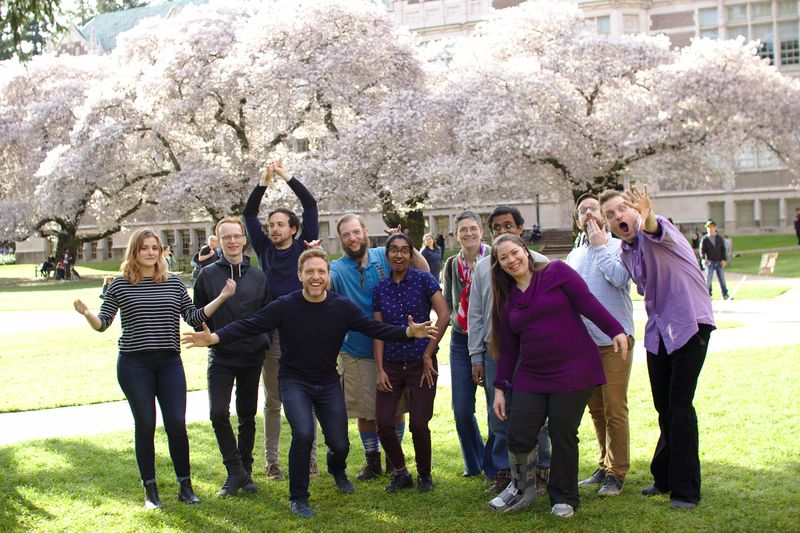
Members of the CDSC and friends assembled for a group meeting at UW in April, 2018. From left to right the people in the picture are: Julia, Charlie, Nate, Aaron, Salt, Sneha, Emilia, Sayamindu (hiding), Kaylea, Jeremy, Mako. Photo credit: Sage Ross (cc-by-sa)
What are these different Ph.D. programs? Why would I choose one over the other?
The group currently includes three faculty principal investigators (PIs): Aaron Shaw (Northwestern University), Benjamin Mako Hill (University of Washington in Seattle), and Sayamindu Dasgupta (University of North Carolina at Chapel Hill). The three PIs advise Ph.D. students in multiple Ph.D. programs at their respective universities. Our programs are each described below.
Although we often work together on research and serve as co-advisors to students in each others’ projects, each faculty person has specific areas of expertise and unique interests. The reasons you might choose to apply to one Ph.D. program or to work with a specific faculty member include factors like your previous training, career goals, and the alignment of your specific research interests with our respective skills.
At the same time, a great thing about the CDSC is that we all collaborate and regularly co-advise students across our respective campuses, so the choice to apply to or attend one program does not prevent you from accessing the expertise of our whole group. But please keep in mind that our different Ph.D. programs have different application deadlines, requirements, and procedures!
Benjamin Mako Hill is an Assistant Professor of Communication at the University of Washington. He is also an Adjunct Assistant Professor at UW’s Department of Human-Centered Design and Engineering (HCDE). Although almost all of Mako’s students are in the Department of Communication, he also advises students in the Department of Computer Science and Engineering and can advise students in HCDE as well—although he typically has no ability to admit students into those programs. Mako’s research focuses on population-level studies of peer production projects, computational social science, and efforts to democratize data science.
Aaron Shaw is an Assistant Professor in the Department of Communication Studies at Northwestern. In terms of Ph.D. programs, Aaron’s primary affiliations are with the Media, Technology and Society (MTS) and the Technology and Social Behavior (TSB) Ph.D. programs. Aaron also has a courtesy appointment in the Sociology Department at Northwestern, but he has not directly supervised any Ph.D. advisees in that department (yet). Aaron’s current research projects focus on comparative analysis of the organization of peer production communities and social computing projects, participation inequalities in online communities, and empirical research methods.
What do you look for in Ph.D. applicants?
There’s no easy or singular answer to this. In general, we look for curious, intelligent people driven to develop original research projects that advance scientific and practical understanding of topics that intersect with any of our collective research interests.
To get an idea of the interests and experiences present in the group, read our respective bios and CVs (follow the links above to our personal websites). Specific skills that we and our students tend to use on a regular basis include experience consuming and producing social science and/or social computing (human-computer interaction) research; applied statistics and statistical computing, various empirical research methods, social theory and cultural studies, and more.
Formal qualifications that speak to similar skills and show up in your resume, transcripts, or work history are great, but we are much more interested in your capacity to learn, think, write, analyze, and/or code effectively than in your credentials, test scores, grades, or previous affiliations. It’s graduate school and we do not expect you to show up pre-certified in all the ways or knowing how to do all the things already.
Intellectual creativity, persistence, and a willingness to acquire new skills and problem-solve matter a lot. We think doctoral education is less about executing a task that someone else hands you and more about learning how to identify a new, important problem; develop an appropriate approach to solving it; and explain all of the above and why it matters so that other people can learn from you in the future. Evidence that you can or at least want to do these things is critical. Indications that you can also play well with others and would make a generous, friendly colleague are really important too.
All of this is to say, we do not have any one trait or skill set we look for in prospective students. We strive to be inclusive along every possible dimension. Each person who has joined our group has contributed unique skills and experiences as well as their own personal interests. We want our future students and colleagues to do the same.
Now what?
Still not sure whether or how your interests might fit with the group? Still have questions? Still reading and just don’t want to stop? Follow the links above for more information. Feel free to send at least one of us an email. We are happy to try to answer your questions and always eager to chat.