Note: We have missed publishing blog posts about academic papers over the past few years. To ensure that my blog contains a more comprehensive record of our published papers and to surface these for folks who missed them, I will be periodically publishing blog posts about some “older” published projects.
It seems natural to think of online communities competing for the time and attention of their participants. Over the last few years, I’ve worked with a team of collaborators—led by Nathan TeBlunthuis—to use mathematical and statistical techniques from ecology to understand these dynamics. What we’ve found surprised us: competition between online communities is rare and typically short-lived.
When we started this research, we figured competition would be most likely among communities discussing similar topics. As a first step, we identified clusters of such communities on Reddit. One surprising thing we noticed in our Reddit data was that many of these communities that used similar language also had very high levels of overlap among their users. This was puzzling: why were the same groups of people talking to each other about the same things in different places? And why don’t they appear to be in competition with each other for their users’ time and activity?
We didn’t know how to answer this question using quantitative methods. As a result, we recruited and interviewed 20 active participants in clusters of highly related subreddits with overlapping user bases (for example, one cluster was focused on vintage audio).
We found that the answer to the puzzle lay in the fact that the people we talked to were looking for three distinct things from the communities they worked in:
- The ability to connect to specific information and narrowly scoped discussions.
- The ability to socialize with people who are similar to themselves.
- Attention from the largest possible audience.
Critically, we also found that these three things represented a “trilemma,” and that no single community can meet all three needs. You might find two of the three in a single community, but you could never have all three.
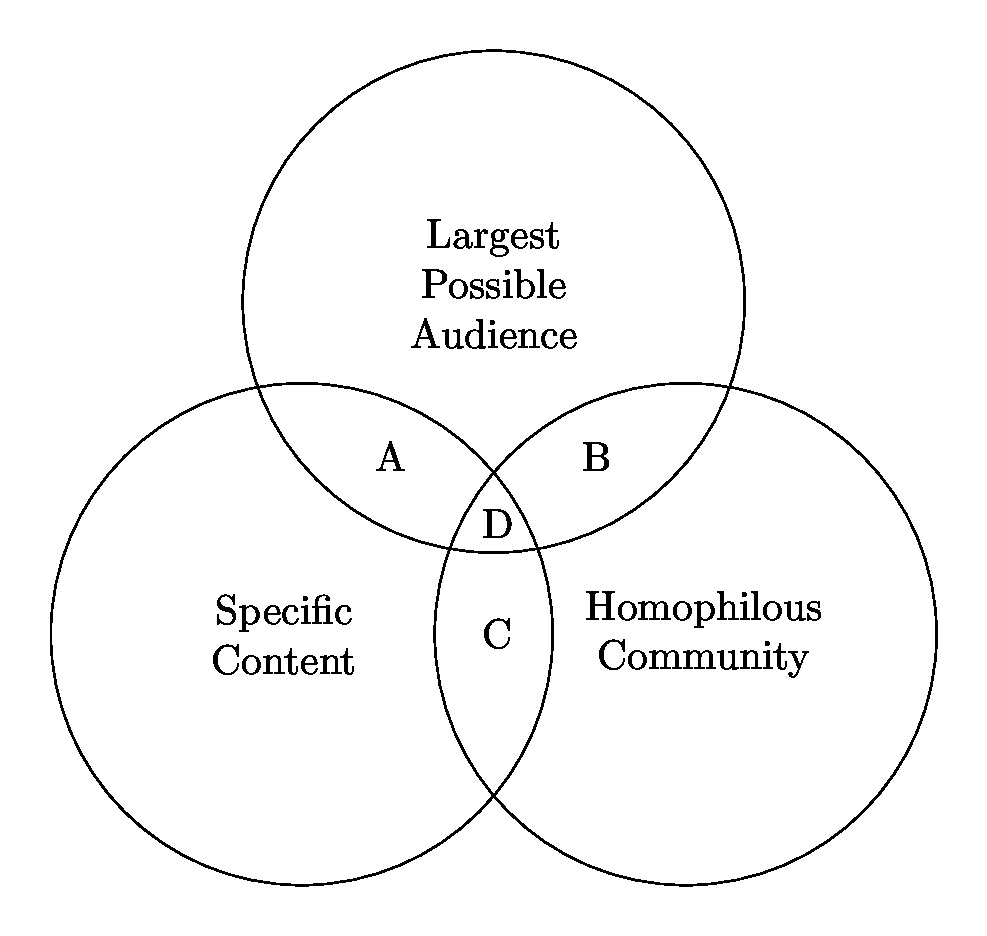
The end result is something I recognize in how I engage with online communities on platforms like Reddit. People tend to engage with a portfolio of communities that vary in size, specialization, topical focus, and rules. Compared with any single community, such overlapping systems can provide a wider range of benefits. No community can do everything.
This work was published as a paper at CSCW: TeBlunthuis, Nathan, Charles Kiene, Isabella Brown, Laura (Alia) Levi, Nicole McGinnis, and Benjamin Mako Hill. 2022. “No Community Can Do Everything: Why People Participate in Similar Online Communities.” Proceedings of the ACM on Human-Computer Interaction 6 (CSCW1): 61:1-61:25. https://doi.org/10.1145/3512908.
This work was supported by the National Science Foundation (awards IIS-1908850, IIS-1910202, and GRFP-2016220885). A full list of acknowledgements is in the paper.
This post was first published on Benjamin Mako Hill’s blog copyrighteous.
Discover more from Community Data Science Collective
Subscribe to get the latest posts sent to your email.
Did homogenous vs heterogenous platforms make a difference? If you’re already on Reddit it’s easy to participate in other subreddits, but it requires more effort to also participate in a Facebook group or Discourse forum or email list. How important is that lower barrier to entry, versus a community that is just as good at meeting the specific needs in question but that is somewhere else?
This particular study didn’t have variation on platform (it was all on Reddit). It’s a very interesting question!