Welcome new student members of the CDSC!

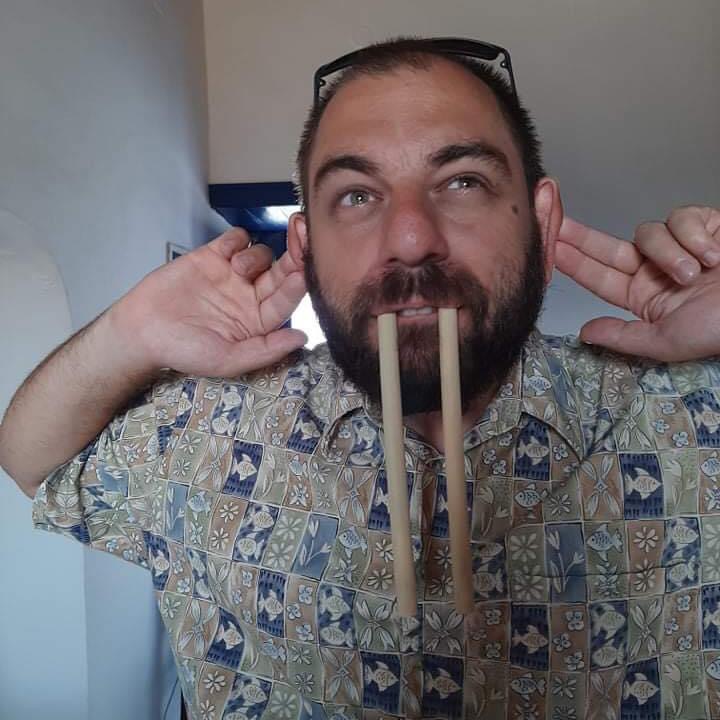
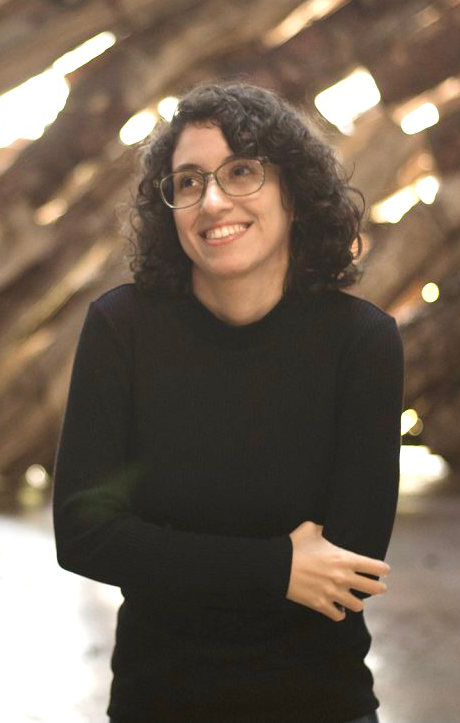
Most years, the CDSC is lucky enough to recruit some amazing new Ph.D. students to the lab. This fall is no exception and we are thrilled to welcome an extraordinary group across several of our group’s campuses. The students join us from a wide variety of places, backgrounds, and prior affiliations (which should be encouraging for any prospective students looking to join the group in the future!). Some short bios and photos follow below (in alphabetical order by last name) with the text largely taken from the people page on our wiki. You can look forward to reading more about their research in the coming years!
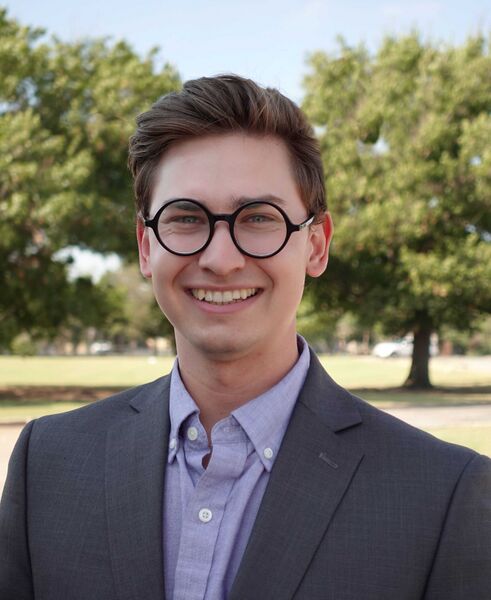
Eric Fassbender is a first year PhD student in the Media Technology and Society program at Northwestern University. He is interested in studying technology adoption as an expression of resistance and protest. He is currently researching the ways that people form decisions to leave online groups around issues of surveillance and political alignment. You can learn more about him on his website here or on mastodon here. Outside of work, Eric loves reading sci-fi, all things cyberpunk, and hiking to improve his landscape photography.
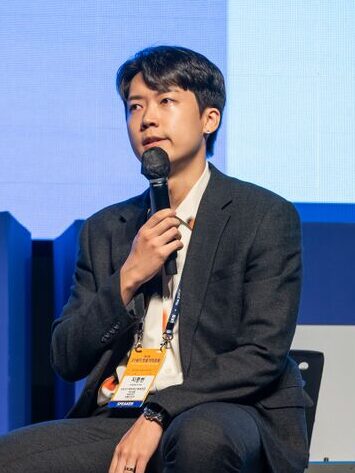
Jonghyun Jee (pronounced Jong-H-yuh-n, not Hyoon) is a first-year PhD student in the Media, Technology, and Society program at Northwestern University. He studies how online communities create and enforce their rules. His research has looked at a range of platforms, from established ones like Wikipedia, YouTube, and Discord to decentralized networks such as Bluesky and Mastodon. Lately, Jonghyun has been exploring how to use LLMs to simulate these social environments at scale. He’s driven by the belief that critiques of technology (even dystopian ones) are less calls for its undoing than invitations to reimagine it. When Jonghyun procrastinates, he practices zen meditation and writes short film synopses.
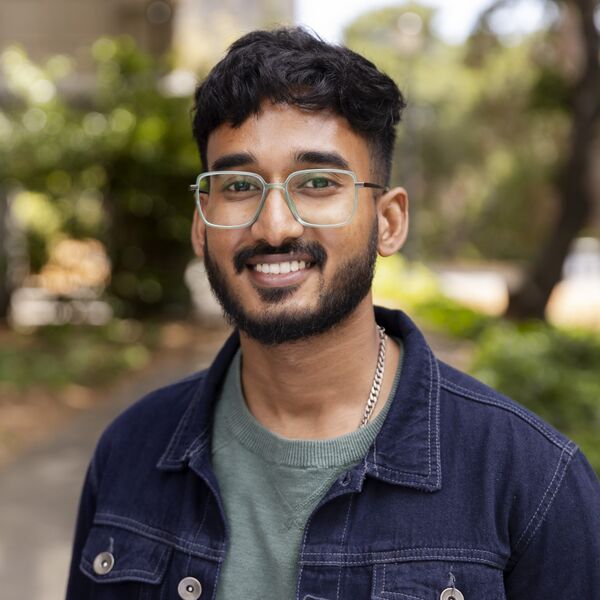
Manish Kumar is a first-year PhD student at the School of Information at the University of Texas at Austin advised by Dr Nathan TeBlunthuis and Dr Edgar Gómez Cruz. Manish’s work explores political expression on social media and how it connects to people’s offline relationships. He’s fascinated by human experiences at scale, and tries to bridge qualitative inquiry with computational techniques to capture that complexity. Broadly, Manish studies how social media/technology becomes woven into people’s everyday political sensemaking. Manish grew up in Patna, India. He earned a degree in Information Science & Engineering and spent a few years as a software developer, but has always been drawn to the sociological side of technology. That curiosity took Manish to UC Berkeley for a Master’s of Information Management and Systems, where he discovered research and got completely hooked. In his free time, Manish like to do nerdy stuff like reading historical fiction, going on walking tours, learning about local history (that includes the petty neighbourhood rivalries) and going to museums.
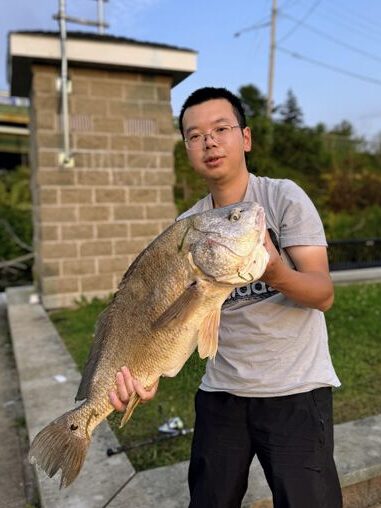
Jianghui Li is a first-year PhD student at the University of Texas at Austin’s School of Information, advised by Dr. Nathan TeBlunthuis. He is interested in researching belief dynamics, collective behavior, and sustainability in sociotechnical systems through the lens of complex adaptive systems. Before studying at UT Austin, Jianghui earned bachelor’s and master’s degrees at Syracuse University’s School of Information Studies, and he misses the cool Syracuse weather Outside of research, Jianghui enjoys fishing, learning about fish, and sometimes thinking about the similarities between ecological systems and human networks.

Dylan Smith is a first-year MA/PhD student at University of Washington—Seattle in Communication. They grew up in Portland, Oregon and got a bachelor’s degree in Computer Science at Carleton College in Minnesota. Dylan’s research interests are in online interpersonal communication and online governance. For the past few years, Dylan has been working on a research project studying Wikipedia’s arbitration process. In their free time, Dylan likes reading fiction, spending time with friends, hiking, and long-distance running. Last Spring, Dylan ran their first marathon!!!
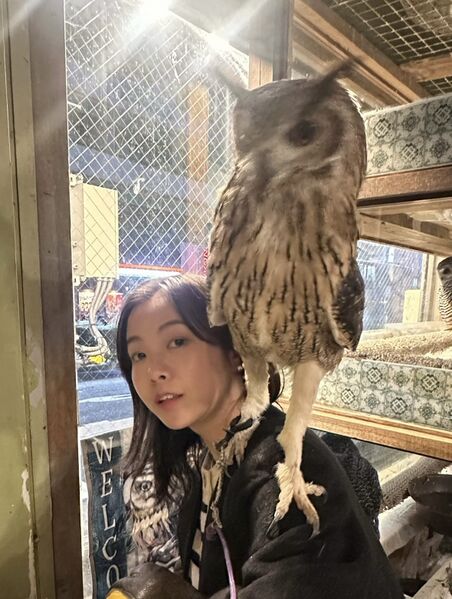
Ran Tang is a MA/PhD student in the Department of Communication at the University of Washington. Her research focuses on the moderation of online communities. She primarily use qualitative methods to study the daily work of volunteer moderators, and is also exploring the use of quantitative approaches in future projects. In her free time, Ran enjoys playing table tennis and swimming.

Yiwei Wu is a first-year PhD student at UT Austin. Previously, she attended the University of Washington for her bachelor’s degree. Her research interests include online collective action, peer production, and community data governance. In her free time, Yiwei enjoys baking, playing musical instruments (bass and Chinese flute), and playing farming games (e.g., Stardew Valley).
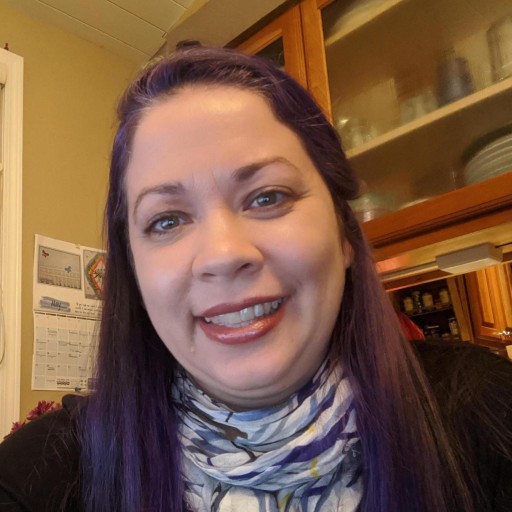
Kaylea Champion Receives Dissertation Awards

CDSC member Kaylea Champion’s dissertation, “Social and Technical Sources of Risk in Sustaining Digital Infrastructure,” has been selected for two awards: the 2025 Annie Lang Dissertation Award from the International Communication Association Information Systems Division, and the 2025 Faculty Award for Outstanding Research – Ph.D. Dissertation Award from the Department of Communication University of Washington.

Kaylea’s dissertation develops new methods to measure and understand risks to our shared digital infrastructure–including platforms, communication systems, the web, and the cloud. Digital infrastructure faces a form of risk called underproduction–highly important, but low-quality software. She argues we can identify this risk by examining the social and technical conditions of software production communities.

Using analysis methods she developed and validated, she found thousands of at-risk software packages. These packages are often old, or written in older languages. However, simply directing more resources toward software maintenance may not be enough: at-risk packages are more likely to be maintained by larger numbers of people and by people who are already highly active in the development community. She identified two factors associated with lower risk: empowerment and retention. Kaylea’s work joins a growing base of scholarship across the CDSC focusing attention toward contributors as a key part of building thriving peer production communities for the benefit of the greater public.

Kaylea will join the faculty of the University of Washington Bothell as an Assistant Professor in the Division of Computing and Software Systems, School of STEM, in Fall 2025.

CDSC Welcomes Dionna, Loizos, and Thaty!

We’re excited to welcome Dionna Taylor, Loizos Bitsikokos, and Thaty (pronounced Tatchi) Andrade Nunes as new core student members of CDSC!

Dionna is a first year MA/PhD student in the Communication Department at the University of Washington, being advised by Mako. She earned her B.A. in Psychology and Communication (also from UW) and is interested in the intersection of human behavior and technology, with a primary focus on online community collapse and online healthcare spaces. In her free time, you can find her reading, line dancing, or traveling.

Loizos is a PhD student at Purdue University’s Brian Lamb School of Communication. His academic journey began with degrees in physics and applied mathematics from the National Technical University of Athens (N.T.U.A.), followed by an MA in computational social science from the University of Chicago, focusing on sociology. His research lies at the intersection of computational social science, online platforms, and organizations. He’s particularly interested in the intricate relationship between algorithms and society. He also studies the tensions between structure and agency within online platforms, examining how platforms influence identity formation and whether users can resist institutionally ingrained biases. His work investigates the conceptualization of desire within platform infrastructures. When he has free time outside of academia, Loizos enjoys writing poems, making and collecting zines, watching cinema, taking photographs, walking in nature, and occasionally playing the saxophone.

Thaty (pronounced like Tatchi) is a first-year PhD student in the Media, Technology, and Society program at Northwestern University, advised by Professor Aaron Shaw. Her interest in studying online communities began while working at game companies in South Korea. In addition to creating social media videos, she was responsible for organizing engaging community events and managing online communities. She was fascinated by how quickly these communities could self-organize, whether by creating guides, wikis, or establishing their own rules and moderation systems. Thaty wants to investigate how communication and information technologies influence social outcomes, how online communities influence participants, what kind of participants (lurkers or active) join them, and why and how they contribute. She’s also interested in the different forms of community engagement such as collaboration, political mobilization, and organization. She’s originally from Brazil, lived in South Korea for seven years, and speaks Portuguese, English, Korean, and some Spanish! In her free time, she enjoys playing story-driven video games, watching horror movies/series, and spending time with friends

Professor Floor Fiers!

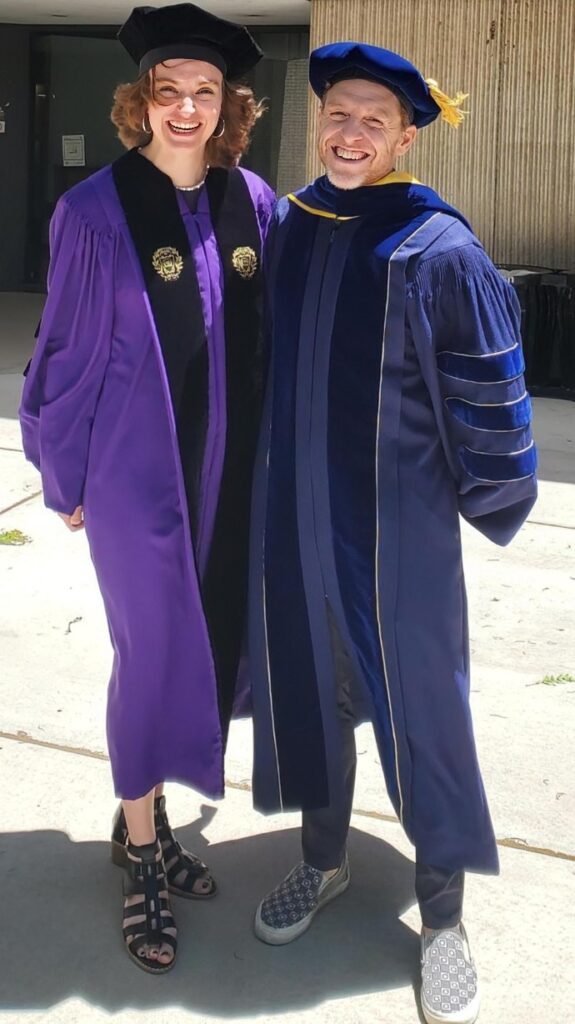
Dr. Floor Fiers and proud faculty mentor Aaron Shaw.
Floor and Aaron just before Northwestern’s doctoral hooding ceremony.

A very special congratulations to CDSC member Floor Fiers on the completion of their Ph.D. in Media, Technology & Society at Northwestern!

Floor’s dissertation Chasing the Ideal and Making It Work: Pursuing Employment in the Remote Gig Economy, seeks to understand inequality among workers in the gig economy and how they navigate the precarity involved in remote gig work. Several of the chapters have already appeared as standalone, peer-reviewed publications, but there’s plenty of new, exciting, and as-yet-unpublished material in there as well.

This week (!), Floor will begin a position as Assistant Professor in the Amsterdam School of Communication Research (ASCoR) at the University of Amsterdam.

Since I (Aaron) am posting this one myself, it seems appropriate to add that it’s been wonderful working with Floor over the past five+ years. Indeed, I’m still in denial about the fact that Floor won’t be physically present in our lab meetings this year. At the same time, I couldn’t be happier for Floor and definitely get a goofy, proud-faculty-mentor grin on my face whenever I think about the incredible things they’ve accomplished already (nevermind all the cool stuff yet to come).

Congratulations again, Floor!

Academic Year-in-review (2023-2024) and celebration!

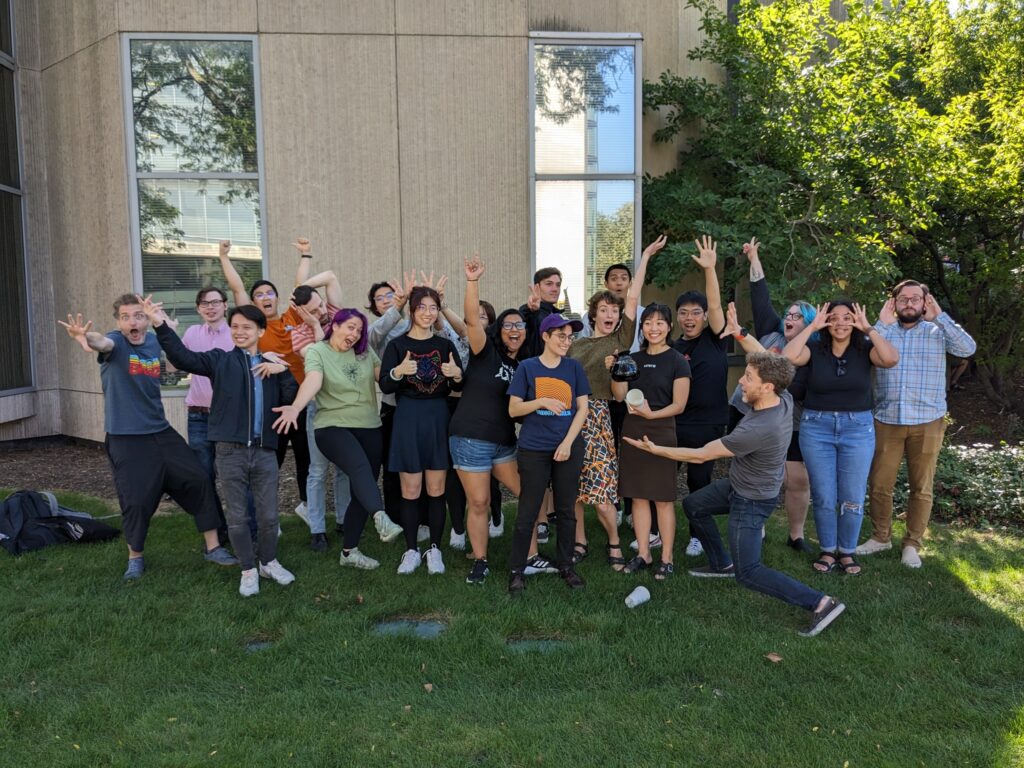
CDSC group photo from Fall, 2023 at Northwestern
CDSC group photo taken at Northwestern in Fall, 2023

We love celebrating the accomplishments of CDSC lab and community members! Here’s a less-than-complete, not-quite-brief summary of some of those accomplishments over the past academic year+ (since the last time we wrote a post like this). Congratulations to everyone involved—including those members of the CDSC community not named below. It truly takes a village to do all of these things and we appreciate the achievements and contributions of all.

Awards, degrees, and fellowships:

  • Hazel Chiu received a Top Paper Award from the International Communication Association (ICA) Communication and Technology (CaT) Division for “User Acceptance of Multiple Accounts Management on SNS: A Technology Acceptance Model Perspective.”
  • Nathan TeBlunthuis received a Top Paper Award from the ICA Computational Methods (CM) Division for “Misclassification in Automated Content Analysis Causes Bias in Regression. Can We Fix It? Yes We Can!.”
  • Dyuti Jha and Ryan Funkhouser were named runners-up for the National Communication Association (NCA) Sam Keltner Top Student paper for “Freedom to flourish: A systematic review of the literature at the intersection of resilience, communication, and peacebuilding.”
  • Floor Fiers completed their Ph.D. and will begin a new role as an Assistant Professor of Communication at the University of Amsterdam.
  • Nathan TeBlunthuis will begin a new role as an Assistant Professor in the Information School at the University of Texas, Austin.
  • Tommy Rousse completed his J.D. and MTS Ph.D. at Northwestern.
  • Sohyeon Hwang will begin a Postdoctoral Fellowship at the Center for Information Technology & Policy (CITP) at Princeton University in the Fall.
  • Yibin Fan completed a Master’s degree in Communication at the University of Washington.
  • Benjamin Mako Hill was a fellow at CITP at Princeton University during 2023-2024.
  • Emily Zou graduated with honors from Northwestern in American Studies with her thesis, “`Did Bro Just Grief the US Government?’: How online community identities create new genres of political communication.” Starting in the Fall, Emily will begin a Ph.D. in Communication at Stanford University.
  • Carolyn Zou graduated with honors from Northwestern in Communication Studies with their thesis, “Sociotechnical Risks of Simulating Humans with Language Model Agents.” Starting in the Fall, Carolyn will begin a Ph.D. in Computer Science at Stanford University.
  • Carolyn Zou was awarded an NSF Graduate Research Fellowship (GRFP).

Publications:

Members of the lab published more than 15 papers and articles. This is too many to list here, but you should check our publications page for more.

Talks and conference presentations:

Members of the group gave way too many presentations to list.

Select venues include: Seattle GNU/Linux Conference (SeaGL); Free and Open Source Software Yearly Conference (FOSSY); PyCon; Wikimania; the Annual Meeting of the International Communication Association (ICA); the Annual Meeting of the National Communication Association (NCA); the ACM Conferences CSCW and CHI; the Yale Internet & Society Project; the Berkman-Klein Center for Internet & Society at Harvard University; Stanford University HCI Speaker Series; University of Maryland, College Park; Rutgers University; Cornell Tech, Digital Life Institute; Learning Planet Institute, Paris; the University of Pennsylvania, Annenberg School for Communication; The Rockefeller Foundation’s Bellagio Center in Bellagio, Italy; and the Stanford Trust & Safety Research Conference, the IEEE International Conferences on Weblogs and Social Media (ICWSM) and Software Analysis, Evolution and Reengineering (SANER).

Teaching:

A selection of the courses taught or TA’ed by members of the group in the past year include:

  • Introduction to Communication
  • Introduction to Programming and Data Science
  • Public speaking
  • Online communities
  • History & theories of information
  • Social Network Analysis
  • Communication technology & politics

Many of these are available via our workshops and classes page.

Events:

Members of the group planned, hosted, or otherwise played leadership roles in the following events:

  • The CDSC Science of Community Dialogues Series
  • The Northwestern Center for HCI+Design Thought-Leader Dialogue Series
  • Free Open Source Software Yearly (FOSSY) Conference, Science of Community Track (2023 and 2024).
  • The Decentralized Social Media Workshop, Princeton University
  • Hongerige Wolf Festival (“Science” branch)

Other career and degree milestones:

  • Madison Deyo joined the group as Program Coordinator!
  • Molly de Blanc began a Ph.D. in Media, Technology, and Society at Northwestern.
  • Haomin Lin and Matt Gaughan joined the CDSC at UW and Northwestern respectively.
  • Carl Colglazier, Ryan Funkhouser, and Zarine Kharazian passed their general/preliminary/qualifying exams.
  • Charlie Kiene completed an internship at Amazon.

CDSC welcomes Madison Deyo!

Madison Deyo has recently joined the CDSC as a Program Coordinator and we couldn’t be more thrilled to welcome her to the team!

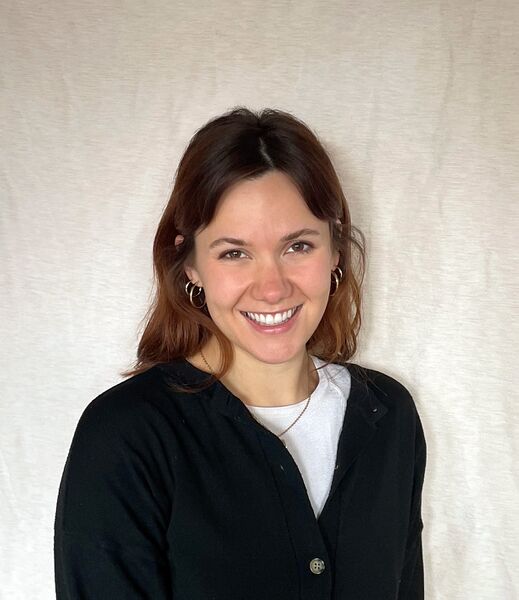
Madison Deyo headshot.

Madison is based at Northwestern. With the CDSC, Madison’s role includes a mix of event planning and coordination; outreach and communications; and supporting the operations of the group. She also works with the Northwestern Center for Human-Computer Interaction + Design. Madison brings experience working with community-based non-profits in several different capacities.

Madison currently lives in Chicago, and grew up in Wisconsin, where she attended the University of Wisconsin-Madison. There, she received my B.S. in Art (with a focus on illustration) and Communications: Radio-TV-Film. In addition to her position at Northwestern, Madison also works as a freelance artist designing mead labels, tattoos, and occasionally album/EP covers. You can check out her portfolio.

2022 Year in Review

One of the fun things about being in a large lab is getting to celebrate everyone’s accomplishments, wins, and the good stuff that happens. Here is a brief-ish overview of some real successes from 2022.

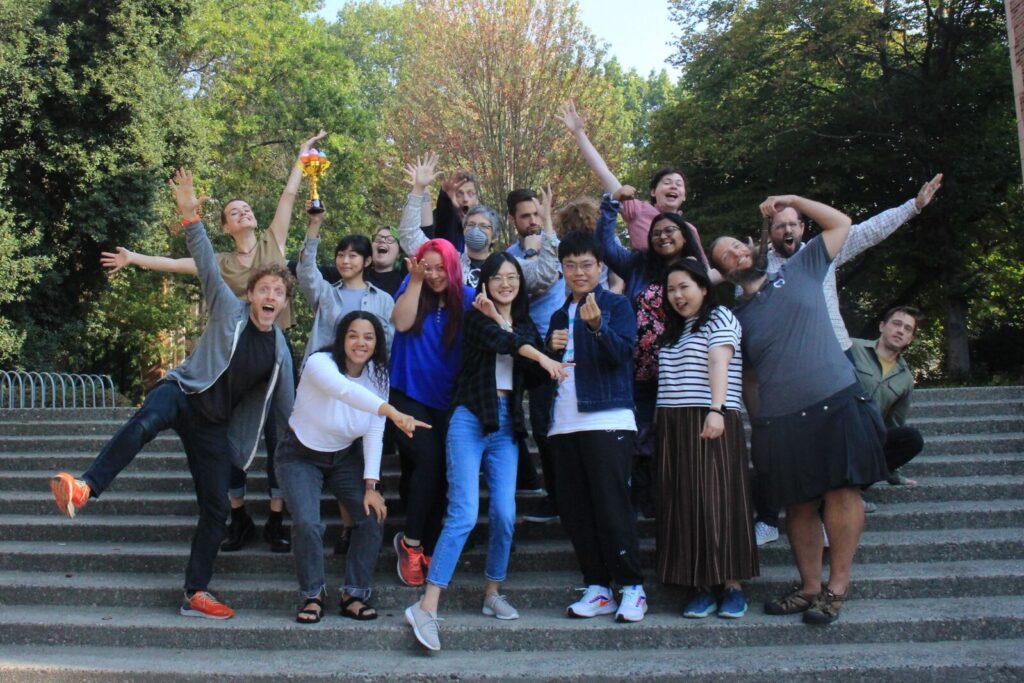
A photo of the CDSC group on some steps with their hands in the air. There are nineteen people in the photo. NINETEEN!
Our 2022 Fall Retreat!

Graduations and New Positions

Our lab gained SIX new grad student members, Kevin Ackermann, Yibin Fang, Ellie Ross, Dyuti Jha, Hazel Chu, and Ryan Funkhouser. Kevin is a first year graduate student at Northwestern and Yibin and Ellie are first year students at University of Washington. Dyuti, Hazel, and Ryan joined us via Purdue and become Jeremy Foote’s first ever advisees. We had quite a number of undergraduate RAs. We also gained Divya Sikka from Interlake High School.

Nick Vincent became Dr. Nick Vincent, Ph.D (Northwestern). He will do a postdoc at the University of California Davis and University of Washington. Molly de Blanc earned their master’s degree (New York University). Dr. Nate TeBlunthius joined the University of Michigan as a post-doc, working with Professor Ceren Budak.

Kaylea Champion and Regina Cheng had their dissertation proposals approved and Floor Fiers finished their qualifying exams and is now a Ph.D. candidate. Carl Colglaizer finished his coursework.

Aaron Shaw started an appointment as the Scholar-in-Residence for King County, Washington, as well as Visiting Professor in the Department of Communication at the University of Washington.

Teaching

As faculty, it is expected that Jeremy Foote, Mako Hill, Sneha Narayan, and Aaron Shaw taught classes. As a class teaching assistant, Kaylea won an Outstanding Teaching Award! Floor also taught a public speaking class. CDSC members were also teaching assistants, led workshops, and gave guest lectures in classes.

an icon of a silhouette holding a book and a wand, with stars and planets around them. Text reads "Best Teacher in the Universe."
BEST TEACHER” by mickeymanzzz is licensed under CC BY-SA 2.0.

Presentations

This list is far from complete, including some highlights!

Carl presented at ICA alongside Nicholas Diakopoulos, “Predictive Models in News Coverage of the COVID-19 Pandemic in the United States.”

Floor was present at the Easter Sociological Society (ESS), AoIR (Association of Internet Researchers), and ICA. They won a top paper award at National Communication Association (NCA): Walter, N., Suresh, S., Brooks, J. J., Saucier, C., Fiers, F., & Holbert, R. L. (2022, November). The Chaffee Principle: The Most Likely Effect of Communication…Is Further Communication. National Communication Association (NCA) National Convention, New Orleans, LA.

Kaylea had a whopping two papers at ICA, a keynote at the IEEE Symposium on Digital Privacy and Social Media, and presentations at CSCW Doctoral Consortium, a CSCW workshop, and the DUB Doctoral Consortium. She also participated in Aaron Swartz Day, SeaGL, CHAOSSCon, MozFest, and an event at UMASS Boston.

Molly also participated in Aaron Swartz Day, and a workshop at CSCW on volunteer labor and data.

Regina gave presentations at the Makecode Team at Microsoft Research, Expertise@scale Salon (Emory University), Microsoft Research HCI Seminar, and CSCW (“Many Destinations, Many Pathways: A Quantitative Analysis of Legitimate Peripheral Participation in Scratch. 2022” and “Feedback Exchange and Online Affinity: A Case Study of Online Fanfiction Writers“) (among others). She attended CHI and NAACL (with two additional papers). Regina’s paper with Syamindu Dasgupta and Mako HIll at CHI 2022 (“How Interest-Driven Content Creation Shapes Opportunities for Informal Learning in Scratch: A Case Study on Novices’ Use of Data Structures“) won Best Paper Honorable Mention Award.

Sohyeon was at GLF as a knowledge steward and presented two posters at the HCI+D Lambert Conference (one with Emily Zou and one with Charlie Kiene, Serene Ong, and Aaron). She also presented at ICWSM, had posters at ICSSI and IC2S2, and organized a workshop at CSCW. In addition to more traditional academic presentations, Sohyeon was on a fireside chat panel hosted by d/arc server, guest lectured at the University of Washington and Northwestern, and met with Discord moderators to talk about heterogeneity in online governance. Sohyeon also won the Half-Bake Off at the CDSC fall retreat.

Public Scholarship

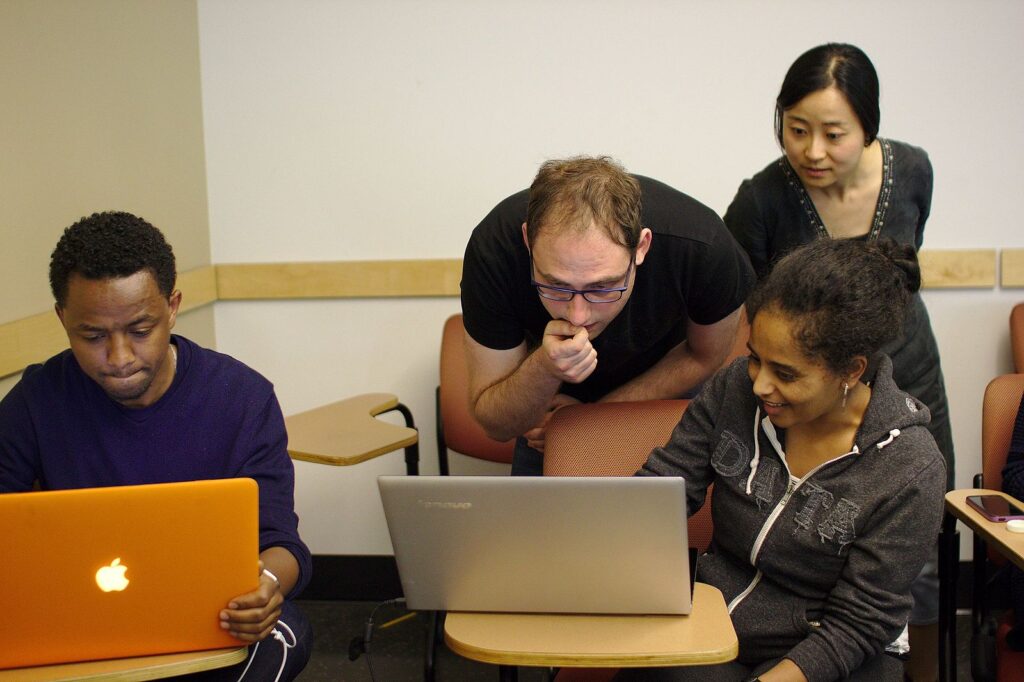
A photo of four people. Two of them are sitting and looking at laptops, while two of them are standing and looking at the laptops thinking. Only one person is smiling.
This image is from 2016

We did a lot of public scholarship this year! Among presentations, leading workshops, and organizing public facing events, CDSC also ran the Science of Community Dialogue Series. Presenters from within CDSC include Jeremy Foote, Sohyeon Hwang, Nate TeBlunthius, Charlie Kiene, Kaylea Champion, Regina Cheng, and Nick Vincent. Guest speakers included Dr. Shruti Sannon, Dr. Denae Ford, and Dr. Amy X. Zhang. To attend future Dialogues, sign up for our low-volume email list!

These events are organized by Molly, with assistance from Aaron and Mako.

Publications

Rather than listing publications here, you can check them out on the wiki.

CDSC students, courses, & (award winning!) instructors featured by Wiki Education

Wiki Education (a.k.a., WikiEdu) is an independent non-profit organization that promotes the integration of Wikipedia into education and classrooms. In pursuit of this mission, WikiEdu has created incredible resources for students and instructors, including tools that facilitate classroom assignments where students create and improve Wikipedia articles.

Wiki Education Foundation
Wiki Education is great! (And the feeling seems to be mutual based on their recent blogposts)

In courses at both Northwestern and the University of Washington, CDSC faculty and students have offered courses with Wikipedia assignments for over a decade. In the past two weeks, WikiEdu has featured the most recent instances of these courses on their blog.

The first WikiEdu post celebrated the work of a team of Northwestern students that included Carl Colglazier (TSB and CDSC Ph.D. student) and Hannah Yang (undergraduate Communication Studies major and former CDSC research assistant). The team, all members of the Online Communities & Crowds course I taught with CDSC Ph.D. student Sohyeon Hwang in Winter 2022, overhauled an article on Inclusive design in English Wikipedia. Since the article’s initial publication back in March, other Wikipedia editors have improved it further and it has attracted over 10,000 pageviews. Amazing work, team!

The second post celebrates UW Communication doctoral student Kaylea Champion, recipient of an Outstanding Teaching Award from the Communication Department on the strength of her work in another Winter 2022 undergraduate course on Online Communities (also taught by Benjamin Mako Hill) that features a Wikipedia assignment. Several of Kaylea’s students thought so highly of her work in the course that they collaborated in nominating her for the award. Kaylea enjoyed the experience enough that she’s about to offer the course again as the lead instructor at UW this upcoming Winter term. I should also note that Kaylea has been nominated for a university-wide award, but we won’t know the outcome of that process for a while yet. Congratulations, Kaylea!

The public recognition of CDSC students and teaching is gratifying and provides a great reminder of why assignments that ask students to edit Wikipedia are so valuable in the first place. Most fundamentally, editing Wikipedia engages students in the production of public, open access knowledge resources that serve a much greater and broader purpose than your typical term paper, pop quiz, or exam. When students develop encyclopedic materials on topics of their interest, motivated undergraduates like Hannah Yang can directly connect coursework with practical, real-world concerns in ways that build on the expertise of graduate students like Carl Colglazier. This kind of school work creates unusually high impact products. Kaylea Champion puts the idea eloquently in that WikiEdu post: “Instead of locking away my synthesis efforts in a paper no one but my instructors would read, the Wikipedia assignment pushed me to address the public.”

Just think, how many people ever read a word of most college (or high school or graduate school) term papers? By contrast, the Wikipedia articles created by our students have routinely been viewed over 100,000 times in aggregate by the end of the term in which we offer the course. Extrapolate this out over a decade and our students’ work has likely been read millions of times by now. As with other content on Wikipedia, this work will shape public discourse, including judicial decisions, scientific research, search engine results, and more. There’s absolutely nothing academic about that!

Conferences, Publications, and Congratulations

This year was packed with things we’re excited about and want to celebrate and share. Great things happened to Community Data Science Collective members within our schools and the wider research community.

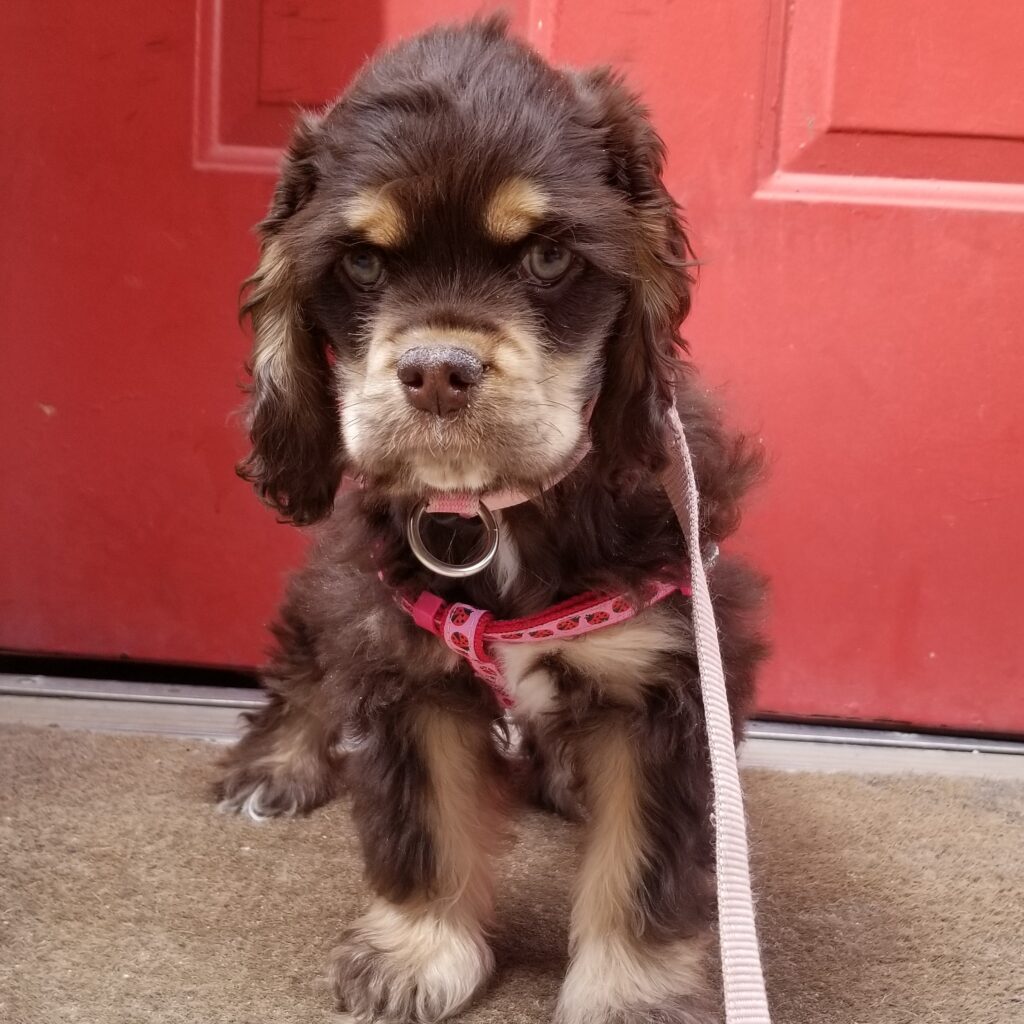
A smol brown and golden dog in front of a red door. The dog is wearing a pink collar with ladybugs. She also has very judgemental (or excited) eyebrows.
Meet Tubby! Sohyeon adopted Tubby this year.

Academic Successes

Sohyeon Hwang (Northwestern) and Wm Salt Hale (University of Washington) earned their master’s degrees. You can read Salt’s paper, “Resilience in FLOSS,” online.

Charlie Kiene and Regina Cheng completed their comprehensive exams and are now PhD candidates!

Nate TeBlunthuis defended his dissertation and started a post-doctoral fellowship at Northwestern. Jim Maddock defended his dissertation on December 16th.

Congratulations to everyone!

Teaching and Workshop Participation

Floor Fiers and Sohyeon ran a workshop at Computing Everywhere, a Northwestern initiative to help students build computational literacy. Sohyeon and Charlie participated in Yale SMGI Community Driven Governance Workshop. We also had standout attendance at Social Computing Systems Summer Camp, with Sneha Narayan, Stefania Druga, Charlie, Regina, Salt, and Sohyeon participating.

Regina was a teaching assistant for senior undergraduate students on their capstone projects. Regina’s mentees won Best Design and Best Engineering awards.

Conference Presentations

Sohyeon and Jeremy Foote presented together at CSCW (Computer Supported Co-operative Work) where they earned a Best Paper Honorable Mention award. Nick Vincent had two presentations at CSCW, one relating to Wikipedia links in search engine results and one on conscious data contribution. Benjamin Mako Hill and Nate presented on algorithmic flagging on Wikipedia.

Salt was interviewed on the FOSS and Crafts podcast. His conference presentations included Linux App Summit, SeaGL and DebConf. Kaylea Champion spoke at SeaGL and DebConf. Kaylea’s DebConf present was on her research on detecting at-risk projects in Debian.

Kaylea and Mako also presented at Software Analysis, Evolution and Reengineering, an IEEE conference.

Emilia Gan, Mako, Regina, and Stef organized the “Imagining Future Design of Tools for Youth Data Literacies” workshop at the 2021 Connected Learning Summit.

Our 2021 publications include:

  • Champion, Kaylea. 2021. “Underproduction: An approach for measuring risk in open source software.” 28th IEEE International Conference on Software Analysis, Evolution and Reengineering (SANER). pp. 388-399, doi: 10.1109/SANER50967.2021.00043.
  • Fiers, Floor , Aaron Shaw , and Eszter Hargittai. 2021. “Generous Attitudes and Online Participation.” Journal of Quantitative Description: Digital Media, 1. https://doi.org/10.51685/jqd.2021.008
  • Hill, Benjamin Mako , and Aaron Shaw , 2021. “The hidden costs of requiring accounts: Quasi-experimental evidence from peer production.” Communication Research 48(6): 771-795. https://doi.org/10.1177%2F0093650220910345.
  • Hwang, Sohyeon and Jeremy Foote . 2021. “Why do people participate in small online communities?”. Proceedings of the ACM on Human-Computer Interaction, 5(CSCW2), 462:1-462:25. https://doi.org/10.1145/3479606
  • Shaw, Aaron and Eszter Hargittai. 2021. “Do the Online Activities of Amazon Mechanical Turk Workers Mirror Those of the General Population? A Comparison of Two Survey Samples.” International Journal of Communication 15: 4383–4398. https://ijoc.org/index.php/ijoc/article/view/16942
  • TeBlunthuis, Nathan , Benjamin Mako Hill , and Aaron Halfaker. 2021. “Effects of Algorithmic Flagging on Fairness: Quasi-experimental Evidence from Wikipedia.” Proc. ACM Hum.-Comput. Interact. 5, CSCW1, Article 56 (April 2021), 27 pages. https://doi.org/10.1145/3449130
  • TeBlunthuis, Nathan. 2021 “Measuring Wikipedia Article Quality in One Dimension.” In Proceedings of the 17th International Symposium on Open Collaboration (OpenSym ’21). Online: ACM Press. https://doi.org/10.1145/3479986.3479991.

Mako Hill gets an NSF CAREER Award!

In exciting collective news, the US National Science Foundation announced that Benjamin Mako Hill has received of one of this year’s CAREER awards. The CAREER is the most prestigious grant that the NSF gives to early career scientists in all fields.

You can read lots more about the award in a detailed announcement that the University of Washington Department of Communication put out, on Mako’s personal blog (or in this Twitter thread and this Fediverse thread), or on the NSF website itself. The grant itself—about $550,000 over five years—will support a ton of Community Data Science Collective research and outreach work over the next half-decade. Congratulations, Mako!