Seeking to Interview People Who Make Software!

Students in the CDSC are recruiting for two interview studies.

The AI Slop study seeks to interview people involved in open source software who have experience dealing with AI-authored contributions. We hope to learn more about how communities are responding to this challenge, with a particular focus on ‘AI Slop’. You can read more about the study and fill out our screening survey here!

The Software Handoffs study seeks to interview people about how responsibility for a given piece of code gets handed off from one person to the next. We are wondering how this task is handled in industry and how this might differ from what is taught in a computer science curriculum. You can read more about the study and fill out our screening survey here!

Performing the News: Rhetoric, Trust, and the Fight Against Video Disinformation in India

Apart from being generally chronically online on political X/Bluesky/Tiktok/Instagram, I also study science disinformation for a living, which means I spend a lot of time reading things that aren’t true. More specifically, I spend time reading the corrections, the careful, methodical, often thankless articles that community media organizations publish after a manipulated video has already been seen by millions. I am currently working on a paper examining exactly this, structurally: how the Indian news organization AltNews debunks video disinformation in India, and what the rhetorical structure of that work reveals about the challenge of fighting falsehoods at scale.

India is, according to the World Economic Forum, the country most susceptible to large-scale disinformation in the world, with 750 million internet users, 22 constitutionally recognized languages, a WhatsApp-dominated information ecosystem that is largely invisible to automated detection systems, and a political environment in which viral video disinformation is regularly amplified by mainstream media, fringe actors, and national political parties. In this context, the question of how fact-checkers write, not just what they correct, but how they construct their corrections and the knowledge ecosystems they engage with, warrants deeper examination. 

The cognitive trap that makes video disinformation so effective

“Seeing is believing” is a popular folk saying. It describes a genuine and well-documented cognitive bias in that visual evidence carries a persuasive weight that text cannot replicate. My paper draws on Fazio et al.’s (2015) finding that knowledge does not reliably protect against illusory truth; that even informed, attentive readers can be swayed by false information that looks credible. Video disinformation exploits this bias with particular efficiency, because the clip itself functions as apparent evidence. You don’t need a caption to believe what you watched.

But there is a second, less obvious problem. As institutional trust erodes and the awareness of manipulation grows, audiences become susceptible not only to false videos, but to disbelieving real ones. The disinformation ecosystem, at its most corrosive, inserts falsehoods and destabilizes the category of visual truth.

The anatomy of a debunk

My analysis of 150 AltNews video debunking articles reveals a consistent rhetorical structure that departs from the conventions of mainstream journalism. Where standard news follows an “inverted pyramid,” placing most important information first and subsequent information in decreasing order of priority, debunking articles are circular. The headline announces a verdict; the final line confirms it, but this time as a logical conclusion earned through evidence. The piece begins and ends with the same claim, but the reader arrives at the ending differently than they arrived at the beginning.

“Debunking arguments do not show their target beliefs to be false but rather undermine the justification a subject may have for holding them.” — Hanno Sauer (2018)

AltNews is not simply telling readers that a video is fake. It is systematically dismantling the reasons a reader “might have believed it,” such as the political authority of the person who shared it, the apparent plausibility of its imagery, or the emotional register in which it circulated. Particularly relevant to COVID-19 scientific misinformation, each article acknowledges in some way the overwhelming scale of the disinformation [like by alluding to its “virality”], and also the fear and confusion in the social circumstances surrounding the disinformation. The correction is not a verdict delivered from above; it is an argument the reader is invited to construct alongside the fact-checker, building collective capacity to discern.

The lead paragraph of each article enacts this invitation with notable rhetorical precision. It uses passive voice and hedged language: “A video in which a woman is seen lying in the bushes is doing the rounds on social media.” The word “seen” does careful work:  it acknowledges what the reader has probably watched, validates their experience, but withholds editorial endorsement of the content. According to rhetoric scholar Kenneth Burke, this is an act of identification: establishing consubstantiality with the audience before introducing dissonance. This identification, a recognition of the reader’s circumstance, allows the reader to be persuaded in the direction of the truth, which is stated once at first in the headline, and repeated at the end. 

The pedagogical burden of video verification

What distinguishes video fact-checking from other forms of debunking is the technical weight it carries. To verify a manipulated clip, AltNews staff extract keyframes, run reverse image searches, conduct metadata forensics, and deploy AI-detection tools. Each of these methods must then be explained—plainly, with screenshots, with links to original sources—to a general readership. The articles are, in this sense, simultaneously corrections and tutorials. By modeling the process of finding out, AltNews both corrects the misinformation, and provides technical clarity in how information is produced and distributed, attempting to build readers’ skill in verifying images and videos out there. 

This “show your work” norm is a deliberate strategy for building what Dourish and Bellotti (1992) call awareness, through establishing the sense that one understands not just an outcome but the process that produced it. For debunking, transparency about method is the mechanism by which readers are gradually equipped to verify things themselves.

Why human-centered collaboration is the only viable response

AltNews’s staff of journalists, scientists, engineers, OSINT specialists, social activists and people working on intersections of those roles, function as a distributed, multidisciplinary verification network. India’s disinformation ecosystem is, as Starbird, Arif, and Wilson (2019) demonstrate, fundamentally collaborative: coordinated networks of accounts, platforms, and political organizations working in concert to amplify false narratives. Automated platform moderation, such as the content bots of Facebook and X, has proven structurally inadequate to this complexity, particularly given India’s linguistic diversity and the closed architecture of WhatsApp groups.

What is needed, and what AltNews partially models, is a collaboratively-informed approach: human-centered, context-specific, and built for heterogeneity rather than scale. The fact that this work runs on donations, in a country where disinformation reaches hundreds of millions, tells us something important about where the gaps in our collective response still lie.

Half-Baked, Full-Throttled

We all wear a lot of hats as researchers. Cowboy hats as we lasso and wrangle data. Noir-style fedoras when we are pinning post-it’s to a wall and stringing together our evidence. Berets when we ponder over the perfect artistic metaphor to describe our results. Sitting dusty in the corner is the tocque, the baker’s cap. We don the tocque, the billowing white like a cloth mushroom, when we’re kneading our ideas and getting ready to bake them. Too often, we don’t really linger in that role, our ideas need to move forward: there are deadlines to meet and papers to publish! However, once a year, the CDSC invites its members to become bakers and play around with our half-baked ideas together in the Great Half Bake-Off.

One of the hallmark’s of the CDSC’s annual retreat, in which our distributed collective gathers at one of the member universities to be merry (and work) together in meat space for a few days, is the annual Great Half Bake-Off (GHBO). The Great Half Bake-Off is an opportunity for members of the group to present an idea in a rapid-fire way that they’re interested in. They might not know where to start with the idea, or the idea seems too big or out there to seem feasible.

The half-bake off, being a part of our retreat at the beginning of the academic year does a lot to glue the group together. With an intention of sharing an idea that we actually care about, but might in other instances be too afraid to share because it feels too undercooked, we become comfortable sharing our ideas with each other, no matter what the stage of thought we’ve put into the project idea.

The exercise helps us learn about each other as it reveals the gulf between what we all work on and what some of the projects we only dream about are. It helps us become more comfortable with airing out our inspirations and ideals. It overall encourages a moment of playfulness and camaraderie.

How Do We Bake (Or, How You Can Host Your Own Great Half Bake-Off)

The logistics for the GHBO are relatively simple. Notify your bakers at least a few weeks before your event to think about what half-baked ideas they want to bring to the table. Provide a collaborative slide deck for them to include a slide if they’d like to organize their half-baked thoughts in that way. We give our bakers 2-3 minutes (but no more!) to present their ideas, and a minute or two to field questions. Then, at the end, for the grand prize of a Silly Little Trophy, we all vote for who had the most half-baked idea. This is a key element to the process: voting on the merits not of the idea’s potential success or creativity, but the vague, unreliable measure of “half-bakedness.”

This is the slide template we give in advance, should people want to use it! Sometimes it’s nice to bake with a recipe. :’)

Some Half-Baked Categories to Prepare Your Bakers:

  • Long Shots – Maybe there’s a project within your repertoire, but you’re not sure how you would find the time, money, or energy to see it through. Sound’s half-baked!
  • Mysteries – Have a research question that you’re just not sure where even to begin to answer? Perfect!
  • New Flavors – Perhaps you have a project that you’re thinking about but it uses a method that you’ve never used (or even seen someone else use!)
  • Something Silly – We all have burning questions that might … not add a lot to the public good if we were to answer them. Now’s your chance to talk about those!
  • Literally anything else – by now, hopefully you get the idea. As long as it is mushy and half-baked – with enough room for your colleagues to poke at its spongy undoneness, it’s worthy of being called half-baked.

  Winner of GHBO 2024, Emily Zou’s, half-baked idea!

What Comes Out of the Half-Baked Off

As we’ve discussed, the main benefits of the Great Half Bake-Off come not necessarily from the immaculate pastries that we pull out of the oven at the end of the ordeal, the goodness of the half bake off exists in the way we get to have a good time with each other, and see deeper into how we each begin to craft our doughs. In fact, more often than not, our ideas from the event many moons later remain just as half-baked as when we presented them. Sohyeon, the 2022 GHBO champion, in a 2024 update on the status of her winning project proposal gleefully remarked that “the idea remains half-baked.”

Online Communities as a Support System

“Reddit.” Picture: Flickr. License: CC BY-NC 2.0

As I’m sure many before me can relate to… after a class here, a conversation with someone there, and a hop, skip, and a jump later, somehow I tumbled my way into grad school!

When I began graduate school, I knew I was interested in the intersection of health communication and online communities, but beyond that, I wasn’t entirely sure what direction I wanted to go in! Fortunately, UW is home to two labs dedicated to these areas and I have been rotating between them throughout my first year in the Communication department.

Last quarter, I started my rotation with the CDSC and began developing my first research project (!!) focused on health-related stigma trends on Reddit. I’ve always been interested in how online communities offer supplementary support for individuals dealing with health-related issues, and I knew I wanted to do something that explored how stigma impacts health-related discussion trends. Various research has been done on stigma communication in online communities. For example, Brown and colleagues (2023) investigated types of stigma tweets associated with different types of health-related stigma on X (formerly known as Twitter) and found that although stigma was prevalent for each condition they studied, anti-stigma messages were more common than the various types of stigma communication. I want to expand on this research area by diving deeper into the motivations and reasoning participants have for joining and contributing to health-related communities online!

This quarter, while I have continued working on my health-related stigma project I also have rotated into the Health Equity Action Lab (HEAL). Given my interest in online communities, I was brought onto a project examining correlates of online support in women experiencing postpartum depression. 

I have since taken the lead on a subset of the data related to Internet use as a form of support. Within the HEAL study, 83% of women who sought information or support online met the criteria for postpartum depression. Research done by Stellefson and colleagues (2018) suggest that greater use of the Internet may be a result of knowledge gaps created by poor patient-provider communication. Our goal is to identify the factors that increase the likelihood of women within this population to seek out support!

Currently, I am categorizing and coding open-ended survey responses to determine whether eHealth literacy is linked to specific apps or websites as resources for information or support among women experiencing postpartum depression. So far, I have found survey participants often turn to WebMD, Reddit, and Facebook as sources of information and support.

Both my project examining health-related stigma on Reddit and my project identifying online destinations for support-seekers demonstrate how the Internet and online communities offer valuable resources for those seeking help, and foster connections with others who share similar experiences. Have you ever turned to an online community to seek out support?

The Relationship Between Facebook and Tradition or How a Peacock Invaded a Garden

A question that’s been bugging me for the past months is how a digital medium can amplify remnants of traditional pre-modern life.

I’m only a recent addition to the Collective and, despite thinking a lot about digitality and how it affects social processes, I’ve only marginally been part of online communities myself.

However, living back and forth, in a perpetual state of limbo, between Greece and the US for the past two and a half years pursuing graduate school, I’ve inevitably become more active online.

That is when I noticed all these Facebook groups popping up in my feed (yes, I am one of those people who find comfort in the platform’s slower mechanics and less engaging feed).

Groups about life in one’s Greek village, groups about homemade traditional delicacies (as grotesque as lamb intestines and brains), groups about tsipouro (the Greek eau de vie, rakı, grappa, moonshine, …).

Those groups seem to be composed by active middle aged members, who barely know how to use the medium in socially acceptable ways devised by my generation (one of the first one’s in Greece to go online), yet spent hours posting facts about how to make cheese or definitions for words no more used, commenting on each other’s drinking habits, discussing about the “proper” way to make moussaka or arguing about the “proper” meze (small dishes, appetizers, tapas, antipasti, …) for tsipouro. On top of that, youngsters invade them as bystanders, looking, smiling, laughing, making fun of the surreal discussions, uppercase comments, text-to-speech mistakes; chaos.

I’m afraid that these groups are part of the general Zeitgeist in the country: dissapointment and longing for long-lost glory, calmness, or simplicity. It is evident in parts of its cultural production. Books about 19th century Greece, movies and TV series about times of old. A remaining obsession with ancient times. Music referring to the country’s folk traditions.

Relatedly and perhaps subconsciously associated, I recently found myself in a concert by the promising Themos Skandamis. Skandamis produces neo-folk (might I say avantgardish [?] songs) which he writes himself. During his concert, comedic elements imitating the local Cretan accent entered his performance. By the end, as a farewell he beautifully sang a capella a traditional song I’ve never heard before.

It’s lyrics follow (original sourced from here, and freely translated by myself with the benevolent help and suggestions of GPT-4):

Για δες περβό… για δες περβόλιν όμορφο,
για δες κατάκρυα βρύση το περιβόλι μας
για δες κατάκρυα βρύση το περβό… τ’ όριο περβόλι μας τ’ όμορφο.

Κι όσα δέντρα κι όσα δέντρα ‘πεμψεν ο Θιος,
μέσα είναι φυτεμένα το περιβόλι μας
μέσα είναι φυτεμένα το περβό… τ’ όριο περβόλι μας τ’ όμορφο.

Κι όσα πουλιά κι όσα πουλιά πετούμενα,
μέσα είναι φωλεμένά το περιβόλι μας
μέσα είναι φωλεμένα το περβό… τ’ όριο περβόλι μας τ’ όμορφο.

Μέσα σε ‘κεί… μέσα σε ‘κείνα (ν)τα πουλιά,
εβρέθη ένα παγώνι το παγωνάκι μας
εβρέθη ένα παγώνι το παγώ… τ’ όριο παγώνι μας τ’ όμορφο.

Και χτίζει τη και χτίζει τη φωλίτσα του,
σε μιας μηλιάς κλωνάρί το παγωνάκι μας
σε μιας μηλιάς κλωνάρι το παγώ… τ’ όριο παγώνι μας τ’ όμορφο.
Behold the garden… behold our garden’s beauty,
behold the cool spring, our garden
behold the cool spring, our gard… our garden’s beauty.

And all the trees, all the trees God has sent,
are planted in, our garden
are planted in, our gard… our garden’s beauty.

And all the bird and all the birds that roam the skies,
have nested in, our garden
have nested in, our gard… our garden’s beauty.

Among those birds… among those birds,
a peacock found, our little peacock,
a peacock found, the pea… our peacock’s beauty.

And it builds its… and it builds its nest,
on the apple tree’s branch, our peacock
on the apple tree’s branch, the pea… our peacock’s beauty.

I kept wondering, what does it mean, and most importantly why a traditional folk song would mark the end of the concert.

And then it strike me, there is this clear metaphor and parallelism between the peacock and digitality. The peacock appears out of context, yet builds its nest in the garden. Digital media invade our analog lives and impose themselves; they become addictively habitual and naturalized.

What is interesting though here is the reversal of roles. The digital sphere, now established, turned into a garden, leaves room for trad life to invade post-modernity; whether it is a cause or an effect of the world’s turmoil remains to be seen.

On the other hand, perhaps I’m thinking too much.

Exit, Voice, and Fork: From One Community to a Network of Groups

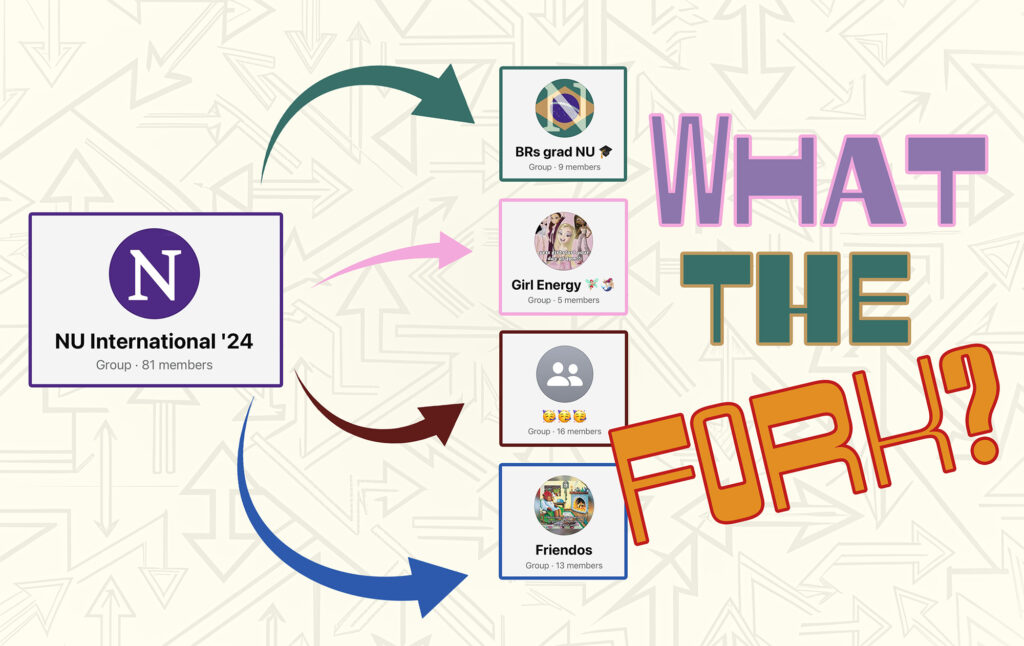
Everyone knows that making friends can be a bit daunting as a new student (especially international or if you’re not from the area). With that in mind, a while after I arrived in Chicago to begin my PhD program last Fall, a Brazilian friend and I made a Northwestern WhatsApp group for international graduate students! Since the point of the group was to make friends, we were pretty laid back in there (still are!), and people mostly shared events across campus and the city of Evanston and Chicago – especially those offering free food.

At some point, the group started to grow fast, and my friend and I lost track of people who were joining. It reached 81(!) members. Eventually, we started to make sub-groups. First, we made a group for the Brazilian grad students; then another group was made for the women called “Girl Energy”; later, one of my friends made a group only for Latinos (the name is interestingly only “🥳🥳🥳”). Lastly, the group “Friendos” emerged, including our guy friends this time!

After a while, activity on the all international grad students group died down. It goes weeks without a message. People have basically spread out into smaller groups. Now… Why is that?

I went to my advisor (Aaron Shaw) and we basically started geeking out. I didn’t plan on doing some random experiment, but I accidentally observed what is called a “fork” of online communities!

To better explain this, let’s go back to the 1970s. Albert O. Hirschman published the influential book Exit, Voice, and Loyalty: Responses to Decline in Firms, Organizations, and States. In the book, Hirschman makes the argument that consumers can show their dissatisfaction in two ways: they can either exit (stop using that service or buying that product) or they can use voice (communicate a complaint and try to suggest a change). The simplicity of this argument makes it applicable in a range of different fields, such as “personal relationships, emigration, workplace relations, political parties,  as well as public policy” (Dowding, 2016). And, more recently, online communities!

There are a lot of works based on Hirschman’s book, and mostly recently the idea of “fork” has also been added as a concept together with exit and voice:
    
“Forking is a form of group secession (exit) that takes an existing set of institutions and creates a  new ‘society’ with a shared history but divergent futures.” (Berg and Berg, 2020)

The term originally comes from open source software communities, where developers are allowed to copy a code repository, work on it separately, modify it, and release it in different forms. Seeing it this way, it makes a lot of sense that it could be applied to online communities as well. In fact, studies related to online community migration keep growing. For example, Fiesler and Dym (2020) explored how transformative fandom communities migrate across platforms over a period of 20 years. Migration was driven by changes in platform policies, user needs, or technical issues. Their work highlights how these migrations can lead to social fragmentation, the loss of shared cultural artifacts, and the reformation of communities in new spaces.

In our case, the international graduate students’ group provided the foundation for forming meaningful connections. However, as people developed closer friendships and found more specific communities of interest (e.g., Brazilian grad students or Girl Energy), the need for the larger, general group diminished. This isn’t necessarily a sign of failure for the original community but rather an indication of its success in fulfilling its initial purpose!

It’s fascinating to observe how the lifecycle of online communities can parallel theoretical concepts like Hirschman’s exit, voice, and loyalty and grow from there. These frameworks help explain not just why communities evolve but also how users actively shape their social environments to meet their changing needs. Have you noticed similar patterns in the communities you’re a part of?

On The Challenges of Governing the Online Commons

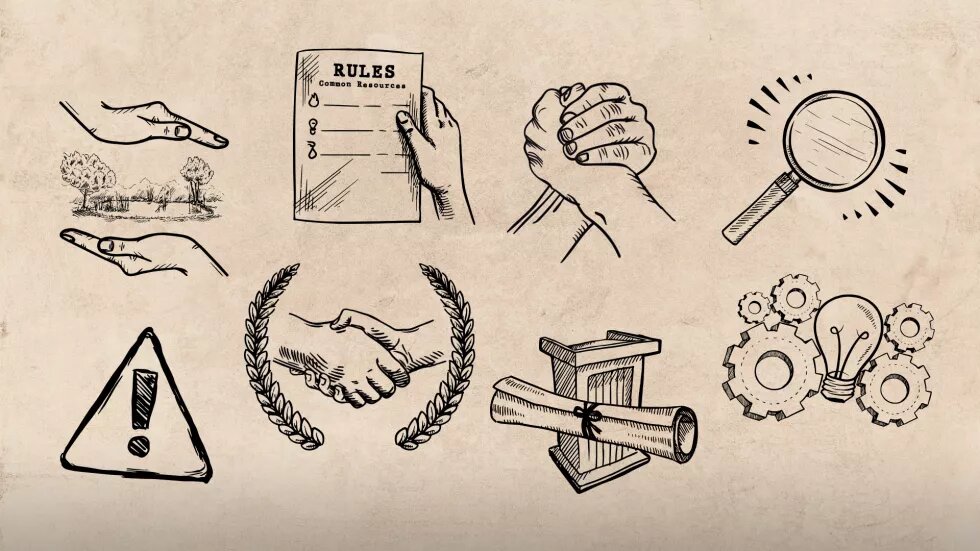
“Elinor Ostrom and the eight principles of governing the commons.” Picture: Inkylab. License: CC-BY-SA 4.0

Over the past several months (post-general exam!), I have been thinking and reading about organizational and institutional perspectives on the governance of platforms and the online communities that populate them. While much of the research on the emerging area of “platform governance”1 draws from legal traditions or socio-technical approaches, there is also a smaller subset of scholars drawing from political science and democratic theory, thinking about designing governance structures at the level of groups, organizations, and institutions that prove resilient to various collective threats.

I think these approaches hold a lot of promise. As far as addressing one collective threat I am interested in – the strategic manipulation of information environments – most interventions I have seen have either focused on empowering individuals to be more discerning of the information they encounter online or proposing structural changes to features of platforms, such as algorithmic ranking, that dampen the virality of false or misleading information. These are, respectively, micro and macro-level interventions. The integration of participatory and distributed self-governance approaches into existing and emerging platforms is distinct: it is a meso-level intervention, and meso-level approaches remain both theoretically and empirically under-explored in discussions of platform governance.

I recently read three works that do explore this meso layer, however: Paul Gowder’s The Networked Leviathan, Nathan Schneider’s Governable Spaces, and Jennifer Forestal’s Beyond Gatekeeping. All three draw on the work of scholars that look at governance dynamics in offline spaces – in particular, the ideas of political economist Elinor Ostrom and philosopher John Dewey feature prominently – to argue that centralized platforms that practice top-down content moderation are fundamentally hostile to democratic inquiry and practice. Gowder, for example, describes this condition as a “democratic deficit” in the form of governance structures that are fundamentally unaccountable to their users. Naturally, this democratic deficit leads to negative outcomes – online spaces are easily manipulated and degraded by motivated actors. To guard against this, Gowder, Schneider, and Forestal offer various proposals for the integration of participatory structures into these platforms –ones composed of workers, civil society members, and everyday users — into platform governance and decision-marking.

I am on board with these approaches’ diagnosis of the problem, but I think the proposed solutions require more iteration. One thing I worry about is that proposals for integrating participatory and distributed governance into online platforms do not sufficiently take into account the qualitative differences between online spaces and the offline settings researchers have previously studied. When I was reading Ostrom’s Governing the Commons, for example, from which many of these interventions take at least some inspiration, I was struck by the three similarities that she noted virtually all of the common-pool resource settings she analyzed shared:

  • They had stable populations over long periods of time. Here’s how Ostrom describes it: “Individuals have shared a past and expect to share a future. It is important for individuals to maintain their reputations as reliable members of the community. These individuals live side by side and farm the same plots year after year. They expect their children and their grandchildren to inherit their land. In other words, their discount rates are low. If costly investments in provision are made at one point in time, the proprietors – or their families – are likely to reap the benefits.”
  • Norms of reciprocity and interdependence evolved in these settings among a largely similar group of individuals with shared interests. Ostrom explains: “Many of these norms make it feasible for individuals to live in close interdependence on many fronts without excessive conflict. Further, a reputation for keeping promises, honest dealings, and reliability in one arena is a valuable asset. Prudent, long-term self-interest reinforces the acceptance of the norms of proper behavior. None of these situations involves participants who vary greatly in regard to ownership of assets, skills, knowledge. ethnicity, race, or other variables that could strongly divide a group of individuals (R.Johnson and Libecap 1982).”
  • These cases were the success stories! Ostrom clarifies that the cases she analyzed “were specifically selected because they have endured while others have failed.” In other words, they already had sustainable resource systems and robust institutions in place.

    Most (virtually all?) online platforms, and the communities that inhabit them, do not share these properties. In online spaces, individuals tend to be geographically scattered across the globe, and there’s no incentive to sustainably maintain the community for future generations to inherit, like there is with a plot of land. Moreover, members of online communities tend to have varying levels of commitment, and the anonymity and distance offered by technology makes norms of social reciprocity and interdependence harder (although not impossible) to cultivate.

The CPRs Ostrom studied were already facing uncertain and complex background conditions — but they also possessed distinct qualities conducive for success. I generally think online spaces, and the digital institutions that govern them, do not possess these qualities, and are thus even more vulnerable to threats like appropriation, pollution, or capture than the CPRs Ostrom studied. Because of this, I think a direct porting of most of Ostrom’s design principles to online governing institutions is probably insufficient. But I see an evolved set of these principles that explicitly addresses the power differentials and adversarial incentives baked into the design of social software as one way forward. What these principles could look like should be the subject of future empirical research, and maybe a future post on this blog. I am excited that researchers are exploring these meso-level interventions, which is where I think a lot of the solution lies.


  1. Gorwa (2019) offers a definition of platform governance: “a concept intended to capture the layers of governance relationships structuring interactions between key parties in today’s platform society, including platform companies, users, advertisers, governments, and other political actors.” ↩︎

Book Review: The Conversational Firm

New hires from the rank-and-file arguing with the CEO in public. Employee-chosen projects and a management team reluctant to say no. Few if any written rules. No offices. Staff arriving and departing when they choose. Messes everywhere. Some companies—especially technology firms—describe their ways of working as remaking the model of the modern business. They describe ways of working that were unthinkable some years ago. But has anything really changed from the organization models of the past, or are these features mostly hype and marketing obscuring the same old bureaucracy and hierarchy?

Although not a Communication scholar, sociologist Catherine J. Turco’s work offers vital insight into how communication structures are reordering relationships, with significant implications for the field and discipline of Communication. In this brief and readable ethnographic study, Turco describes ‘TechCo,’ a social media marketing company, in rich detail. TechCo employees have access to the perks and features familiar to those who study firms in Silicon Valley — hack nights, freedom to experiment, flexible schedules, an open floor plan, a “dogs welcome” policy, free beer, and so on. The company seeks to embody its own industry: positioning itself as open, freewheeling, and engaged, just like the social media platforms they help their customers to use. Beyond this external branding, the founders have made an explicit goal internally: to create a company that is intentionally more `open’ and less hierarchical than traditional firms. How is this goal accomplished—and is it indeed accomplished at all?

Turco’s answer to this question is that these companies accomplish half of this goal. Companies are indeed able to deliberately open their communication, including the disclosure of financial details that in many firms is held exclusively by C-level leadership, as well as allowing for frank, public feedback from rank and file staff to executive leadership. However, they do so while leaving their hierarchical structure for decisionmaking largely intact. Turco argues that staff are satisfied by this arrangement—and in fact prefer to have decisionmaking power left in the hands of executives.

Drawing from theoretical background stretching from Max Weber to Albert Hirschmann to Sherry Turkle, Turco elaborates a theory of the conversational firm. In the conversational firm, voice and decision making power are intentionally decoupled. Therefore, these two factors can be analyzed distinctly and in tension with one another. This poses a particular challenge to lines of research which treat voice and authority as intertwined or interchangeable.

Communication scholars may find much to reflect on in her careful articulation of what is meant by and accomplished by the idea of “openness” in a firm, from her exploration of how employee use of social media can both benefit and harm a firm, and her case study of how efforts to brand and disseminate company culture can be both a marketing boon and an internal headache.

The book opens with conversations with the founders of TechCo and their desire for “radical openness” (p. 2) and anti-bureaucratic approach to structure. Turco describes the company’s experiences with openness and anti-bureaucratic tendencies from a range of perspectives: as reflected in the experiences of an eager young woman who is new to the workforce, as observed in Hack Nights, as visible within the company’s rollicking wiki discussions about everything from financial information to kitchen cleanup duties, and in their grappling with a lack of strict policies (instead, TechCo asks employees to “Use Good Judgment'”).

Through the first three chapters, Turco asks what this openness means, and finds that although the founders’ goal is to be transparent and less hierarchical than traditional firms, hierarchy remains and is even desired by employees: instead, what’s truly different about TechCo is its embrace of employee perspectives, and the employees’ trust that the firm will take them into account. Through long-running discussions on the company wiki and chat platforms, town hall meetings and cross-departmental dinners, we see frank conversations unfold and influence the direction of the company. Turco also observes that employees seem to primarily seek to be heard—they don’t have, and often don’t want, decision rights: they want and receive voice rights.

Turco concludes that despite the findings of prior work that bureaucracy is largely indestructible and reproduces itself, openness in communication allows greater freedom for employees, at least bending the bars of what Weber called the iron cage. The book returns to the limitations of anti-bureaucratic approaches throughout the text, with a series of examples in Chapter Six navigating the limitations of this openness: how the company came to have a traditional human resources department despite the founders’ repeated public expressions of distate for formal HR and concerns about noise, mess, and distraction in open ‘officeless’ seating plans.

In chapter four, Turco turns attention away from TechCo’s internal dialog and to the relationship between TechCo and external audiences—in particular, the absence of a social media policy. Unlike other firms which have strict rules for how employees comport themselves on social media—and the risk that the company faces from public response to employee behavior and disclosures—here again TechCo emphasizes their “Use Good Judgment” guideline. When employees make mistakes that reflect poorly on the company, TechCo’s response is to treat this as a learning opportunity, turning the event into training materials to shape employee understanding of what good judgment looks like (and doesn’t look like).

Chapter five offers a case study of TechCo’s external communication about their company culture. The founders disseminated a `manifesto’ that combined both their beliefs about TechCo’s culture and their beliefs about how companies should be organized to succeed in the current era. Although the document received extensive positive attention and served as a recruiting tool, existing employees were troubled by gaps between their experience and the company’s description of its culture. Employees also voiced the irony of a document developed in a top-down way describing a participatory and bottom-up culture. Satisfaction plummets. Over time, however, continuing conversation about the document and making revisions to it seems to allow employees to regain their sense of voice, eventually resolving the crisis.

Published in 2016 from fieldwork that ended in 2013, this account does not allow us to see how the conversational firm fared during recent events that have disrupted the structure, functioning, and culture of organizations—e.g. the isolation of Covid-19 pandemic, the migration to remote work, and questions about returning to the office.

In elaborating a theory of how firms can be conversational, decoupling decisionmaking power and voice, the book offers a useful framework for scholars examining the future of work and organizations, as well as other topics of enduring interest in Communication: the shifting relationship between firms and publics and the continued blurring of the public and the private in social media. Of key interest is the extent to which Communication theories about voice, the constitutive power of communication, and factors such as concertive control can be applied to these organizations.

Graduate students with an interest in ethnographic methods will find particular value in the blunt personal narratives that comprise an extended methodological appendix. Turco describes the process of gaining access to the company, gathering observations and interview data, and iteratively analyzing her notes and memos, all of which will be familiar to many. However, this section is unique in offering a series of self-critical reflections on the work of organizational ethnography, explicit description of the personal toll the work exacted from her, and the sometimes painful experience of receiving feedback from her subjects as the analysis emerged.

Ultimately, Turco argues that embracing open communication in firms is a transformative way forward. While we in Communication may agree, what remains for us is to investigate what it means: for how we understand voice in organizations and how we assess the role of technology and platforms for communication.

Excavating online futures past

Cover of Kevin Driscoll's book, The Modem World.

The International Journal of Communication (IJOC) has just published my review of Kevin Driscoll’s The Modem World: A Prehistory of Social Media (Yale UP, 2022).

In The Modem World, Driscoll provides an engaging social history of Bulletin Board Systems (BBSes), an early, dial-up precursor to social media that predated the World Wide Web. You might have heard of the most famous BBSes—likely Stuart Brand’s Whole Earth ‘Lectronic Link, or the WELL—but, as Driscoll elaborates, there were many others. Indeed, thousands of decentralized, autonomous virtual communities thrived around the world in the decades before the Internet became accessible to the general public. Through Driscoll’s eyes, these communities offer a glimpse of a bygone sociotechnical era and that prefigured and shaped our own in numerous ways. The “modem world” also suggests some paths beyond our current moment of disenchantment with the venture-funded, surveillance capitalist, billionaire-backed platforms that dominate social media today.

The book, like everything of Driscoll’s that I’ve ever read, is both enjoyable and informative and I recommend it for a number of reasons. I also (more selfishly) recommend the book review, which was fun to write and is just a few pages long. I got helpful feedback along the way from Yibin Fan, Kaylea Champion, and Hannah Cutts.

Because IJOC is an open access journal that publishes under a CC-BY-NC-ND license, you can read the review without paywalls, proxies, piracy, etc. Please feel free to send along any comments or feedback! For example, at least one person (who I won’t name here) thinks I should have emphasized the importance of porn in Driscoll’s account more heavily! While porn was definitely an important part of the BBS universe, I didn’t think it was such a central component of The Modem World. Ymmv?

Shaw, A. (2023). Kevin Driscoll, The Modem World: A Prehistory of Social Media. International Journal Of Communication, 17, 4. Retrieved from https://ijoc.org/index.php/ijoc/article/view/21215/4162

How to cite Wikipedia (better)

 Two participants of the "Rally to Restore Sanity and/or Fear" in Washington D.C. (USA), holding signs saying "Wikipedia is a valid source" and "citation needed." Photo by Kat Walsh (Wikipedia User: Mindspillage), October 30, 2010, CC-BY-SA 3.0.
Two participants of the “Rally to Restore Sanity and/or Fear” in Washington D.C. (USA), holding signs saying “Wikipedia is a valid source” and “citation needed.” October 30, 2010. Kat Walsh (User:Mindspillage), CC BY-SA 3.0 https://creativecommons.org/licenses/by-sa/3.0, via Wikimedia Commons
Wikipedia provides the best and most accessible single source of information on the largest number of topics in the largest number of languages. If you’re anything like me, you use it all the time. If you (also like me) use Wikipedia to inform your research, teaching, or other sorts of projects that result in shared, public, or even published work, you may also want to cite Wikipedia. I wrote a short tutorial to help people do that more accurately and effectively.

The days when teachers and professors banned students from citing Wikipedia are perhaps not entirely behind us, but do you know what to do if you find yourself in a situation where it is socially/professionally acceptable to cite Wikipedia (such as one of my classes!) and you want to do so in a responsible, durable way?

More specifically, what can you do about the fact that any Wikipedia page you cite can and probably will change? How do you provide a useful citation to a dynamic web resource that is continuously in flux?

This question has come up frequently enough in my classes over the years, that I drafted a short tutorial on doing better Wikipedia citations for my students back in 2020. It’s been through a few revisions since then and I don’t find it completely embarrassing, so I am blogging about it now in the hopes that others might find it useful and share more widely. Also, since it’s on my research group’s wiki, you (and anyone you know) can even make further revisions or chat about it with me on my user:talk page.

You might be thinking, "so wait, does this mean I can cite Wikipedia for anything"??? To which I would respond "Just hold on there, cowboy."

Wikipedia is, like any other information source, only as good as the evidence behind it. In that regard, nothing about my recommendations here make any of the information on Wikipedia any more reliable than it was before. You have to use other skills and resources to assess the quality of the information you’re citing on Wikipedia (e.g., the content/quality of the references used to support the claims made in any given article).

Like I said above, the problem this really tries to solve is more about how to best cite something on Wikipedia, given that you have some good reason to cite it in the first place.